1953 Parkhurst #27 Jean Béliveau RC: The Rookie Card of 'Le Gros Bill,' Where PSA 4 Is the Peak and a Single 9 Tops 693 Graded
The 1953 Parkhurst #27 Jean Béliveau is the rookie card of a player Montreal spent years trying to sign. PSA has graded 693 copies. The most common grade is PSA 4, and only one copy has ever reached PSA 9. There are no PSA 10s.
The Player
Béliveau was born in Trois-Rivières, Quebec, on Aug. 31, 1931, and was a star in Quebec hockey long before he played a full NHL season. The Canadiens called him up twice for brief stints, in 1950-51 and 1952-53, but he stayed in Quebec's senior league until 1953. By then he was known as "Le Gros Bill."
NHL.com describes him arriving in Montreal that year from the semiprofessional Quebec Aces as "a long-courted superstar-in-the-making." He signed on Oct. 3, 1953, to a five-year deal that was, at the time, the most generous contract in the NHL. General manager Frank Selke put it simply: "All I did was open the [Montreal] Forum vault and say, 'Jean, take what you think is right.'"
The signing paid off. Béliveau played his whole NHL career in Montreal, retiring after the 1970-71 season with 507 goals and 712 assists for 1,219 points in 1,125 regular-season games. He won the Hart Trophy twice, in 1956 and 1964, and in 1965 he became the first winner of the Conn Smythe Trophy as playoff MVP. He won 10 Stanley Cups as a player and seven more as a Canadiens executive, and his name appears on the Cup 17 times. He entered the Hockey Hall of Fame in 1972.
The Card
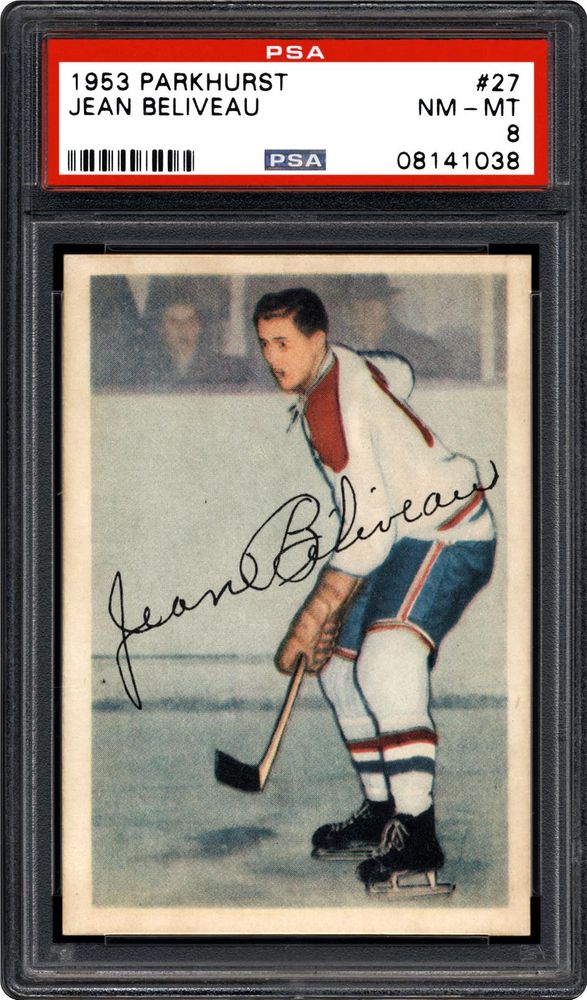
The card dates from that first full season, 1953-54. The photo shows Béliveau in a skating crouch in a white Canadiens sweater trimmed in red and blue, his stick on the ice and spectators visible behind him. A black facsimile signature, "Jean Beliveau," runs across the image from the lower left. Other than the signature, the front carries no printed name or team, just the photo inside a cream border. PSA lists the card as his rookie card.
The copy pictured is a PSA NM-MT 8, cert 08141038. Its label reads "1953 PARKHURST / JEAN BELIVEAU / #27."
PSA Population Report
| PSA Grade | Population |
|---|---|
| PSA 10 | 0 |
| PSA 9 | 1 |
| PSA 8 | 33 |
| Total Graded (All Grades) | 693 |
* Population data as of November 7, 2026. PSA population counts are dynamic and increase as more cards are submitted for grading.
Reading the Curve
This curve peaks in the lower half of the scale. PSA 4 is the single most common grade, with 128 copies. Close behind are PSA 1 and PSA 3 at 107 each, with 95 at PSA 2. More than three in five graded copies sit at PSA 4 or below.
Above that, the numbers thin out steadily: 91 at PSA 5, 59 each at PSA 6 and PSA 7, and 33 at PSA 8. Then the curve nearly ends. There is one PSA 9 and no PSA 10. Only 34 copies, about 5 percent of the total, grade 8 or better.
The half grades follow the same pattern. PSA has issued 129 of them, and the largest group is 43 copies at 1.5, at the very bottom of the scale. At the top, seven copies grade 8.5, which means a near-miss 8.5 is seven times as common as a 9. Qualified grades are rare, seven in all. Thirteen copies came back Authentic, and those are included in the 693. With the half grades and qualifiers added, PSA has slabbed 829 copies.