1957 Topps #77 Bill Russell — More PSA 1s Than Slabs at PSA 8 or Better, and the Set's Only PSA 10 Belongs to Dick Atha
Every card in the 1957 Topps basketball set was walked through PSA's population endpoint for this case file — all eighty of them. Across 25,426 whole grades, the set contains exactly one PSA 10. It is not Bill Russell's card, and it is not Bob Cousy's or Bob Pettit's. It belongs to Dick Atha, one of 251 copies graded.
PSA Population Report
| PSA Grade | Population |
|---|---|
| PSA 10 | 0 |
| PSA 9 | 3 |
| PSA 8 | 48 |
| Total Graded (All Grades) | 974 |
* Population data as of September 17, 2026. PSA population counts are dynamic and increase as more cards are submitted for grading.
Russell's rookie card has been submitted to PSA 974 times at a whole number, a figure that includes 18 slabs marked Authentic, plus 119 half grades and 218 qualified grades — 1,311 PSA slabs in all. Zero of them are PSA 10s. The card's ceiling is the MINT 9, and three exist.
The Set Has One Gem, and It Is Not a Star
The eighty-card walk holds its shape cleanly: CardFacts ids run sequentially with the checklist, so every card number from 1 to 80 returned its own record with no drift and no gaps. The set totals come out at 25,426 whole grades, 1,262 half grades and 4,185 qualified grades — 30,873 slabs of a set that is sixty-nine years old.
Against that, the high end barely exists. Seventy-nine of the eighty cards have never graded a PSA 10. Nineteen of the eighty have never graded a PSA 9 either. The single gem in the set sits on card 14, Dick Atha of the Detroit Pistons — a card with 251 whole grades to Russell's 974, and four PSA 9s to Russell's three.
The heaviest submissions go where you would expect, and Russell is second. Cousy's card 17 leads the set at 1,083 whole grades, Russell's 77 follows at 974, and Pettit's 24 is third at 816. Nothing is tied at Russell's number — one card has been graded more often, and that is the whole list.
Forty-Eight Eights, and Nobody Has More
Where Russell does lead, he leads on the shoulder of the curve rather than its peak. His 48 PSA 8s is the joint-highest PSA 8 count in the set alongside Pettit's 48, ahead of Gene Shue and Maurice Stokes at 42 apiece.
That lead is a matter of volume, not of odds, and the distinction needs drawing precisely. Russell's 48 eights come out of 974 whole grades — 4.93 per cent. Of the cards in this set graded at least 100 times, seventy have a higher PSA 8 rate than he does: card 65 Win Wilfong tops the set at 39 from 242, and Gene Shue's 42 come from 284. So the card holding the most NM-MT copies in the set is also one of the least likely to produce one.
And then the other end of the ladder, which is where the card gets genuinely strange:
- Russell has 52 PSA 1s — the most of any card in the set.
- The full eighty-card set has 189 PSA 1s between them, so more than a quarter of the set's lowest grades sit on this one card.
- Russell's slabs at PSA 8 or better total 51 — 48 eights, three nines, no tens. There are more PSA 1s of this card than there are copies at PSA 8 or above.
Cousy is the only card anywhere near it, with 35. Pettit, third in submissions, has 11.
The qualified column tells the same story from another direction. Russell's 218 qualified grades are second in the set behind Cousy's 245, and they are a separate bucket from the 974 — PSA counts a qualified grade outside the whole-grade total, not inside it. Set-wide, qualified grades outnumber half grades better than three to one, 4,185 to 1,262.
PSA's Own Scan Is One of the Three
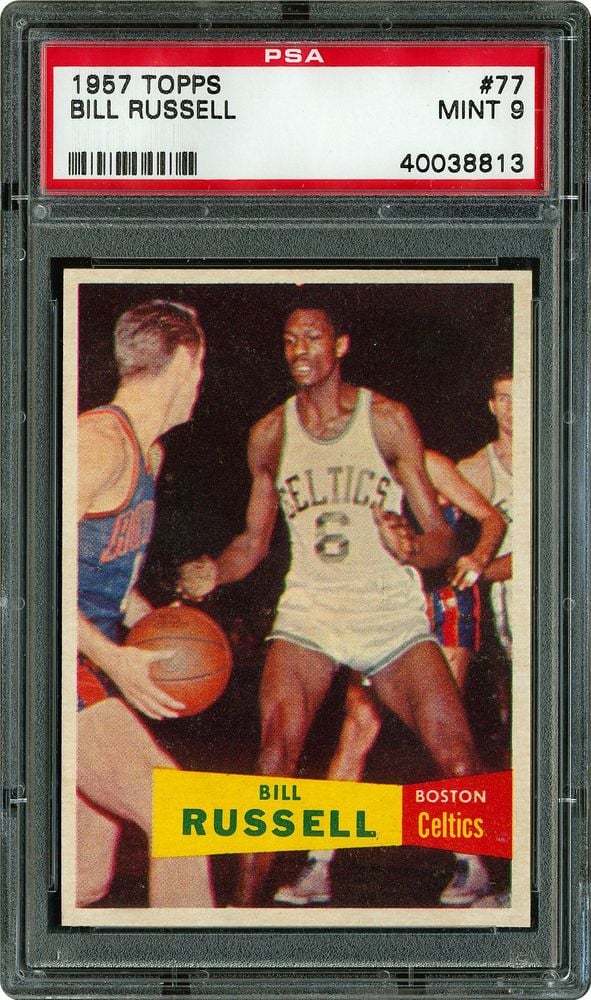
The image on this case file is the scan PSA publishes on the card's own CardFacts page, and the label matters more than the picture. It reads 1957 TOPPS #77 BILL RUSSELL, MINT 9, cert 40038813. PSA's cert lookup returns exactly that grade for that number.
So the example PSA chose to illustrate the card is one of the three highest-graded copies that have ever passed through the company. There is no better one to photograph.
The Player Who Changed What the Numbers Measure
The Naismith Basketball Hall of Fame puts it plainly: "Before Bill Russell brought his marvelous defensive and shot-blocking skills to basketball, the game focused primarily on offense. Russell reversed the trend, initiating a defensive mentality that remains a focal part of championship basketball." The Hall calls him the greatest defensive center in basketball history.
He arrived from the University of San Francisco, where he played under Hall of Fame coach Phil Woolpert alongside fellow Hall of Famer K.C. Jones and won two NCAA titles. In Boston he won eleven NBA championships, including eight consecutive titles from 1959 to 1966. The Hall records five MVP awards (1958, 1961-63 and 1965), twelve All-Star selections, Sports Illustrated's Sportsman of the Year in 1968 and The Sporting News Athlete of the Decade in 1970.
This card is his rookie issue, printed the year after his first championship. It has been graded more often than any card in the set except his own teammate's, and the results are stacked at the bottom of PSA's scale rather than the top.
Verdict: the 1957 Topps Bill Russell is the second-most-submitted card in its set and the leader at both ends of the grade it actually reaches — forty-eight eights, the most in the set, and fifty-two PSA 1s, the most by a wider margin still. Zero PSA 10s in 974 whole grades. The only gem in the entire eighty-card set sits on card 14.