1958 Topps #22 Johnny Unitas — The Golden Arm That Built Monday Night Football
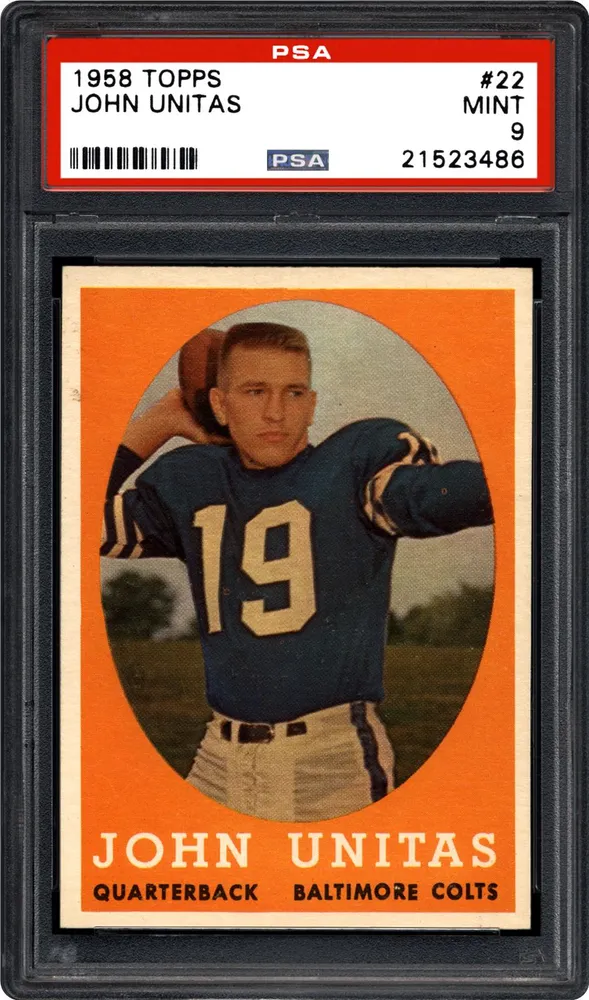
There are quarterbacks, and then there is Johnny Unitas — the man who invented the modern passing game before most of today's football fans were born. His 1958 Topps #22 card, the first Topps football card ever issued for Unitas, captures the golden arm at the exact moment professional football stopped being a niche sport and started becoming America's game. And with only 8 PSA 9s and zero PSA 10s in existence, it is one of the most condition-sensitive vintage football cards in the hobby.
The Card That Started Modern Football Collecting
The 1958 Topps football set is one of the most visually striking vintage issues in the hobby, with bold team-color backgrounds — reds, blues, yellows — that make every card pop. Unitas appears as card #22 in a deep red background that perfectly complements the navy-and-white Baltimore Colts uniform. The 1958 Topps design features a classic portrait with a facsimile signature overlay, a format that Topps had perfected after years of experimentation in the 1950s.
This card is Unitas's first Topps football card. While some debate whether it qualifies as a true "rookie card" (Unitas appeared earlier in minor regional issues and the 1957 Topps set, but with a different card number), the collecting consensus treats his 1958 Topps #22 as the premier Unitas card for vintage football collectors. It is the card that anchors any serious "Mount Rushmore of QBs" collection alongside the Jim Brown (#0065), Joe Namath (#0072), and Joe Montana (#0040) cards the blog has already covered.
The Golden Arm
Johnny Unitas entered the NFL as an undrafted free agent in 1955, cut by the Pittsburgh Steelers before ever taking a snap, and worked construction jobs before the Baltimore Colts gave him a second chance. By 1958, he was the best quarterback in football. Over his 18-year career, Unitas accomplished things the league had never seen:
- 47-game touchdown pass streak (1956–1960) — an NFL record that stood for 52 years until Drew Brees broke it in 2012
- Three NFL championships (1958, 1959, 1968) and Super Bowl V (1970)
- Three NFL MVP awards (1959, 1964, 1967)
- 10 Pro Bowl selections and first-ballot Hall of Fame induction (1979)
- 40,239 career passing yards and 290 touchdowns — both NFL records at the time of his retirement
But Unitas's most enduring legacy is the 1958 NFL Championship Game against the New York Giants, still known as "The Greatest Game Ever Played." Played at Yankee Stadium on December 28, 1958, it was the first NFL championship game ever to go into sudden-death overtime. Unitas led a legendary 86-yard drive in the final minutes to tie the game, then drove the Colts downfield again in overtime for the winning touchdown. An estimated 45 million viewers watched on television — the largest audience ever for a football game at that point — and the game is widely credited with single-handedly launching the NFL into the national consciousness.
PSA Population Report
The 1958 Topps Unitas is brutally difficult to find in high grade. The set's card stock was prone to chipping, centering was inconsistent, and the bold red background shows every surface flaw. The PSA population tells the story:
| PSA Grade | Population | Value |
|---|---|---|
| GEM-MT 10 | 0 | — |
| MINT 9 | 8 | $8,300 |
| NM-MT 8 | 75 | $3,100 |
| Total Graded (All Grades) | 1,660 | — |
* Population data as of July 6, 2026. PSA population counts are dynamic and increase as more cards are submitted for grading.
Zero PSA 10s is the headline here. Even the Kareem Abdul-Jabbar 1969-70 Topps tallboy we covered as COTD #0133 had 2 PSA 10s. The Unitas has never graded Gem Mint — not once. At the MINT 9 level, only 8 copies exist with a $8,300 PSA Price Guide value. Even NM-MT 8 examples, with 75 graded copies and a $3,100 guide, are scarce enough that they rarely appear at public auction without drawing serious attention.
Market Position and Value
At $8,300 for a PSA 9 and $3,100 for a PSA 8, the Unitas represents strong value relative to other vintage Hall of Fame quarterbacks. The 1958 Topps Jim Brown RC (#62) from the same set trades at a premium because Brown's is the undisputed rookie card, while Unitas's 1958 Topps sits in a slightly ambiguous "first Topps card" category. But that ambiguity creates opportunity: the Unitas card has meaningful room to appreciate as the Mount Rushmore QB theme gains traction among vintage football collectors.
For collectors who cannot chase PSA 9s at $8,300, the mid-grade market (PSA 5–7) offers an accessible entry point, with PSA 7 examples trading around the $2,000 range and lower grades available for several hundred dollars. Given that the 1958 Topps set is one of the most collected vintage football sets and Unitas is its marquee quarterback, demand is structurally supported across all grade levels.
Verdict: Johnny Unitas's 1958 Topps #22 is a cornerstone of any serious vintage football collection — a card that represents both a historic player and the game that made the NFL what it is today. With zero PSA 10s and just 8 PSA 9s, condition matters enormously. Buy the card, not the grade, and hold for the long term.