1961 Fleer #8 Wilt Chamberlain RC: At PSA 9, Qualified Copies Outnumber Clean Ones, 34 to 33
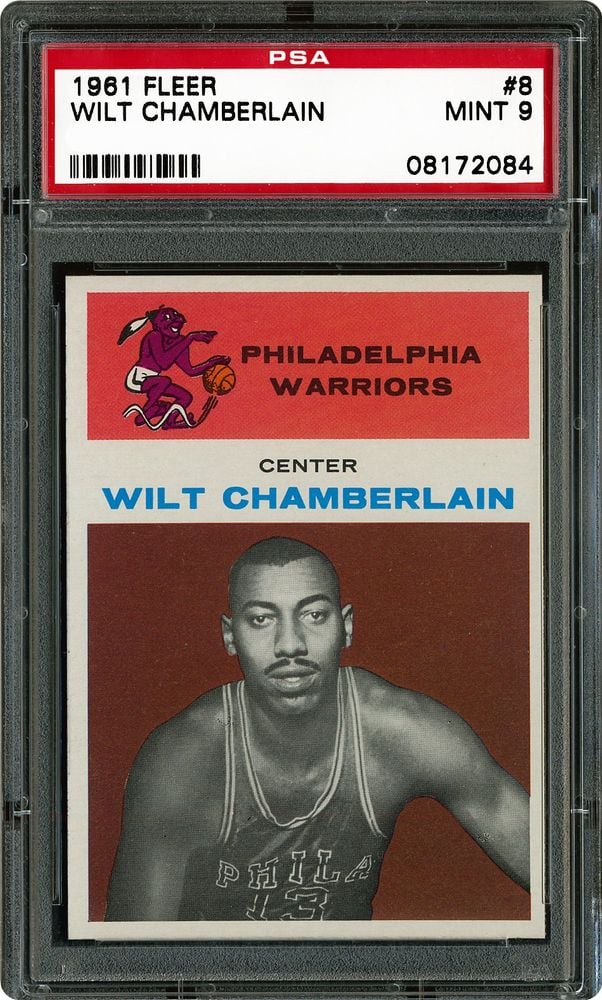
The copy pictured here is a PSA MINT 9, cert 08172084. PSA's cert page puts 33 straight 9s in the population and three graded higher. There are also 34 more copies of this card at the 9 level that carry a qualifier, one more than the straight 9s.
That split, more qualified 9s than clean ones, is the most unusual thing in the population of one of the hobby's most important basketball cards. Wilt Chamberlain's 1961-62 Fleer #8 is listed as his rookie card on TCDB's checklist, and PSA's own CardFacts record tags him as a rookie and a Hall of Famer.
The Card
The top of the card belongs to the team. A red banner carries the Philadelphia Warriors' logo and name, and below it are the position and the player: "CENTER," then "WILT CHAMBERLAIN" in blue capitals. The photo below is a head-and-shoulders portrait against a maroon background, with "PHILA" and his No. 13 visible on the jersey.
The season TCDB's checklist puts on the set, 1961-62, is the one that matters. On March 2, 1962, playing for those Warriors in Hershey, Pa., Chamberlain scored 100 points in a 169-147 win over the New York Knicks. NBA.com notes that he shot 36-for-63 from the field and 28-for-32 from the line, and that the 100 broke his own record of 78 points, set less than three months earlier. The Naismith Hall of Fame still lists the 100-point game as the NBA single-game record.
The Player
The Hall's biography of Chamberlain, enshrined in 1979, is a list of numbers that still look misprinted. He scored 50 or more points 118 times and 60 or more 32 times, and he remains the NBA's all-time leading rebounder with 23,924. He left the league in 1973 with two championships, one with the Philadelphia 76ers and one with the Los Angeles Lakers. The Hall adds that his "skills were so far beyond his competitors that rule changes were enacted to harness his awesome abilities."
Born in Philadelphia on Aug. 21, 1936, he was a legend at Overbrook High School and, in the Hall's words, "the most coveted schoolboy recruit in the country." At Kansas he led the Jayhawks to the 1957 NCAA Finals. The Hall's bio says that although his achievements were often put down to size, he was "a talented athlete who possessed exceptional speed, agility, stamina, and strength." He died on Oct. 12, 1999.
PSA Population Report
| PSA Grade | Population |
|---|---|
| PSA 10 | 3 |
| PSA 9 | 33 |
| PSA 8 | 185 |
| Total Graded (All Grades) | 1,729 |
* Population data as of October 2, 2026. PSA population counts are dynamic and increase as more cards are submitted for grading.
A Curve With Two Humps
The 1,729 straight grades in the table don't climb steadily toward a peak. The most common grade is PSA 4, with 306 copies, and PSA 6 is close behind at 288. Between them sits a dip, 243 at PSA 5. Above the 6, the count falls off steadily: 252 at PSA 7, 185 at PSA 8, then a drop to 33 at PSA 9 and three at PSA 10. Only 36 straight-graded copies sit above the 8.
The total also includes 88 copies encapsulated as Authentic, without a numeric grade. On top of the straight grades, PSA has issued 202 half grades and 400 qualified grades, bringing the card to 2,331 slabs in all.
The Qualifier Climb
A qualified grade carries a code next to the number, and PSA counts those slabs separately from the straight grades. PSA's grading-standards page uses one, OC for off-center, as its example. The population report counts qualified slabs without saying which code each one carries, so this card's numbers show only how many there are, not why.
From PSA 4 up, the share of qualified copies at each number, against straight copies at the same number, rises at every step:
- PSA 9: 34 qualified, 33 straight, just over half
- PSA 8: 130 qualified, 185 straight, about 41%
- PSA 7: 75 qualified, 252 straight, about 23%
- PSA 6: 55 qualified, 288 straight, about 16%
- PSA 5: 25 qualified, 243 straight, about 9%
- PSA 4: 24 qualified, 306 straight, about 7%
That is the population's real shape. At PSA 4 and 5, more than nine copies in ten get their number with no qualifier. At PSA 9, more than half don't. The 130 qualified 8s alone outnumber all the straight 9s and 10s put together, 130 to 36.
The Top of the Ladder
Three copies have been graded PSA 10, and the cert on the pictured 9 confirms the same figure from a different PSA page: Pop Higher, 3. That makes the copy in the image one of 33 sitting one step below the top, on a card where more than half of the copies graded at that number came back with a qualifier attached.
Verdict: the 1961-62 Fleer Chamberlain is the rookie card of the man who scored 100 in that same season, and its population tells a story of its own. The curve crests at PSA 4, and the higher a copy grades, the likelier it is to carry a qualifier. At PSA 9 the qualified copies have pulled ahead by one, and a clean 9 like this one is the less common of the two.