1966 Philadelphia #31 Dick Butkus RC — One PSA 10 in 1,723, and More Qualified 8s Than Clean 9s
PSA has put 2,048 Dick Butkus rookie cards in holders. Exactly one of them is a PSA 10. Nine more are straight PSA 9s — and forty-four copies earned a PSA 8 with a qualifier attached, which means the defect-flagged 8s outnumber the clean 9s by nearly five to one.
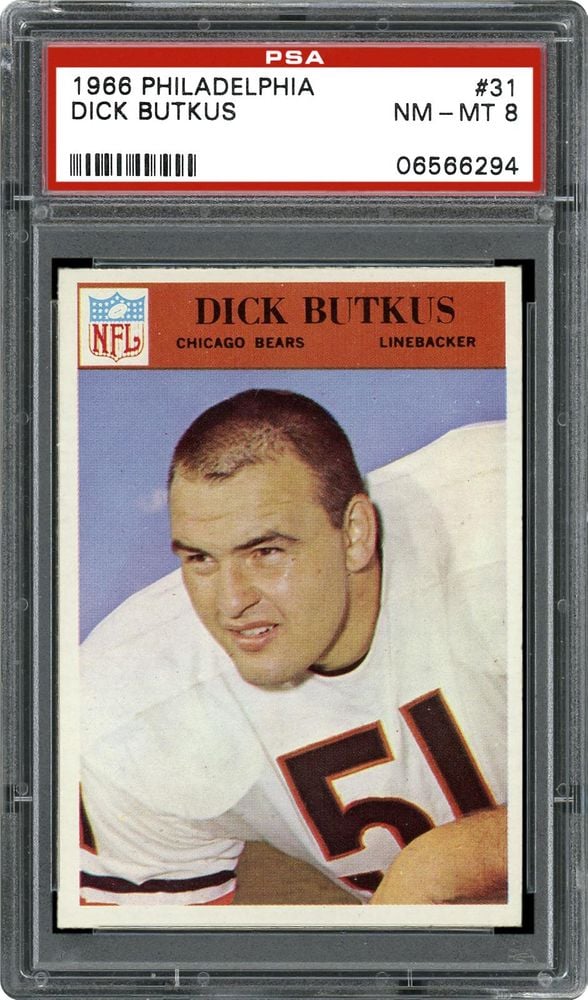
The card is the 1966 Philadelphia #31, Butkus's rookie card and the one PSA flags with its own (R) and (HOF) markers. The front is a posed portrait: no helmet, white jersey, the 51 half out of frame at the bottom, a flat blue sky behind him. The orange banner across the top reads DICK BUTKUS — CHICAGO BEARS — LINEBACKER, and that is the whole position note. The card does not say middle linebacker. The example pictured above is a PSA NM-MT 8, cert 06566294 — one of the 168 copies at that grade, which on this card is very near the top of the ladder. The Trading Card Database lists the card at #31 in the 1966 Philadelphia set and flags it as a rookie.
PSA Population Report
| PSA Grade | Population |
|---|---|
| PSA 10 | 1 |
| PSA 9 | 9 |
| PSA 8 | 168 |
| Total Graded (All Grades) | 1,723 |
* Population data as of September 3, 2026. PSA population counts are dynamic and increase as more cards are submitted for grading.
The Curve Peaks in the Middle and Falls Off a Cliff
Three rows and a total hide what this card actually is. Here is the full straight-grade distribution PSA published this morning: 34 ones, 68 twos, 175 threes, 317 fours, 321 fives, 373 sixes, 249 sevens, 168 eights, nine nines and one ten, plus eight copies that came back Authentic with no numeric grade. Add 129 half-grades and 196 qualified copies and the card has 2,048 slabs in circulation.
The peak is the PSA 6. Not the 8, not the 7 — the 6, with 373 copies, and the fours and fives sit just behind it at 317 and 321. Those three rows alone hold 1,011 of the 1,715 numerically graded copies, just under three in five. This is a card that grades middling almost every time it is submitted.
Then the top of the ladder collapses. From 168 eights to nine nines is a drop of more than eighteen to one, and from nine nines to a single ten is the rest of the way. Ten copies in total have ever graded above an 8 — 0.58 percent of the numerically graded population.
The qualified counts tell the same story from the other side. A qualifier is PSA's note that a card would have graded higher but for a specific defect, most often centering. Forty-four Butkus rookies hold a qualified 8 against nine straight 9s, and thirteen hold a qualified 9 against that one 10. At every rung near the top of this card, the copies with a flagged defect outnumber the copies without one.
The Other Rookie in the Same Set
Butkus is not even the most-graded rookie card in his own set. This blog filed the 1966 Philadelphia #38 Gale Sayers rookie as CASE #0207 on July 31, and the numbers make a clean pair:
- Sayers #38 — 3,557 straight grades, 368 eights, 38 nines, no PSA 10
- Butkus #31 — 1,723 straight grades, 168 eights, nine nines, one PSA 10
Sayers has been submitted to PSA more than twice as often and has never produced a gem. Butkus has produced exactly one. Between the two marquee rookie cards of the 1966 Philadelphia set, across 5,280 straight grades, there is a single PSA 10.
The two cards belong together for a better reason than the set they share. Chicago drafted both men in 1965, they played their rookie season together, and according to the Pro Football Hall of Fame, Butkus "had only one challenger for National Football League Rookie of the Year honors, teammate Gale Sayers." Their rookie cards were printed side by side in the same 1966 release, seven numbers apart.
Analysis: A grade curve that peaks at 6 and produces one 10 in sixty years describes the cardboard, not the player. PSA publishes the counts and not a cause, and nothing in the population data isolates one. What the counts establish is the shape of the thing: a Butkus rookie in a PSA holder is overwhelmingly likely to be a mid-grade card, and the high end is not a matter of patience but of a population that contains ten copies above the 8.
The Case
Butkus played nine seasons, all for Chicago, all at middle linebacker. He was named first-team All-NFL as a rookie and five more times after that, six in all, and went to the Pro Bowl following his rookie season and in each of the next seven years — eight straight. He intercepted 22 passes from the middle of a defense, a strange and telling number for a linebacker of that era.
A serious right knee injury in 1970 never fully responded to surgery. He played three more seasons on it and retired after 1973. The Hall of Fame elected him in 1979, his first year of eligibility — and here the reflex phrase happens to be correct: he went in on the first ballot.
Butkus died on October 5, 2023, at his home in California, at 80. In the Hall's tribute, president Jim Porter said he "was considered the person who defined the position of middle linebacker," and noted that USA Today had once called him the "gold standard by which other middle linebackers are measured." He played in an era when several of his contemporaries at the position also reached Canton, and his name was still the one cited first.
The Verdict
The card is a plain thing — a bare-headed man in a white jersey under a one-word position label. What makes it a case file is the curve behind it: sixty years of submissions have produced 168 copies at PSA 8, nine at PSA 9, and one single 10.
Gale Sayers has never produced a PSA 10 in 3,557 tries. Butkus has produced one in 1,723. Somewhere out there is a single gem-mint copy of the card that the Hall of Fame says defined the middle linebacker — and on the evidence of the other 2,047, nobody should expect a second.