1966 Topps #126 Jim Palmer RC: He Shut Out Koufax's Dodgers at 20, Went Unclaimed on Waivers at 22, and PSA Has Never Graded a 10
Jim Palmer's rookie card came out in the season he joined Baltimore's rotation. That October, at 20, he shut out the Dodgers in the World Series in a game started by Sandy Koufax. Two years later the Orioles put him on waivers and nobody claimed him. PSA has graded 5,426 copies of the card, and not one is a Gem Mint 10.
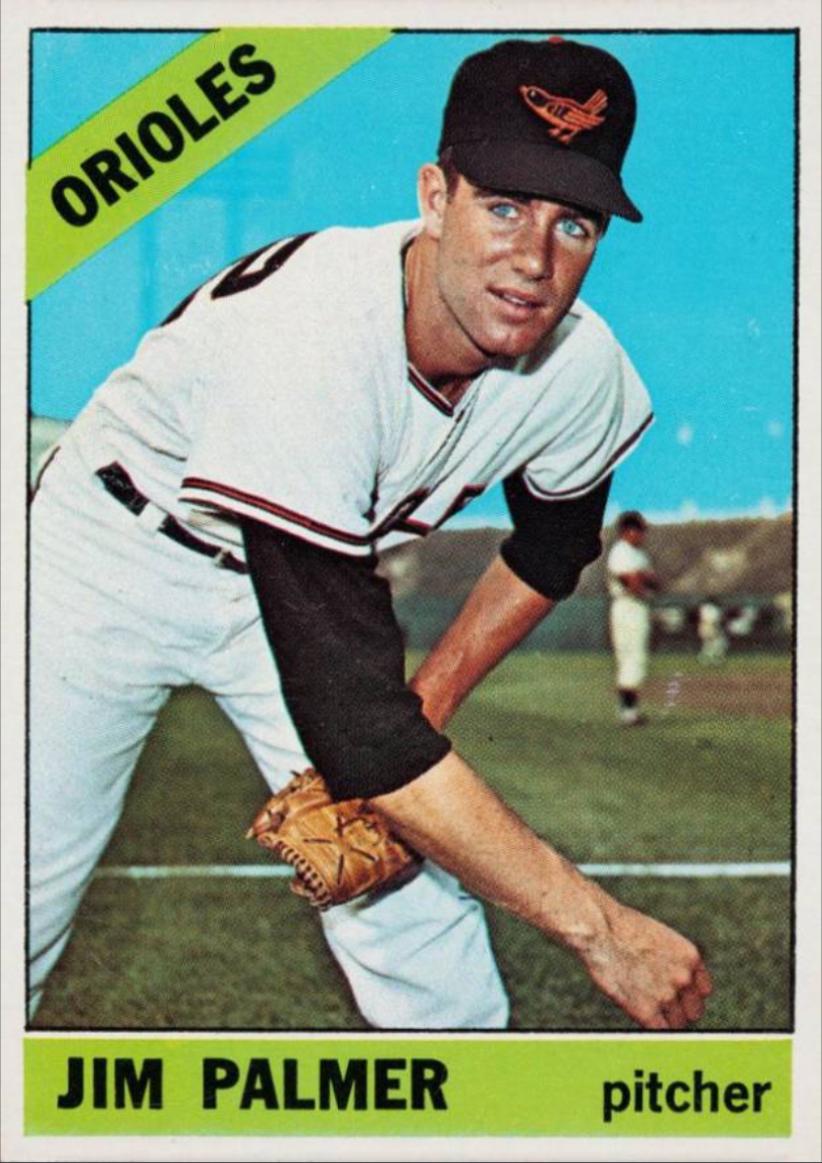
The card is #126 in the 1966 Topps baseball set, and PSA's record for it carries both the rookie and Hall of Fame designations. Palmer is caught at the end of his delivery in Baltimore's home whites, glove hand low, cap with the cartoon oriole on it, and another player stands in the background. A green "ORIOLES" pennant cuts across the top-left corner, and a matching green bar along the bottom carries "JIM PALMER" and, in lower case, "pitcher."
Twenty Years Old Against Koufax
Palmer won his first major-league game in relief on May 16, 1965, against the Yankees, and hit a two-run home run off Jim Bouton in the same game. In 1966 he moved into the starting rotation, won 15 games and pitched the game that clinched the American League pennant.
Game 2 of the 1966 World Series, at Dodger Stadium, matched him against Koufax, who had won his third Cy Young Award in four years that season and was making his last appearance. Palmer threw a 6-0 shutout. At 20 years and 11 months, nine days before his 21st birthday, he is still the youngest pitcher to throw a complete-game shutout in a World Series. Baltimore swept the defending champions.
Waived, and Not Claimed
He had hurt his arm that season, by his own account using a paint roller in his new house in Baltimore, and pitched through it on cortisone. In 1967 the arm stayed heavy. He was sent down after a poor start in May, and pitched only three more games for the Orioles that year. In 1968 he never pitched for Baltimore at all. The Orioles placed him on waivers that September, and the next month he was left unprotected in the expansion draft for the Royals and Pilots. No one took him.
He came back healthy in 1969, threw the only no-hitter of his career that August, and went 16-4. Palmer went on to win at least 20 games in eight seasons, took the Cy Young Award in 1973, 1975 and 1976, and won more games than any pitcher in the majors in the 1970s, 186. He never allowed a grand slam in a major-league game. He retired in 1984 with 268 wins, the most in Orioles history, and was elected to the Hall of Fame in 1990, his first year of eligibility. He is still the only pitcher to win a World Series game in three different decades.
PSA Population Report
| PSA Grade | Population |
|---|---|
| PSA 10 | 0 |
| PSA 9 | 83 |
| PSA 8 | 540 |
| Total Graded (All Grades) | 5,426 |
* Population data as of October 19, 2026. PSA population counts are dynamic and increase as more cards are submitted for grading.
A Population Built in the Middle
PSA has never graded this card a 10. The top of the population is 83 Mint 9s, and only 623 copies, about one in nine, reach PSA 8 or better.
Most of the card's graded copies sit in the middle grades. The most common is PSA 6, but PSA 4 is close behind, and a copy is more likely to come back a 4 than an 8:
- PSA 9: 83
- PSA 8: 540
- PSA 7: 865
- PSA 6: 1,111
- PSA 5: 951
- PSA 4: 1,032
- PSA 3: 495
- PSA 2: 239
- PSA 1: 98
Twelve more copies have been encapsulated Authentic, which completes the 5,426.
Outside those straight grades, PSA has issued 393 half grades and 222 qualified grades. The qualifiers gather near the top: there are 84 qualified PSA 8s, one more than the number of straight PSA 9s.
Verdict: the 20-year-old on this card beat Koufax in the World Series, then went unclaimed on waivers two years later, and still retired with more wins than anyone in Orioles history. His rookie card has never been graded a Gem Mint 10, and only about one copy in nine reaches PSA 8 or better.