Card of the Day: 1969-70 Topps #25 Lew Alcindor (Kareem Abdul-Jabbar) RC
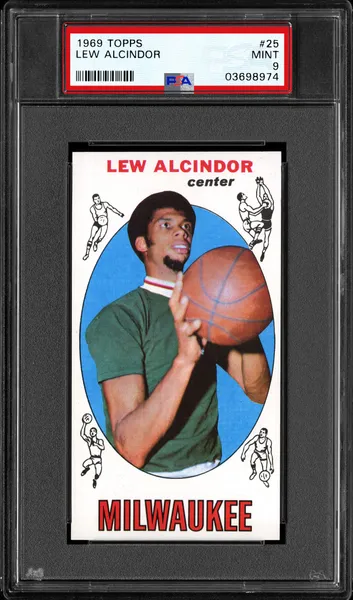
Lew Alcindor — before he became Kareem Abdul-Jabbar — was already the most dominant college basketball player in history when Topps released its first-ever basketball set in 1969-70. His rookie card, #25 in that iconic "tallboy" vertical format, captures a moment frozen in time: the UCLA legend, the first overall pick of the 1969 NBA Draft, and a player on the verge of becoming the NBA's all-time leading scorer.
The 1969-70 Topps set is notable not just for its debutante status but for its distinctive design. The vertical "tallboy" format gives each card a portrait-like presentation that stands out from the horizontal layouts that dominated the era. Alcindor's card, bearing his birth name before his conversion to Islam and name change in 1971, is the undisputed key to the set and one of the most important vintage basketball cards in existence.
PSA Population Report
| PSA Grade | Population | Value |
|---|---|---|
| GEM-MT 10 | 2 | — |
| MINT 9 | 18 | $216,000 |
| NM-MT 8 | 170 | $34,800 |
| Total Graded (All Grades) | 5,072 | — |
* Population data as of June 30, 2026.
A Rarity That Rivals the Greats
The population numbers tell a striking story. With only 2 PSA 10s and 18 PSA 9s across more than 5,000 total graded examples, the Alcindor rookie is one of the most condition-sensitive vintage basketball cards in the market. The tallboy format's extended edges and corners made the card particularly susceptible to wear — a PSA 10 gem rate of approximately 0.04% puts it in rarefied air alongside the 1952 Topps Mickey Mantle in terms of high-grade scarcity.
The PSA 9 value of $216,000 reflects the enormous premium collectors place on condition for this card. Even an NM-MT 8 commands $34,800, making it a significant investment grade card at virtually every level above mid-grade. The absence of a listed PSA 10 value in the PSA Price Guide speaks to the near-mythical status of those two specimens — when they do trade, they do so in private transactions at prices that set records.
More Than a Rookie Card
Kareem Abdul-Jabbar retired as the NBA's all-time leading scorer with 38,387 points — a record that still stands. His six NBA championships, six MVP awards, and 19 All-Star selections place him in the innermost circle of basketball immortality. But the Lew Alcindor rookie card represents something more: a tangible link to a transformative moment in American sports and culture, when a dominant Black athlete made his professional debut under a name he would soon leave behind.
The "Lew Alcindor" moniker on the card — a name Kareem has described as a slave name imposed on his family — adds a layer of historical weight that transcends sport. Collectors aren't just buying a basketball card; they're buying a piece of the complex, evolving story of race, identity, and excellence in American athletics.
Market Position
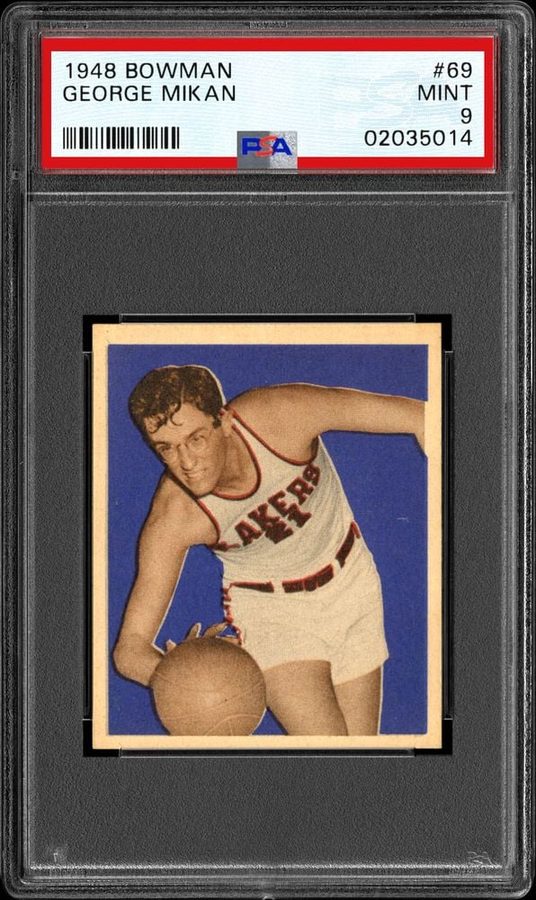
The Alcindor rookie sits alongside the 1961-62 Fleer Wilt Chamberlain and 1948 Bowman George Mikan as the foundational pillars of vintage basketball collecting. Unlike the post-1986 modern market, where print runs exploded, the 1969-70 Topps set had a relatively modest print run, and high-grade examples have become increasingly difficult to find as the collecting base has grown.
For serious vintage basketball collectors, the Kareem Abdul-Jabbar rookie is not a question of if but when. The card's position at the intersection of cultural history, condition scarcity, and all-time-great player performance makes it one of the most secure long-term holds in the vintage sports card market.
The verdict: Two PSA 10s, 18 PSA 9s, and a legacy that spans the entire modern history of basketball. The Lew Alcindor rookie card is a true condition census monster and a cornerstone of any world-class vintage basketball collection.