1969 Topps #120 Larry Csonka RC: Printed a Year Before Shula Rebuilt Him, With 574 PSA 8s, 41 PSA 9s and Two 10s
Larry Csonka's rookie card came out in 1969, after a first pro season with two concussions, a ruptured eardrum, a broken nose and talk that he might have to quit. A year later Don Shula arrived and taught him to run again. PSA has graded 2,993 copies of the card. Two are 10s.
The Card
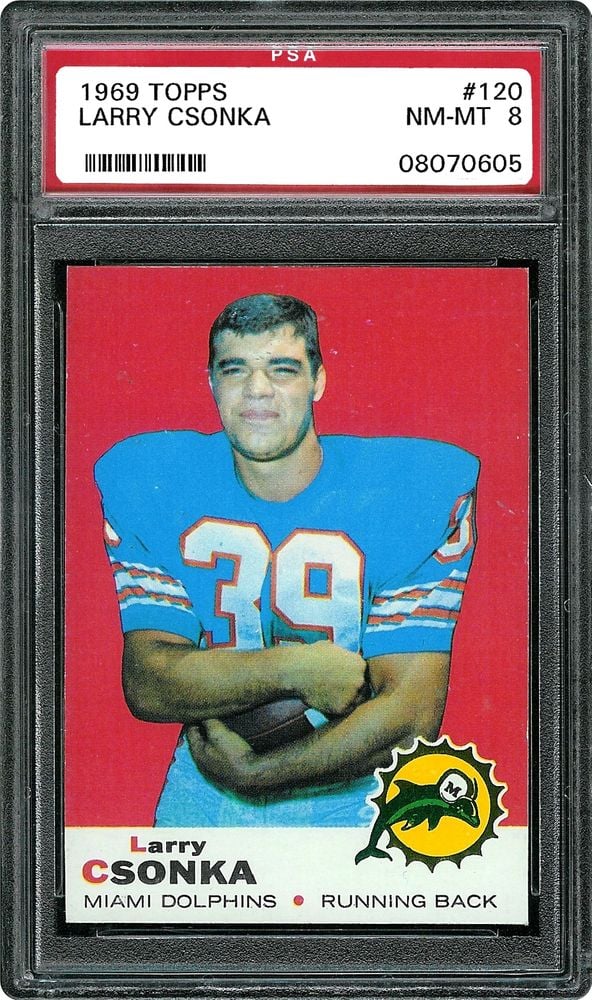
Topps gives Csonka card No. 120 in its 1969 football set. He stands against a solid red background in a light aqua Dolphins jersey with orange-and-white sleeve stripes, the big No. 39 across his chest, his arms folded over a football tucked against his stomach. A white strip at the bottom carries his name, with "Larry" in small red script over "CSONKA" in heavy capitals, and under it "MIAMI DOLPHINS • RUNNING BACK." The Dolphins logo, a leaping dolphin in a helmet inside an orange sunburst, sits in the lower right corner.
TCDB's checklist marks it as his rookie card, and PSA's CardFacts record tags him as a rookie and a Hall of Famer. The copy pictured here is a PSA NM-MT 8, cert 08070605.
The Player
Csonka was born in Stow, Ohio, on Dec. 25, 1946, and grew up on his family's farm there. He was a consensus All-American at Syracuse, and Miami made him its first-round pick in 1968.
The start did not look like a Hall of Fame career. In his fifth pro game he was knocked out against Buffalo and spent two days in the hospital. Three weeks later in San Diego he took a second concussion, plus the ruptured eardrum and the broken nose. He ran for 540 yards as a rookie and 566 the next year, missing three games in each season.
Then Shula came in 1970. Teammate Nick Buoniconti later wrote that the new coach "literally had to teach Csonka how to run with the football," getting him to lead with his forearm instead of his head. Csonka did not miss a game over the next four seasons.
The 6-3, 235-pound fullback became the battering ram of Miami's ball-control offense. He ran for more than 1,000 yards in each of the three Super Bowl seasons from 1971 to 1973, including 1,117 during the perfect 1972 season, and was named All-Pro all three years. In Super Bowl VIII he carried 33 times for a then-record 145 yards and two touchdowns and was named the game's MVP.
He left Miami after 1974 for the World Football League's Memphis Southmen, played three seasons with the New York Giants and came back to the Dolphins for one last year in 1979, when he scored 12 rushing touchdowns, the most of his career. He finished with 8,081 rushing yards and fumbled only 21 times in 11 seasons. The Pro Football Hall of Fame inducted him in 1987, and the Dolphins retired his No. 39 in 2002.
PSA Population Report
| PSA Grade | Population |
|---|---|
| PSA 10 | 2 |
| PSA 9 | 41 |
| PSA 8 | 574 |
| Total Graded (All Grades) | 2,993 |
* Population data as of Nov. 3, 2026. PSA population counts are dynamic and increase as more cards are submitted for grading.
The full straight-grade curve:
- PSA 10: 2
- PSA 9: 41
- PSA 8: 574
- PSA 7: 694
- PSA 6: 637
- PSA 5: 465
- PSA 4: 380
- PSA 3: 134
- PSA 2: 51
- PSA 1: 6
- Authentic, no numeric grade: 9
The curve peaks at PSA 7 and stays heavy at 8: more than one copy in five, 617 of the 2,993, has graded 8 or better.
Above that is a cliff. For every 14 copies at PSA 8 there is about one at PSA 9, and only 43 copies, about 1.4 percent, have reached 9 or 10. The half grade between them nearly fills the gap on its own: 37 copies sit at PSA 8.5, four fewer than the straight 9s.
Beyond the straight grades, PSA has issued 245 half grades and 102 qualified holders, for 3,340 slabs in all. Five of the qualified copies are 9s and 25 are 8s.
Verdict: The card caught Csonka before Shula rebuilt him, and the population shows a card that survives in good shape far more often than in great shape. An 8 is easy to find. A 9 is one copy in 73, and the two 10s are the entire top of the report.