1970 Topps #123 Pete Maravich RC: Topps Called Him a Forward, and His Card Has More PSA 1s Than PSA 9s
Pete Maravich's rookie card calls him a forward. He is still the all-time leading scorer in NCAA Division I men's basketball, and PSA has graded 4,397 copies of the card. Only two have come back Gem Mint 10.
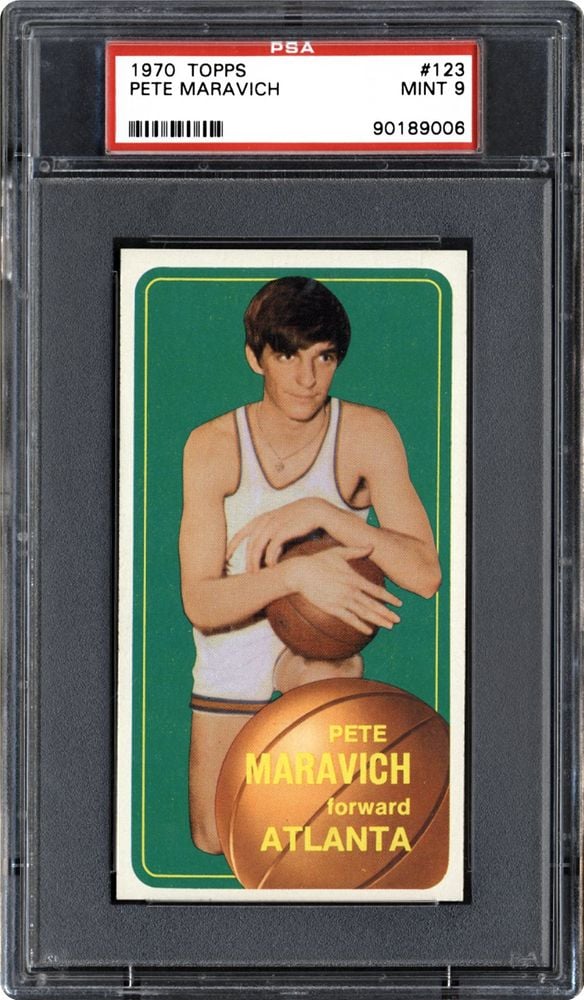
The card is #123 in the 1970 Topps basketball set, and PSA's record for it carries both the rookie and Hall of Fame designations. The slab pictured above is a PSA Mint 9, certification 90189006. Inside it is the set's tall, narrow card: a green field inside a thin yellow border, Maravich in a white sleeveless jersey with a mop of brown hair, hugging a basketball, and a second, painted basketball at the lower right carrying his name in yellow, "PETE MARAVICH," over "forward" and "ATLANTA."
Topps had the team right and the position loose. Wikipedia describes the 6-foot-5 Maravich as a guard, and the Atlanta Hawks already had a scoring guard in Lou Hudson when they drafted him.
Pistol Pete
The Naismith Memorial Basketball Hall of Fame opens its biography with "Perhaps the greatest creative offensive talent in history," and adds that he "rarely duplicated the same move twice." Playing three varsity seasons at LSU for his father, Press Maravich, he scored 3,667 points and averaged 44.2 a game. Both are still NCAA men's records, and he led the nation in scoring all three years. The nickname came from high school, from his habit of shooting from his side as if he were holding a revolver.
Atlanta took him with the third pick of the 1970 draft. He averaged 23.2 points in 81 games and made the NBA All-Rookie Team. After four seasons with the Hawks he was traded to the expansion New Orleans Jazz, and in 1976-77 he led the league at 31.1 points a game. He was a five-time All-Star before injuries ended his career in 1980, after a final part-season with the Boston Celtics.
He was inducted into the Hall of Fame in 1987. On Jan. 5, 1988, he collapsed during a pickup game in Pasadena, Calif., and died at 40 of an undetected heart defect.
PSA's population report for the card, pulled today, reads:
PSA Population Report
| PSA Grade | Population |
|---|---|
| PSA 10 | 2 |
| PSA 9 | 87 |
| PSA 8 | 514 |
| Total Graded (All Grades) | 4,397 |
* Population data as of October 12, 2026. PSA population counts are dynamic and increase as more cards are submitted for grading.
A curve that crests at six
The most common grade for this card sits in the middle of the scale. The full straight-grade curve climbs to PSA 6 and falls away on both sides:
- PSA 1 – 3: 146, 291 and 459
- PSA 4 – 5: 710 and 700
- PSA 6: 803 — the largest single grade
- PSA 7 – 8: 667 and 514
- PSA 9 – 10: 87 and 2
Another 18 slabs carry an Authentic grade instead of a number. The grades from four through six hold 2,213 copies between them, half of everything PSA has graded.
More ones than nines
The sharpest drop on the card is at the top. It goes from 514 at the eight to 87 at the nine. That leaves the PSA 1 column, with 146 copies, larger than the PSA 9 column.
That is the pattern of a card collectors send in whatever its condition. Copies in rough shape keep arriving at PSA; copies in mint shape are the scarce ones.
The qualified grades point the same way. On top of the straight population, PSA has slabbed 231 qualified copies and 464 half grades, and the largest qualified group is at the eight: 79 copies, almost as many as the 87 straight nines.
The pictured slab's own cert page lists 87 at its grade and two higher, the same two Gem Mint 10s in the table. The Mint 9 above is one of the 87.
Topps printed "forward" under Pete Maravich's name and put him in Atlanta on his rookie card. After 4,397 trips through PSA, the card most often comes back a six, it has more ones than nines, and only two copies have ever earned a ten.