1976 O-Pee-Chee #115 Bryan Trottier RC: A Calder Winner's First Card, and Just 9 PSA 10s in 855
Bryan Trottier's rookie card arrived after his rookie season, not during it. By the time the 1976 O-Pee-Chee #115 was printed, the center from Val Marie, Saskatchewan, had already won the Calder Trophy at 19. The card shows him at the start of a career that produced six Stanley Cups as a player and 1,425 points.
The Player
Trottier was born on July 17, 1956, in Val Marie, a small town near the Montana border. The Saskatchewan Hockey Hall of Fame says he learned to skate on a river behind the family home and dreamed of one day playing for the local Val Marie Mustangs. His grandmother, CBC Sports reported, was Cree "from the Dakotas," and he has Métis, Cree and Chippewa ancestry.
The New York Islanders took him in the second round of the 1974 draft, 22nd overall. He reached the NHL in 1975-76 and scored 32 goals and 63 assists for 95 points in 80 games. The Calder followed, at 19.
Islanders coach Al Arbour put him between Mike Bossy and Clark Gillies. The Saskatchewan Hall calls the result "the most dangerous line in the league." In 1978-79 Trottier led the NHL in scoring with 134 points, on 47 goals and 87 assists. He finished plus-76 and won both the Art Ross and the Hart.
The Card
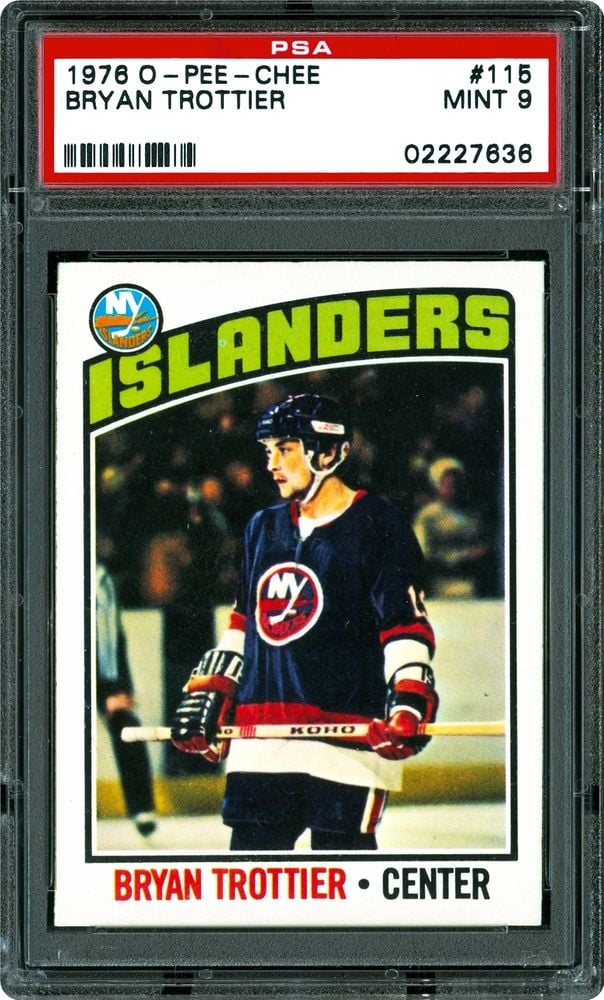
The 1976 O-Pee-Chee design puts the team name across the top in big green capitals, "ISLANDERS," arched beside the club's round logo. Below the photo, a single line reads "BRYAN TROTTIER • CENTER." Trottier is pictured in a dark blue Islanders jersey, stick held across his body, with a crowd behind him. PSA lists the card as his rookie.
The pictured copy is a PSA MINT 9, certification number 02227636. It is one of 76 copies at that grade, and its cert page counts 9 graded higher. Those 9 are the tens.
PSA Population Report
| PSA Grade | Population |
|---|---|
| PSA 10 | 9 |
| PSA 9 | 76 |
| PSA 8 | 174 |
| Total Graded (All Grades) | 855 |
* Population data as of October 25, 2026. PSA population counts are dynamic and increase as more cards are submitted for grading.
The Shape of the Population
Trottier's curve has a flat top, not a peak:
- PSA 1: 1
- PSA 2: 10
- PSA 3: 32
- PSA 4: 69
- PSA 5: 113
- PSA 6: 191
- PSA 7: 179
- PSA 8: 174
- PSA 9: 76
- PSA 10: 9
The most common grade is PSA 6, but only just. Grades 6, 7 and 8 sit within 17 copies of each other, and together they hold more than 60 percent of the total. Then the line falls by more than half, from 174 at PSA 8 to 76 at PSA 9.
The qualifiers point to the copies that came close. On top of the straight grades, PSA has given 42 copies a qualified grade, a number grade with a defect noted on the label. Twenty-two of them are qualified 8s and eight are qualified 9s. Another 19 copies carry half grades, and one is graded Authentic. Counting every slab, PSA has graded 916 copies of the card.
What Came After
Trottier won the Conn Smythe Trophy as playoff MVP in 1980, the first of four straight Islanders championships from 1980 through 1983. He added two more Cups with Mario Lemieux's Pittsburgh Penguins in 1991 and 1992, and a seventh as an assistant coach with the 2000-01 Colorado Avalanche. Over 18 NHL seasons he played 1,279 games and had 524 goals and 901 assists.
The Hockey Hall of Fame inducted him in 1997. His two-way game left a mark on the next generation, too. CBC Sports reported that Steve Yzerman wore No. 19 in his honour.
The 1976 O-Pee-Chee #115 is the first card of a Calder winner who became the center of a dynasty. Its population is flat across the middle grades and thin at the top: 76 nines and 9 tens in 855.