Card of the Day: 1978 Topps #36 Eddie Murray RC — The Only Switch-Hitter with 3,000 Hits and 500 Home Runs
Switch-hitters who can change a game with one swing are rare. Switch-hitters who reach 3,000 hits and 500 home runs? There is exactly one: Eddie Murray. "Steady Eddie" was never the flashiest player on the field, but over 21 seasons he built a resume that places him among the most complete offensive players in baseball history. His rookie card from the 1978 Topps set captures Murray at the dawn of a career that would define the Baltimore Orioles for over a decade and cement his place in Cooperstown.
The 1978 Topps Set
Topps' 1978 offering is one of the most visually distinctive sets of the decade. The design features a large color headshot framed by a team-colored border, with the team name displayed prominently in a circular crest at the bottom corner. The set runs 726 cards deep and includes a loaded rookie class beyond Murray — Paul Molitor, Alan Trammell, Jack Morris, and Ozzie Smith all appear in this set, making it one of the most consequential Topps releases of the late 1970s.
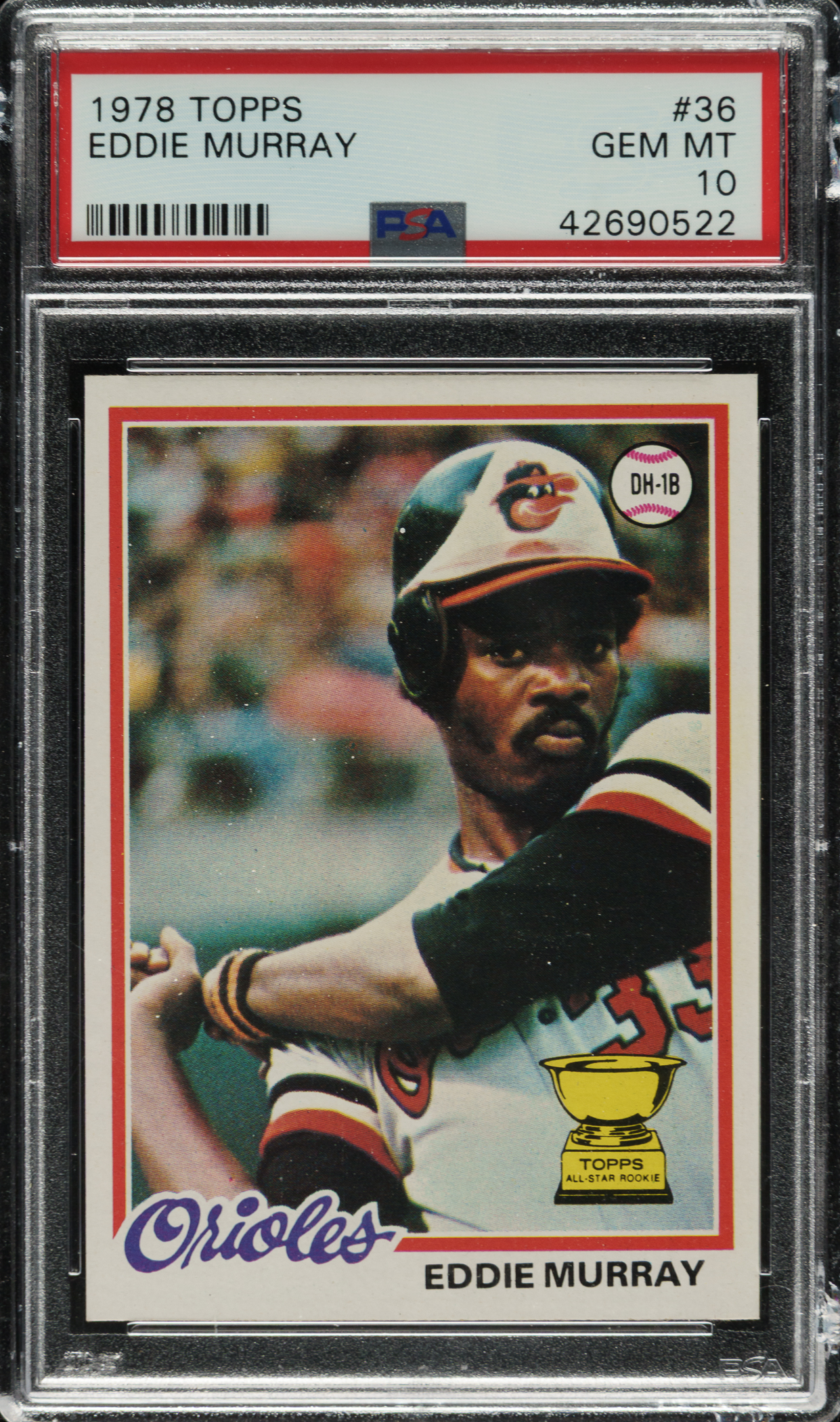
Eddie Murray's card, number 36 in the set, is his true solo rookie card. (He also appears on card #707, the Baltimore Orioles Team Leaders card, alongside Ken Singleton.) The card shows a young Murray in an Orioles orange jersey, wearing the thick-framed glasses that would become part of his signature look during his early years in Baltimore.
The Career of Steady Eddie
Eddie Murray made his MLB debut on April 7, 1977, and by his third season he was an All-Star. Over 21 seasons, he put up Hall of Fame numbers across the board:
- 3,255 hits — 11th all-time among MLB players with 500+ home runs
- 504 home runs — one of 28 players in the 500-HR club
- 1,917 RBIs — 14th all-time, tops among switch-hitters
- .287 batting average — consistent excellence across two decades
- 8 All-Star selections, 3 Gold Gloves, 3 Silver Sluggers
- AL MVP in 1984 — hit .306 with 33 HR and 110 RBI
- World Series champion in 1983 — the Orioles' most recent title until 2026
Murray's defining trait was his consistency. He drove in 100+ runs in 11 of 13 seasons from 1979 to 1991. He hit 20+ home runs in 17 consecutive seasons from 1977 to 1993. He never had a season where he was the best player in the league, but he was elite for so long that his career totals are staggering. Only Hank Aaron, Babe Ruth, Stan Musial, Willie Mays, and Rafael Palmeiro have more combined hits and home runs than Murray — and Murray is the only switch-hitter in that group.
PSA Population Report
| PSA Grade | Population | Value |
|---|---|---|
| GEM-MT 10 | 18 | $44,750 |
| MINT 9 | 722 | $1,175 |
| NM-MT 8 | 3,920 | $215 |
| Total Graded (All Grades) | 15,105 | — |
* Population data as of July 2, 2026.
Rarity and Value
Only 18 PSA 10 examples exist out of 15,105 total graded — a gem rate of just 0.12%. That is not surprising given the 1978 Topps set's notorious centering issues. Topps printed these cards on sheets that often resulted in miscut borders, and finding a perfectly centered Murray RC is genuinely difficult. A PSA 10 commands $44,750 at the PSA Price Guide level, while a MINT 9 is a far more attainable $1,175. For most collectors, NM-MT 8 examples around $215 represent the sweet spot of value and condition.
When compared to his rookie-class contemporaries, Murray's 1978 RC looks undervalued. Paul Molitor's 1978 Topps RC in PSA 9 trades around $300, while Ozzie Smith's PSA 9 is in the $2,500 range. The gap between Murray and Smith is notable — both are Hall of Famers with similar career WAR, but Smith's defensive wizardry has historically commanded a premium. For collectors looking at the long game, Murray's combination of statistical rarities (the only switch-hitter with 3,000 hits and 500 HR) and his first-ballot Hall of Fame status makes his RC one of the most compelling values in the 1978 set.
The Verdict
Eddie Murray's 1978 Topps rookie card is an undervalued cornerstone of late-1970s baseball collecting. With only 18 PSA 10s, a Hall of Fame resume that includes membership in both the 3,000-hit and 500-HR clubs, and the unique distinction of being the only switch-hitter to achieve both milestones, this card has room to grow. For collectors building a set of Hall of Fame rookies from the 1970s, Murray is a must-own that still trades at a reasonable entry point for high-grade examples.