1978 Topps #315 Tony Dorsett RC — 5,715 Graded, 13 Gems, and a $26,100 Cliff
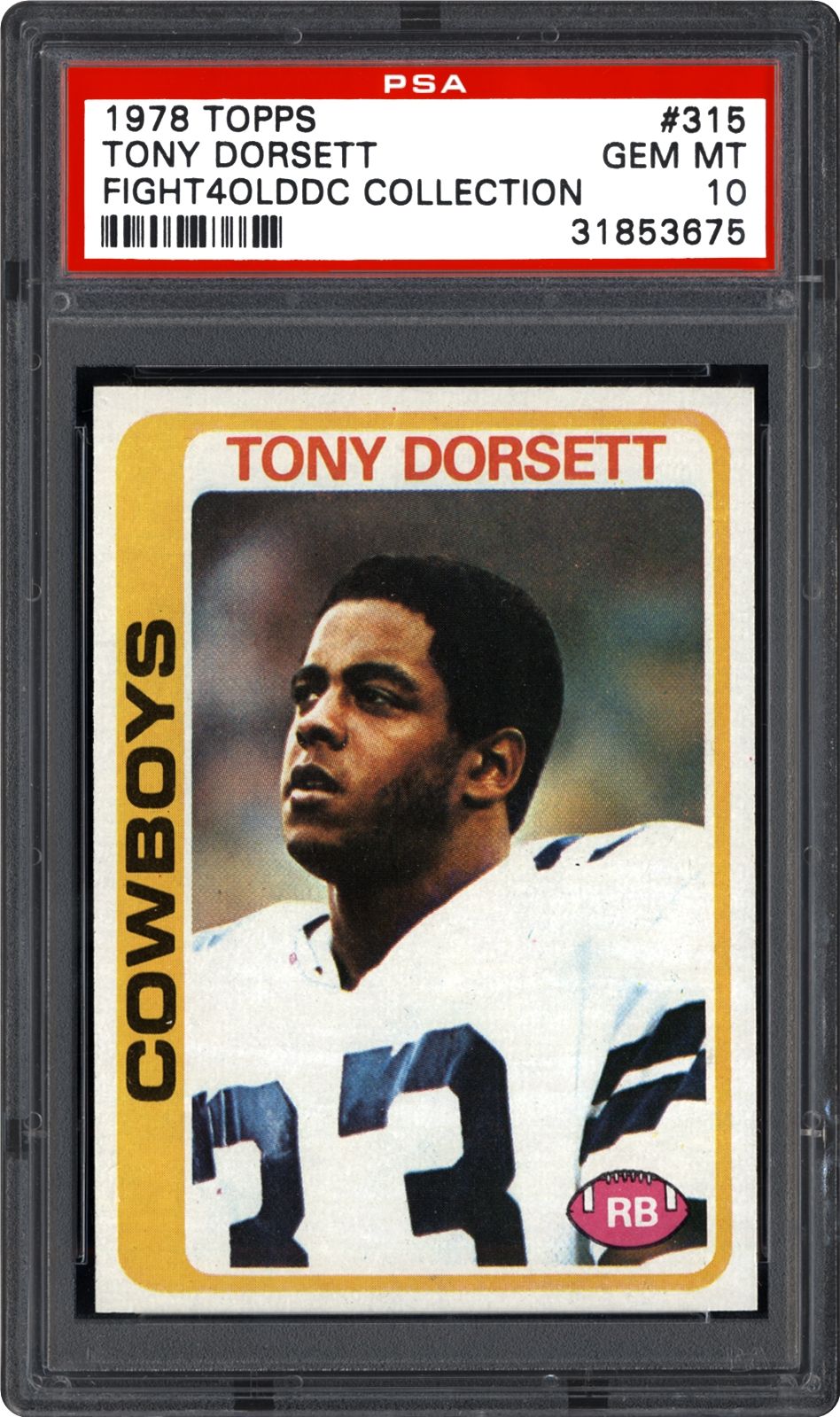
The slab pictured above is one of thirteen. PSA cert 31853675, graded GEM MT 10, housed in the FIGHT4OLDDC Collection — one of only thirteen 1978 Topps Tony Dorsett rookie cards ever to earn a perfect grade, out of 5,715 submitted.
That ratio is the whole case file. This is not a rare card. It is a card almost nobody can get right.
The Card
Card #315 in the 1978 Topps set gives Dorsett a portrait shot in his Cowboys white — helmetless, looking off past the camera, the number 33 just visible across his chest. Topps framed it in the set's mustard-yellow border, ran COWBOYS vertically in heavy black type down the left edge, set his name in red across the top, and dropped a pink football icon reading RB into the lower right corner. TCDB's checklist for the set confirms the entry: 315 Tony Dorsett RC Dallas Cowboys.
It is the rookie card of the 1976 Heisman Trophy winner. Per the Pro Football Hall of Fame's own record, Dorsett was a four-time All-America at Pittsburgh, arrived in Dallas as the Cowboys' first-round pick in 1977, rushed for 1,007 yards and 12 touchdowns as a rookie to become a virtually unanimous NFL Offensive Rookie of the Year, played in Super Bowls XII and XIII and five NFC championship games, finished with 12,739 rushing yards and 91 touchdowns, and was elected to Canton on January 29, 1994.
PSA Population Report
| PSA Grade | Population | Value |
|---|---|---|
| GEM-MT 10 | 13 | $26,100 |
| MINT 9 | 378 | $925 |
| NM-MT 8 | 1,593 | $190 |
| Total Graded (All Grades) | 5,715 | — |
* Population data as of August 19, 2026. PSA population counts are dynamic and increase as more cards are submitted for grading.
The Cliff
Read the value column from the bottom up and the shape of this card's market appears immediately.
- NM-MT 8 to MINT 9: $190 to $925. A little under five times.
- MINT 9 to GEM-MT 10: $925 to $26,100. More than twenty-eight times.
The entire distance from an 8 to a 10 is 137 times the price, and the overwhelming majority of it is concentrated in the final half-step. A PSA 9 Dorsett is a card a collector can plan to buy. The 10 is a different object with the same picture on it.
The gem rate works out to 0.23% — roughly one perfect card for every 440 submitted. For context drawn from this blog's own archive, the 1976 Topps Walter Payton rookie (CASE #0109) has returned 56 tens from 16,514 submissions, a rate of 0.34%. Dorsett's card is two years younger and grades worse.
The Opposite Of Yesterday's Card
The blog's previous Card of the Day, the 1957 Topps Bart Starr rookie (CASE #0261), had zero PSA 10s in 2,282 submissions. That is a scarcity story — a small population of a fragile card from a set nobody expected to survive.
Dorsett is the other failure mode entirely. 5,715 people submitted this card — two and a half times Starr's population — because it was cheap, plentiful, and only twenty-odd years old when the grading boom started. They had every reason to expect success. Thirteen of them got it.
The closest parallel in the archive is the 1958 Topps Jim Brown rookie (CASE #0065): 5,160 graded, a nearly identical submission volume, and zero tens. Two Hall of Fame running backs, their rookie cards twenty years apart, undone by the same combination — loose cutting tolerances and a border design that makes every millimeter of drift obvious.
The yellow border is the culprit. A wide, saturated frame makes every millimeter of centering drift visible from across a room, and 1978 Topps was cut with the tolerances of a product meant to be flipped for a stick of gum. The photographs survived fine. The margins did not.
Worth noting for anyone checking the archive: the blog has covered a 1978 Topps card before, the Eddie Murray rookie (CASE #0137) — but that is the baseball set. Topps issued football separately, and this is its own release.
Verdict: a Hall of Fame rookie that 5,715 collectors thought was worth grading, and thirteen were right. Misdemeanor — not for what the card did, but for what a mustard-yellow border did to it.