1980 Topps Empire Strikes Back #10 Darth Vader: More Copies Sit at PSA 7 Than at Any Other Grade, With One Gem Mint in 297
Darth Vader's card in Topps' 1980 Star Wars sequel set has exactly one PSA 10 among 297 straight-graded copies — and the population does not peak where a collector would expect it to.
The card is #10 in the 352-card set Topps produced for The Empire Strikes Back, the Star Wars sequel that premiered at London's Dominion Theatre on May 6, 1980 and reached United States theaters on May 21. Vader is played on screen by David Prowse, with James Earl Jones supplying the voice, and he is the film's antagonist.
PSA's population report for the card, pulled today, shows a single Gem Mint 10 against 25 nines and 84 eights, with 297 straight-graded copies in total. PSA's Price Guide carries values at all three of those grades, so the table below runs with them.
PSA Population Report
| PSA Grade | Population | Value |
|---|---|---|
| PSA 10 | 1 | $35 |
| PSA 9 | 25 | $15 |
| PSA 8 | 84 | $7 |
| Total Graded (All Grades) | 297 | — |
* Population data as of October 6, 2026. PSA population counts are dynamic and increase as more cards are submitted for grading.
The 10 is the whole story at the top. One copy out of 297 straight grades is a gem rate of 0.34%, and the card does not have a deep second tier to compensate: only 26 copies — that one ten and 25 nines — sit at PSA 9 or better, or 8.75% of everything graded.
Where the population actually concentrates is a grade lower than most modern submissions do. PSA 7 leads the card with 87 copies, three more than the 84 at PSA 8 and 28 more than the 59 at PSA 6. It is a curve that builds slowly, crests a full grade beneath the near-mint line, and then collapses: from 84 eights, the count drops to 25 nines and then to a single ten. The bottom end is almost as thin as the top, with one copy each at PSA 2 and PSA 3.
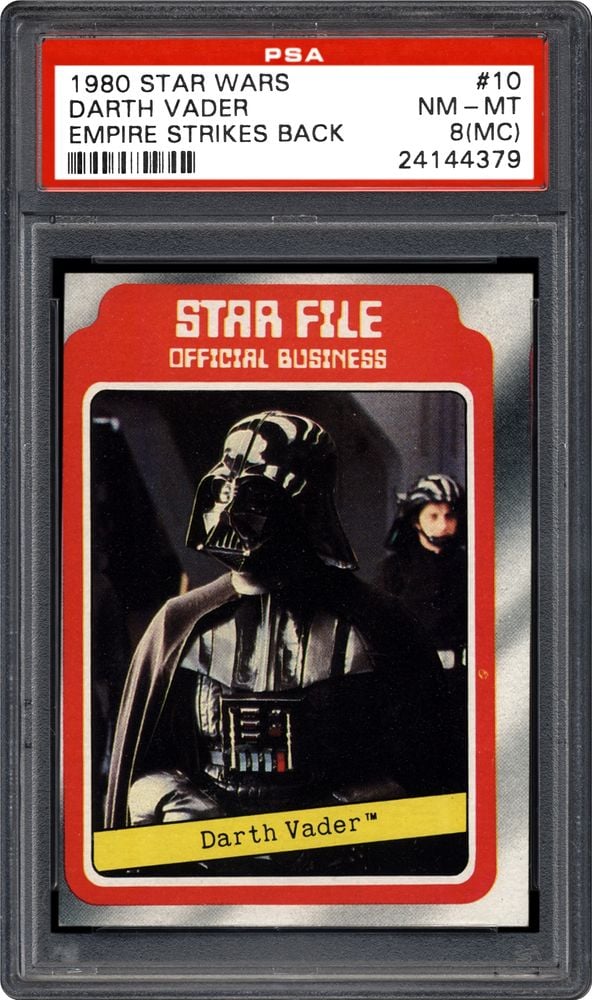
PSA also qualifies copies of this card, and those live outside the totals above. Eight copies carry a qualifier — two at PSA 7, three at PSA 8 and three at PSA 9 — which PSA reports in a separate qualified total rather than folding into the straight grades. That is why the slab pictured here, a 1980 Star Wars #10 Darth Vader in NM-MT 8, is labelled 8(MC): the MC is PSA's code for a miscut, and it means this example is one of the card's three qualified eights rather than one of the 84 straight ones. The same distinction applies a grade up, where three qualified nines sit beside the 25 clean ones. Count qualified copies with the straight grades and the card's nine population moves from 25 to 28.
The half-grade column is close to empty: two copies in total, one at PSA 8.5 and one at 6.5. The card's weight sits almost entirely in the 7 and 8 grades, and the extremes are single copies or close to it.
Added together, the card accounts for 307 graded copies: 297 straight grades, the two half grades and the eight qualified ones. The 7 and the 8 hold 171 of them, or 55.7% of everything submitted, and each of those two rows is more than three times the size of the PSA 9 row.
The scan PSA carries for this card is a graded example rather than a raw one: its label reads 1980 Star Wars #10 Darth Vader, NM-MT 8, with cert number 24144379. The card's front is a red-bordered design with a STAR FILE / OFFICIAL BUSINESS banner above a dark photograph of Vader, his name printed along a yellow bar at the foot of the frame. It is also the only scan PSA publishes on the card's CardFacts entry.
What the numbers describe is a single-copy ceiling. A collector who wants a Vader 10 from this set is not choosing between examples or waiting for a better one; there is one, it has been accounted for, and the next best thing is a nine, of which there are 25. Topps built the set around a film that has now been in circulation for 46 years, and the graded population still carries exactly one copy with nothing above it.
One gem mint, 25 nines, and a curve that spends its weight on PSA 7 — the Vader card is not scarce in a way that rewards patience. It is scarce in a way that only allows one buyer to hold the top of the pop.