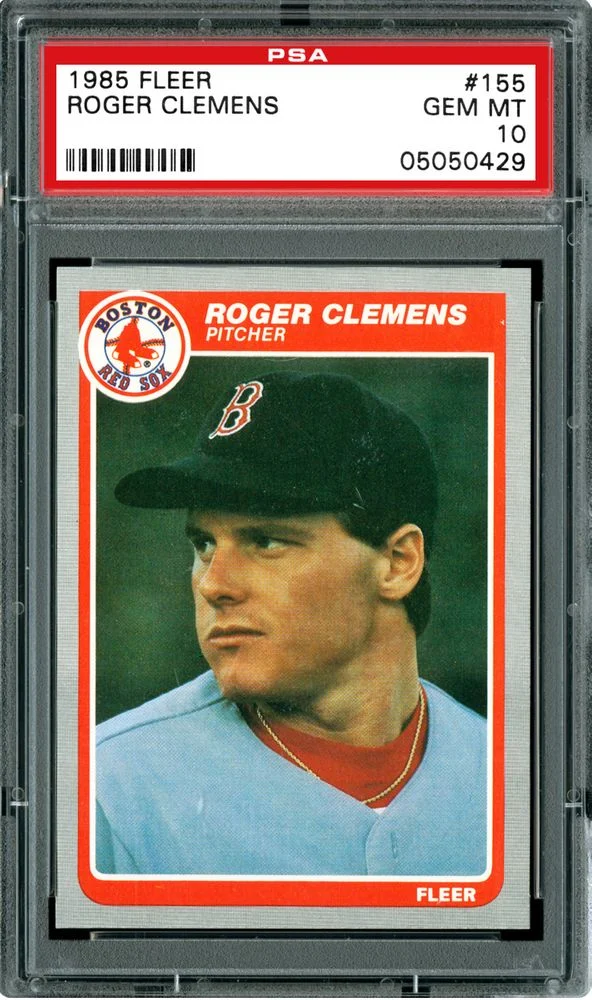
1985 Fleer #155 Roger Clemens RC — The Rocket\'s Defining Rookie Card
In the pantheon of baseball rookie cards from the 1980s, few carry the weight — or the condition sensitivity — of the 1985 Fleer #155 Roger Clemens. It's the card of a pitcher who redefined what dominance looked like on a baseball diamond, captured in a set notorious for print quality that makes high-grade examples genuinely scarce three decades later.
Roger Clemens burst onto the scene in 1984 with a 9-4 rookie campaign for the Boston Red Sox, but 1985 was the year the league learned his name. He struck out 231 batters over 240 innings, posted a 3.29 ERA across 39 starts, and established himself as the most feared right-handed pitcher in the American League. The following season, he would win the first of his seven Cy Young Awards — and the only MVP award of his career — with a 24-4 record and a 1.93 ERA that remains one of the single greatest pitching seasons in modern baseball history.
The 1985 Fleer set occupies a curious place in hobby history. It's not the most aesthetically celebrated design of the decade — that honor belongs to 1983 Topps or 1987 Topps — but it's among the most condition-sensitive major sets ever produced. Fleer's print quality in the mid-1980s was notoriously inconsistent: centering varies wildly card to card, print lines are common, and the card stock's susceptibility to corner wear means that even pack-fresh examples often present at PSA 8 or lower. A PSA 10 of any key card from this set is a genuine achievement.
Clemens's rookie card is the set's marquee attraction, and the population data tells the story of its scarcity in high grade. Out of 7,578 total graded examples, only 188 have earned the PSA 10 designation — a gem mint rate of just 2.48%. That's strikingly low for a mid-1980s card, especially when compared to contemporaries like the 1984 Topps Don Mattingly RC or 1986 Topps Jose Canseco RC, which gem at significantly higher rates. The supply of PSA 9s is more robust at 2,105 examples, but even that number understates the difficulty of finding a well-centered, clean copy in the wild.
Market values reflect this scarcity hierarchy. PSA 10 examples command approximately $800, a premium that has held steady as the market has matured. PSA 9s trade in the $70 range, while PSA 8s settle around $25. The jump from PSA 9 to PSA 10 — roughly 11x — underscores just how difficult the 1985 Fleer set is to gem. For comparison, many of Clemens's contemporaries from Topps sets of the same era show a 3-4x multiplier between 9 and 10. The 1985 Fleer premium is real, and it's entirely driven by the set's production quality.
PSA Population Report
| PSA Grade | Population | Value |
|---|---|---|
| PSA 10 | 188 | $800 |
| PSA 9 | 2,105 | $70 |
| PSA 8 | 3,640 | $25 |
| Total Graded (All Grades) | 7,578 | — |
* Population data as of June 15, 2026.
The Rocket's career arc — seven Cy Young Awards, 4,672 strikeouts, 354 wins, two World Series rings, and one of the most controversial Hall of Fame debates in baseball history — gives his rookie card a narrative complexity that fuels enduring collector interest. Clemens's story includes both the unparalleled dominance of his prime (that 20-strikeout game against the Mariners in 1986, the two Cy Young Awards in his age-40 season with the Astros) and the performance-enhancing drug allegations that have kept him out of Cooperstown on all but the Veterans Committee ballot. That tension — between the numbers that scream "first-ballot immortal" and the off-field questions that have divided the baseball world — makes his rookie card a collectible that exists at the intersection of statistical achievement and historical debate.
For collectors building a 1980s rookie card run, the 1985 Fleer Clemens is a necessary piece alongside the 1984 Topps Mattingly, the 1986 Fleer Jordan, and the 1987 Topps McGwire. But unlike those cards, the Clemens presents a genuine grading challenge that few have conquered. A PSA 10 Clemens isn't just a nice card — it's a statement piece that fewer than 200 people in the world can claim to own.
At $800 for a PSA 10 and $70 for a PSA 9, the 1985 Fleer Roger Clemens offers one of the better bargains in the Hall of Fame pitcher rookie market — especially when you consider that the card's scarcity in high grade is driven by production quality, not lack of collector interest. The Rocket's rookie remains a defining card of the mid-1980s boom, and its population data suggests it will only get harder to find in top condition with each passing year.