The 1989 Griffey Rookie Is the First Card to Pass 200,000 Graded Copies — and PSA Alone Holds About Two-Thirds of Them
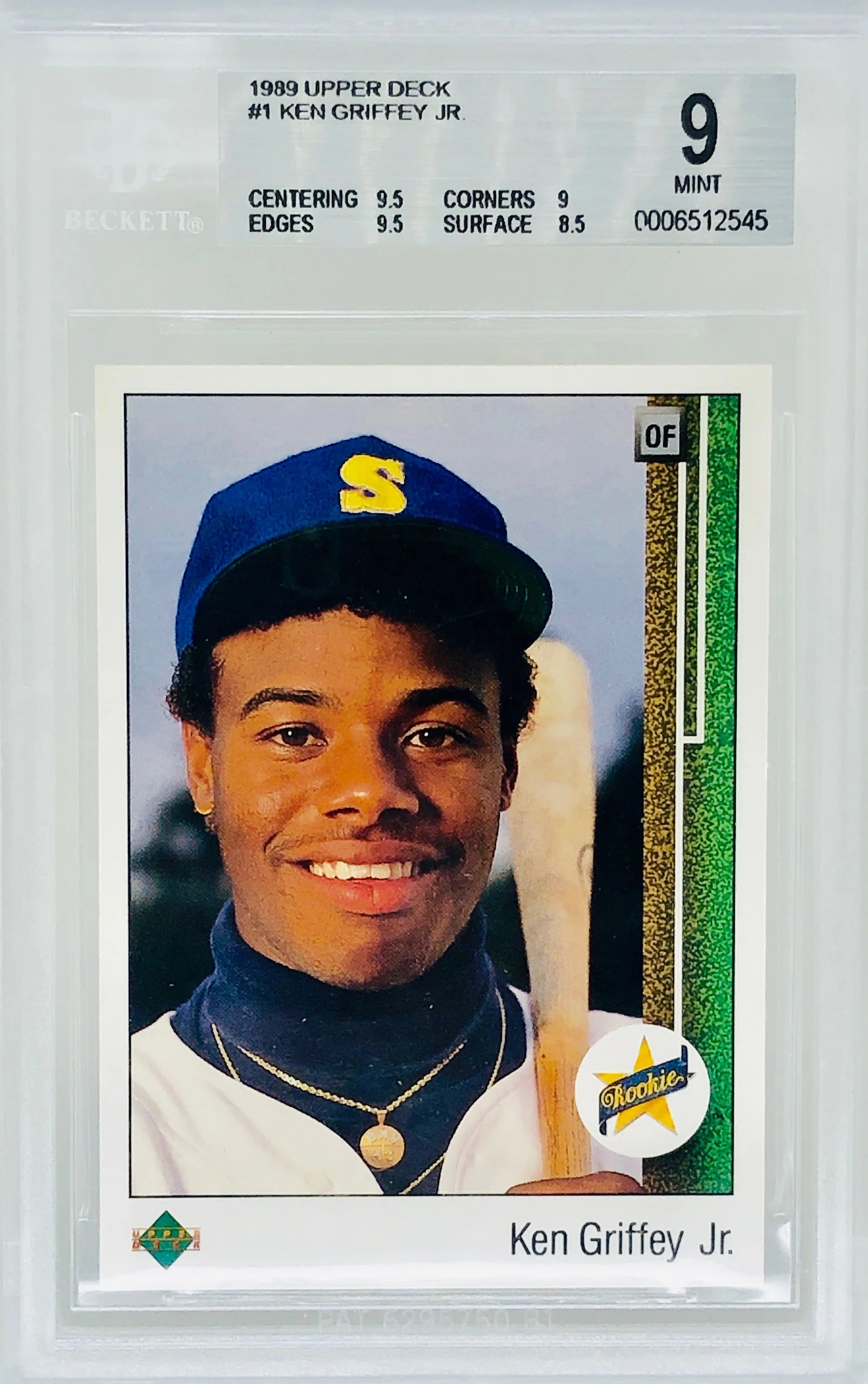
The 1989 Upper Deck Ken Griffey Jr. rookie is the first trading card ever to pass 200,000 graded copies. Collector Nation reported the milestone on September 16, and framed it the way the number deserves: no card in any sport, and nothing in the Pokémon or wider trading-card world, had previously reached that population.
The outlet is also explicit about what the figure is. It counts graded copies across population reports as a whole, and it is not broken down by grading company. Nobody covering the milestone itemises it. One company's share, though, is public and pullable on demand.
PSA's Share, Pulled Today
This blog pulled PSA's CardFacts population record for the card (CardFacts ID 39836) on September 16, 2026. PSA's count:
- PSA 10: 4,251
- PSA 9: 33,845
- PSA 8: 47,342
- All straight grades: 130,393 — a total that includes 208 copies slabbed Authentic
- Half grades: 919 · Qualified grades: 853
PSA counts those three buckets separately, so they add rather than overlap. Together they put 132,165 PSA slabs of this one card in the world.
Against a 200,000 threshold, that is roughly two-thirds — and it is a ceiling, not a fixed share. The milestone says the cross-company total has passed 200,000, not that it stopped there, so PSA's real proportion is at most 66% and shrinks as the true figure climbs above the line. Every other grading company in the hobby is dividing the remaining third.
The Shape of 130,000 Slabs
The distribution explains why this card can be simultaneously the most-graded object in the hobby and a difficult card to own at the top. The PSA 8 is the single most common outcome at 47,342 copies — better than a third of every straight grade PSA has assigned it. Add the nines and those two grades alone account for 81,187 slabs, 62% of the straight-grade population. The PSA 10 is 4,251 of them, a gem rate of 3.26%.
Underneath the eight the counts fall away quickly: 16,637 sevens, 15,101 sixes, 8,072 fives, and 4,937 copies spread across every grade from the four down to the one. A card printed in quantities nobody has ever credibly counted has produced fewer than 4,300 PSA 10s in thirty-seven years.
What Changed Since June
This blog has its own dated reading of the same endpoint. CASE #0004 recorded PSA's figures as of June 13, 2026: 4,245 PSA 10s, 33,610 nines, 46,616 eights, and 127,514 straight grades in all.
Ninety-five days later, PSA's straight-grade count for the card is up 2,879 — an average of about thirty copies a day, for a card that came out of packs in 1989. Of that increase, 726 landed at the PSA 8 and 235 at the nine. The remaining 1,912 came in below the eight, or as Authentic.
Six were PSA 10s.
Analysis: Six gems inside an increase of 2,879 is a rate of 0.2%, against the 3.26% this card has gemmed at over its lifetime. Two cautions belong on that comparison: a net change in a population report is not a count of submissions, because copies can be regraded or removed, and the blog can see only what was graded, never what was sent. What survives both cautions is the direction. The bulk of this population is still growing at pace while the top of it has effectively stopped moving, which is what a picked-over raw pool looks like from the outside.
Why the Split Matters
A 200,000-copy threshold is a hobby-wide fact, and it belongs to the card rather than to any one grader. But the thing that makes it reachable is visible in the split: a single company has slabbed something close to two-thirds of them, at a pace that left this blog's own June pull 2,879 copies out of date inside a single summer.
Analysis: The missing company breakdown is not a small omission. "200,000 graded copies" invites a reader to picture one population report. What it describes is several companies' ledgers — different standards, different half-grade conventions, different qualifier rules — stacked into a single number. PSA's own count is already disjoint internally, with straight, half and qualified grades kept as three separate totals rather than one. A cross-company figure inherits every one of those seams before it inherits anything else.
The milestone is real and the card earned it. The number worth carrying around underneath it is 132,165 — what one company has slabbed, on a day somebody went and looked.
Confidence note: The 200,000-copy milestone, its first-ever status and the absence of a company-by-company breakdown are reported by Collector Nation (September 16, 2026). Every PSA figure in this article was pulled from PSA's CardFacts population record for CardFacts ID 39836 on September 16, 2026. The June 13, 2026 comparison figures are this blog's own, as published in CASE #0004. Passages labelled Analysis are the blog's interpretation of that data, not findings in either source.