1990 Score Supplemental #65T Junior Seau — 295 Gems, 186 Eights, and a Population Shaped Upside Down
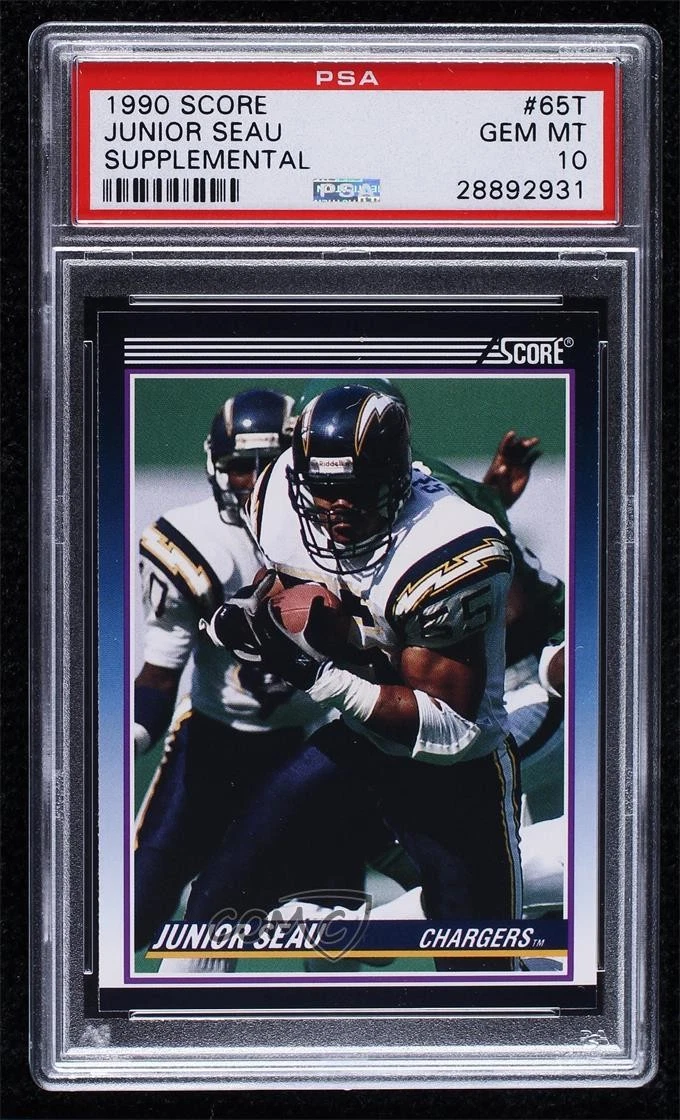
The slab pictured above is one of 295. PSA cert 40739430, graded GEM MT 10, its label reading 1990 SCORE SUPPLEMENTAL · JUNIOR SEAU · #65T.
Now look at the rest of the population, because this card's grade distribution is upside down. There are more perfect copies of it than there are NM-MT 8s. That almost never happens.
The Player
Junior Seau was born in San Diego on January 19, 1969, and in 1990 the San Diego Chargers took him fifth overall. A hometown linebacker playing for the hometown team, and he became the best defensive player the franchise ever had.
Per the Pro Football Hall of Fame's own record: eight All-Pro selections, 12 Pro Bowls, 56.5 sacks, 18 interceptions, and 10 or more tackles in a game 64 times. He was named NFL Defensive Player of the Year in 1992 by UPI and Football Digest. He led the Chargers in sacks in 1996 and 1997, was the club's leading tackler eight times, and was voted the team's Most Valuable Player six times. In 1994 he carried San Diego to the only Super Bowl appearance in franchise history. He made the NFL's All-Decade Team of the 1990s.
He played 268 games across 20 seasons — the Chargers from 1990 to 2002, the Dolphins in 2004 and 2005, the Patriots from 2007 to 2009, reaching another Super Bowl in New England. He died on May 2, 2012, at 43. He was elected to the Hall of Fame on the eve of Super Bowl XLIX and enshrined in Canton on August 8, 2015.
The Card
Card #65T comes from the 1990 Score update release — the same set that produced the Emmitt Smith #101T rookie this blog examined in CASE #0130. It was distributed through Score's dealer outlets and sold only as a complete set, and the "T" suffix on the card backs is what gives the checklist its numbering.
The photograph is an unusual one for a linebacker: Seau in the Chargers' white jersey, 55 across the front, the gold-and-navy lightning bolt on his shoulder and helmet, the football tucked under his arm and a green-jerseyed opponent's hand reaching in from behind. Score framed it in a thin magenta line inside a blue-to-black gradient, set the SCORE logo in the top right, and ran a gold-underlined banner along the bottom reading JUNIOR SEAU and CHARGERS.
The set answers to two names. PSA files it as 1990 Score Supplemental; the Trading Card Database files the identical cards as 1990 Score Rookie & Traded, where the entry reads 65T Junior Seau San Diego Chargers. Same cardboard, two catalog names — worth knowing before you go looking for it.
PSA Population Report
| PSA Grade | Population |
|---|---|
| GEM-MT 10 | 295 |
| MINT 9 | 500 |
| NM-MT 8 | 186 |
| Total Graded (All Grades) | 1,004 |
* Population data as of August 21, 2026. PSA population counts are dynamic and increase as more cards are submitted for grading.
Read The Table From The Bottom
A normal graded population is a pyramid. Most submissions land in the middle, fewer reach the top, and the number of perfect copies is the smallest figure on the page. This one inverts: 295 tens against 186 eights. There are 59% more perfect copies of this card than there are NM-MT 8s.
The card that shares its checklist shows what the normal shape looks like. The Emmitt Smith #101T, from the same set, the same year, the same sealed dealer product:
- Seau #65T: 1,004 graded — 295 tens, 500 nines, 186 eights. Gem rate 29.4%.
- Smith #101T: 12,009 graded — 803 tens, 5,422 nines, 5,139 eights. Gem rate 6.7%.
Twelve times as many people sent in the Smith card, and it comes back perfect less than a quarter as often.
Analysis: The two cards were printed together, so it is unlikely the cardboard itself differs that much. What differs is who got submitted. A population of 12,009 is what happens when collectors send in everything — the whole box, sight barely checked. A population of 1,004 is what happens when they send in only the copies they have already inspected and believe are flawless. The first process produces a pyramid because it grades the full range of what was printed. The second produces an inverted one because the mediocre copies never left the closet. Seau's 29.4% gem rate is not evidence that this card was printed better than Smith's; it is evidence that it was filtered before it ever reached PSA. That is our reading of the two distributions, not a finding published by PSA.
One more detail from comparing the pulls. When CASE #0130 published on June 29, the Smith card stood at 11,947 graded with 803 tens. Seven weeks later it has absorbed 62 more submissions — and it still has 803 tens. Not one of those 62 came back perfect.
Nine Cards, One Rookie Year
Seau's rookie season produced at least nine different cards. The Trading Card Database lists him in 1990 Score, 1990 Score Rookie & Traded, 1990 Topps, 1990 Topps Traded, 1990 Topps Collector's Edition (Tiffany), 1990 Pro Set, 1990 Fleer Update, 1990 Action Packed Rookie/Update, and 1990 Asher Candy Stars 'n Stripes.
This is the junk wax era doing what it did to everyone who arrived in it. A player can be a Hall of Famer, a twelve-time Pro Bowler and the defining figure in his franchise's history, and still have no rookie card that collectors agree is the one. Attention that would have concentrated on a single piece of cardboard in 1958 or 1978 gets split nine ways in 1990.
What survives that split is a card with a genuinely small graded footprint. A thousand copies in PSA holders, across thirty-six years, for a player of this stature is a modest number — the Tony Dorsett rookie in CASE #0264 has 5,715, and the Smith card from this very set has twelve times as many.
Verdict: the best defensive player San Diego ever had, on a card that grades beautifully because almost nobody bothered to submit a bad one. Misdemeanor — the card did nothing wrong; 1990 printed eight more of it.