1999 Pokémon #4 Charizard 1st Edition — 123 PSA 10s in 5,375, and the Scarcest Print Grades the Cleanest
PSA has assigned a straight grade to 5,375 copies of the 1999 1st Edition Charizard, and 123 of them came back Gem Mint 10. The same grader has handled the Unlimited printing of the identical card 102,437 times — and the scarcer card is the one that grades clean.
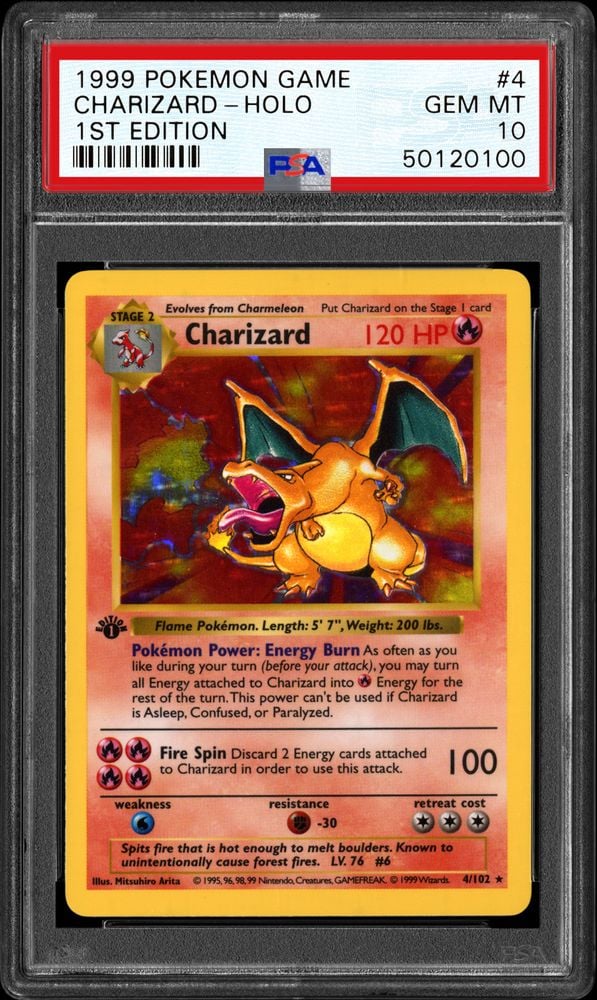
Card 4 of 102 in the 1999 Base Set, listed by the Trading Card Database in its 1999 Pokémon Base Set 1st Edition checklist as "4/102 Charizard Rare Holo." PSA files it as the 1999 Pokémon Game #4 CHARIZARD-HOLO, variety 1ST EDITION. It is a Stage 2 card that evolves from Charmeleon, 120 HP, illustrated by Mitsuhiro Arita, carrying the Pokémon Power "Energy Burn" and a Fire Spin attack for 100 damage. Weakness water, resistance fighting at -30, retreat cost three. The flavour line at the bottom reads that it spits fire hot enough to melt boulders.
The thing that makes it this card rather than one of its two siblings is a black stamp roughly a quarter-inch tall, set below the left edge of the artwork. Everything else on the front is identical across all three printings.
PSA Population Report
| PSA Grade | Population | Value |
|---|---|---|
| PSA 10 | 123 | $181,900 |
| PSA 9 | 729 | $17,700 |
| PSA 8 | 715 | $10,600 |
| Total Graded (All Grades) | 5,375 | — |
* Population data as of August 31, 2026. PSA population counts are dynamic and increase as more cards are submitted for grading.
The Curve Peaks at PSA 6
That 5,375 counts full straight grades only. PSA has slabbed another 225 half-grade copies and 14 qualified ones, which puts 5,614 1st Edition Charizards in PSA holders all told.
Read the straight grades from the bottom and the shape is not the one a $181,900 guide value suggests. There are 214 copies at PSA 1, 244 at 2, 448 at 3, 619 at 4, 782 at 5, and then the single largest bucket on the card — 847 copies at PSA 6. From there it falls: 607 at 7, 715 at 8, 729 at 9, and 123 at the top. A further 47 copies carry no numeric grade at all, having come back Authentic.
Counting the Authentic slabs, 2,354 of the 5,375 straight-graded copies — roughly 44 percent — sit at PSA 5 or below. Copies at 9 or 10 account for 852, just under 16 percent.
Analysis: That is the population profile of a card that was opened, sleeved badly or not at all, played with, and submitted decades later by owners who already knew what it was worth. The mode sitting at 6 rather than at 8 or 9 is what separates a 1999 chase card from a modern one. PSA publishes the counts and the grades; it does not publish a reason, and nothing in the data supplies one.
The Two Cards Either Side of It
PSA's own catalogue numbers the three Base Set Charizard printings consecutively, which makes the comparison unusually clean: the same artwork, the same year, the same grading standard, separated only by print run.
The Unlimited printing is the common one. PSA has straight-graded it 102,437 times and returned 489 Gem Mint 10s, 8,468 nines and 16,202 eights. The Shadowless printing has 14,189 straight grades, 58 tens, 849 nines and 1,502 eights. The 1st Edition has the smallest population of the three at 5,375, and the second-most PSA 10s in raw count.
As a rate, the gap is wider than the raw counts show. The 1st Edition returns a 10 on 2.29 percent of its straight-graded copies. Shadowless returns one on 0.41 percent, Unlimited on 0.48 percent. The scarcest of the three printings is between four and six times likelier to come back Gem Mint than either of the others.
PSA's Price Guide runs in the same direction and further. It carries the 1st Edition PSA 10 at $181,900, the Shadowless PSA 10 at $120,000 and the Unlimited PSA 10 at $10,000. At PSA 9 the same three read $17,700, $12,000 and $800. These are guide values published by PSA — its own read of the market, not completed sales anyone can point to.
Analysis: A scarcer card grading better than a common one inverts the usual expectation, and the likeliest explanation is not that the cardboard was different. It is that the three printings were never handled by the same people. The 1st Edition stamp marked a card as special in 1999, before anybody had graded anything; the Unlimited run went into the hands of children by the hundred thousand. What PSA's population is measuring across these three rows may be less about print quality than about what owners did with the cards in the months after the packs were opened. The data establish the gap; they do not establish the cause.
What the Archive Already Said About This Card
CASE #0015 tracked a first-edition Charizard from roughly $10,000 in 2020 to north of $200,000 by late 2025, on Wall Street Journal reporting of returns above 3,000 percent across a five-year window in select Pokémon cards. That case also flagged the risk: a wave of anniversary reprints fragmenting collector money across too many versions of the same picture.
Eighteen months on, PSA's guide for the 1st Edition 10 stands at $181,900 and its population at 123. The reprints multiplied. The number of 1999 copies that can still earn a 10 did not.
The slab pictured above is one of those 123 — PSA certification 50120100, graded Gem Mint 10.
The verdict: 5,375 straight grades, 44 percent of them at PSA 5 or below, and a population curve that peaks two grades under mint. The 1st Edition Charizard is not scarce because it was printed in small numbers — 5,614 slabs is not scarce. It is scarce at the top, where 123 copies out of every printing, stamp and holder PSA has ever seen carry a 10.