1957 Topps #119 Bart Starr RC — Zero PSA 10s, Three PSA 9s, and a $288,000 Cliff
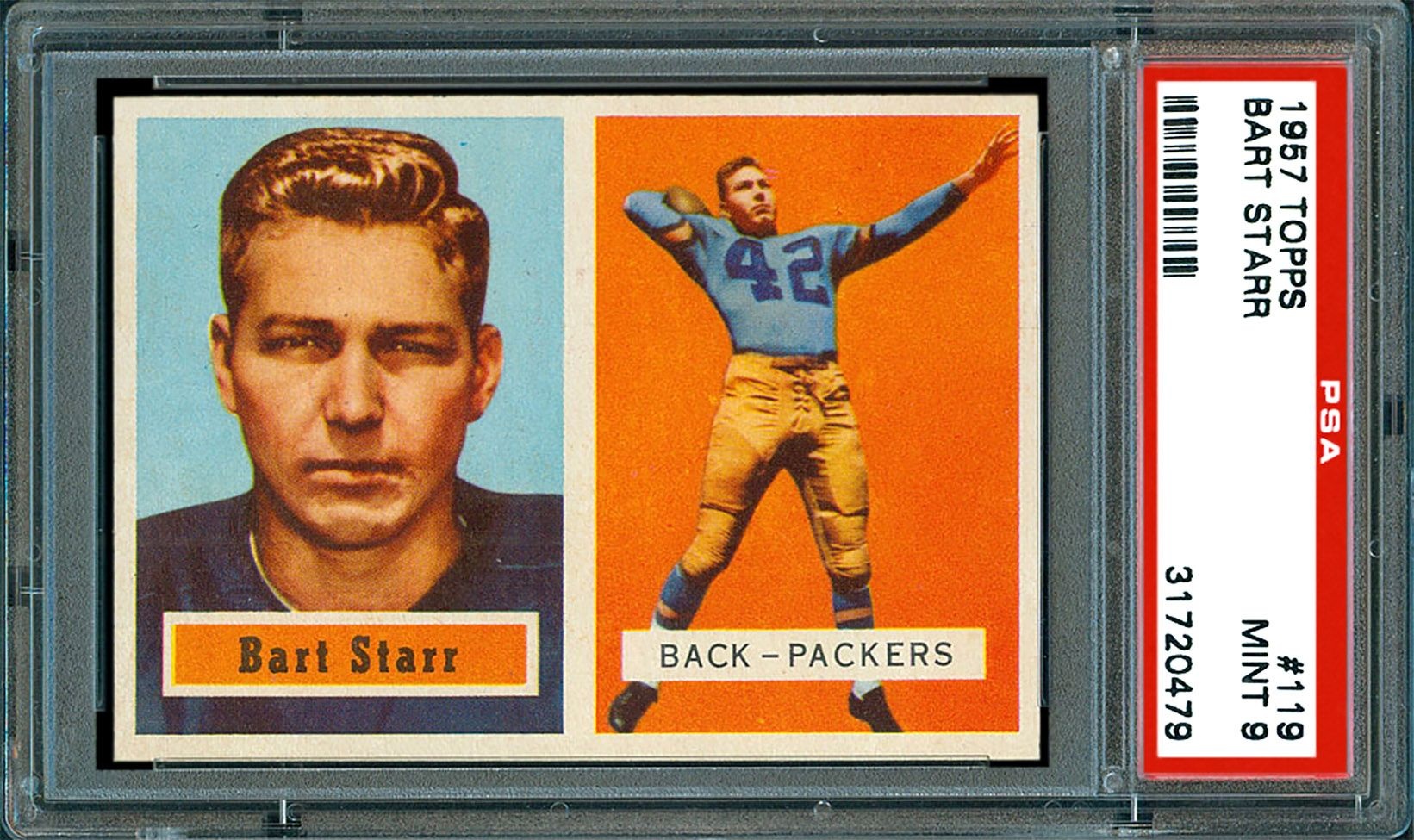
The card pictured above is one of the three best Bart Starr rookies on Earth. The slab reads 1957 TOPPS #119, BART STARR, MINT 9, cert 31720479 — and PSA's population report says only three copies have ever reached that grade. Above it there is nothing at all. In sixty-nine years, PSA has never awarded a single GEM-MT 10.
Starr's rookie card is the split-panel 1957 Topps design: a portrait on pale blue at left under an orange nameplate, an action photo on burnt orange at right beneath a white "BACK — PACKERS" banner. TCDB's 1957 Topps checklist lists card 119 as Bart Starr, rookie card, short print, Green Bay Packers.
PSA Population Report
| PSA Grade | Population | Value |
|---|---|---|
| PSA 10 | 0 | — |
| PSA 9 | 3 | $288,000 |
| PSA 8 | 95 | $12,400 |
| Total Graded (All Grades) | 2,282 | — |
* Population data as of August 18, 2026.
A 23× Cliff at the Top
Most vintage cards get more expensive as the grade climbs. This one falls off a ledge. PSA's Price Guide puts the PSA 8 at $12,400 and the PSA 9 at $288,000 — a 23-fold jump across a single grade. The half-step between them, NM-MT+ 8.5, carries $30,000, which means the real cliff sits in the final increment: 8.5 to 9 alone is a 9.6× move.
Below that the ladder is almost gentle by comparison — $4,650 at NM+ 7.5, $3,450 at NM 7, $1,825 at EX-MT 6, $1,350 at EX 5. A collector can own a perfectly presentable Bart Starr rookie for the price of a decent modern parallel. The gap between "presentable" and "one of three" is where the money went.
That shape is what a hard population ceiling does to a price. When the top grade is empty and the one below it holds three cards, there is no supply to absorb demand, and the guide number stops describing a market and starts describing an auction of last resort.
Where It Sits in the Archive
Zero-PSA-10 vintage is not rare on this beat — 15 of the 89 cards this blog has profiled with population data have never produced a gem. What separates Starr is the thinness of the tier below the empty one. Re-derived from our own records:
- 1957 Topps Bart Starr — 0 tens, 3 nines, 2,282 graded
- 1965 Topps Joe Namath RC (CASE #0072) — 0 tens, 5 nines, 1,821 graded
- 1962 Topps Fran Tarkenton RC (CASE #0195) — 0 tens, 6 nines, 1,820 graded
- 1958 Topps Jim Brown RC (CASE #0065) — 0 tens, 6 nines, 5,160 graded
Three is the smallest top-tier count among the zero-gem football rookies in this archive. As a share of population, Jim Brown's rookie is fractionally tighter — six nines against a much larger 5,160 submissions — so Starr's distinction is the raw count, not the percentage. Either way, the practical position is the same: a collector who wants the best available Bart Starr rookie is bidding against two other people in the world, and only when one of them decides to sell.
Why 1957 Topps Fights Back
The design does its owner no favors. A dark portrait panel butted against a white border shows every touch of wear at the edge, and the bold orange field makes centering errors obvious at a glance. Add the short-print status TCDB records for #119 and a print run aimed at children in 1957, and 2,282 submissions producing exactly three Mint 9s starts to look less like bad luck than arithmetic.
The verdict: the quarterback who won the first two Super Bowls has a rookie card that has never once been called perfect — and the three copies that came closest are effectively out of circulation.