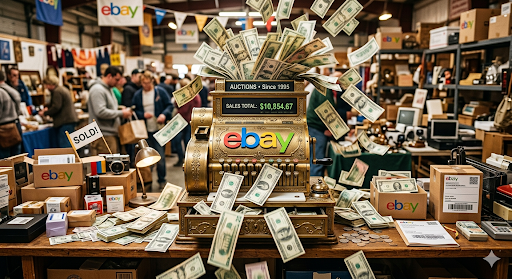
The eBay Tax: What Every Card Seller Is Really Paying
Every time you sell a card on eBay, you're writing a check. The question is: do you know how much?
Between final value fees, managed payment holds, authentication program detours, and the looming IRS 1099-K threshold, the actual cost of selling a sports card online has quietly grown into something that deserves a closer look. This isn't about complaining about fees — it's about understanding where your money actually goes so you can price your cards intelligently.
Cardboard Police pulled the receipts. Here's what sellers are actually paying.
Final Value Fees: The 13.25% Bite
eBay's standard final value fee for trading cards sits at 13.25% of the total sale amount — that's the final sale price plus shipping and any applicable taxes. For a $100 card, eBay keeps $13.25 before you see a dime.
Above the $7,500 mark, the formula shifts: 13.25% on the first $7,500, then 2.35% on everything beyond that. A $10,000 sale costs you $993.75 in fees on the first $7,500, plus $58.75 on the remaining $2,500 — totaling $1,052.50. That's a meaningful break for high-end cards, but it only kicks in well above the range where most collectors operate.
Insertion fees were eliminated for most sellers years ago, so listing a card costs nothing upfront. The bite comes at the sale.
Promoted listings add another layer: an optional ad rate (typically 2% to 10% of the sale price) on top of the final value fee. If you promote a $200 card at a 5% ad rate and it sells, you owe eBay $13.25 (final value) plus $10 (promotion) — $23.25 on a $200 sale. Over 11% of what you thought you were getting.
The Authenticity Guarantee Toll
eBay's Authenticity Guarantee for trading cards sounds like a buyer protection feature — and it is. But sellers need to understand how it affects their timeline and risk.
Cards valued at $250+ graded or $500+ raw are routed through an independent authenticator (CGC, CSG, or similar) before reaching the buyer. The seller ships the card to the authenticator, not the buyer. The authenticator verifies it, then forwards it to the buyer. The fee for this service is baked into the 13.25% final value fee — you're already paying for it whether your card qualifies or not.
The hidden cost here is time and risk. Your card spends extra days in transit to and from the authenticator. If the authenticator flags your card — even incorrectly — the sale is canceled, the buyer is refunded, and you get the card back. You're out the shipping costs, the time, and potentially the sale. There is no seller protection payment for a canceled authentication, no matter how clean the card was when it left your hands.
For raw cards sent through authentication, there's an additional risk: the authenticator's grade may not match your description. List a card as "Near Mint-Mint" and the authenticator calls it "Excellent" — the sale is dead, and you're eating return shipping on a card that now has fewer potential buyers.
Managed Payments: Your Money on a Timer
Since eBay forced all sellers onto managed payments in 2021, payouts have been standardized. For most established sellers, funds are released the next business day after the buyer pays. But "next business day" is a best case:
- New sellers face holds of up to 30 days on payouts
- High-value sales (over $1,500) are often held until tracking confirms delivery plus an additional 24 hours
- Returns freeze the payout entirely until the return window closes or the dispute is resolved
If you sell a card for $2,000 on a Friday and the buyer doesn't receive it until Wednesday, you're looking at a Thursday payout at the earliest — six days after the sale. Meanwhile, eBay has already collected their 13.25%. Your money sits in eBay's account, not yours.
The 1099-K: Uncle Sam Wants His Cut
The IRS 1099-K reporting threshold has been a moving target. Originally scheduled to drop to $600 in 2023, the implementation has seen multiple delays and phase-ins. For the 2026 tax year, the reporting threshold is in flux — but the trend is clear: if you sell more than a few cards a year, the IRS is going to know about it.
Here's what this means in practice: every dollar that comes through eBay — including the shipping you charged the buyer — gets reported as gross revenue. That $100 card you sold? eBay reports $100 (plus whatever the buyer paid in shipping) as income. Your actual profit after accounting for what you paid for the card, supplies, and fees is your responsibility to track and deduct. eBay doesn't do that math for you.
Many casual sellers who list cards from their personal collection are in for a surprise. Selling a card for less than you paid for it isn't taxable income — but you need records to prove it. eBay sends the 1099-K based on gross sales, not profit.
The Real Math
Let's run a realistic example. You sell a card for $500. Here's where the money goes:
- Sale price: $500.00
- eBay final value fee (13.25%): -$66.25
- Shipping (tracked, insured): -$10.00 - $15.00
- Supplies (Mylar bag, top loader, team bag, cardboard): -$2.00
- Total cost to sell: roughly $80
- Net to you: roughly $420
You lost 16% of your sale price before the card even left your hands. And if the buyer claims it never arrived or wasn't as described? You're out the card and the money.

The Bottom Line
eBay remains the largest marketplace for sports cards by a wide margin. That's not changing anytime soon. But the fees, delays, and reporting requirements mean that sellers need to price intentionally. Slap a 13.25% markup on your floor price just to cover the platform fee. Factor in shipping and supplies. Know your cost basis for tax purposes.
The Cardboard Police aren't here to tell you not to sell on eBay. We're here to tell you to know what you're signing up for. The platform takes its cut at every stage of the transaction — the sale, the promotion, the payout, and tax season. The more you understand the cost structure, the less likely you are to get caught off guard by an $80 haircut on a $500 sale.
Sellers, be warned. The fees are the real crime here.