Topps Left 23 of 25 Players' Supernovas Out of Cosmic Chrome Packs. The Way In Now Is an Interstellar Gold /50, One Use per Serial Number
Topps says Supernova inserts for 23 of the 25 players in 2026 Topps Cosmic Chrome Baseball were left out of the product by mistake. Only Aaron Judge and Juan Soto made it into packs. For the other 23, the way to get a Supernova now runs through a numbered gold parallel, and each copy of that parallel can be used only once.
Topps disclosed the error in a statement on its social channels, embedded by Sports Illustrated on Nov. 9. "We recently discovered a production error in 2026 Topps Cosmic Chrome Baseball that resulted in Supernova cards for 23 of the 25 players being inadvertently omitted from the product," the statement read. "We sincerely apologize for this error."
SI's Cole Benz put the practical effect plainly. Collectors who had trouble finding Supernovas in the product, "just released last week," were not running into rarity. For 23 players, there was nothing to find. CollectiblesNews adds that the 23 were left out "despite being included in the published odds."
Why the Supernovas Matter
On their own, the Supernovas would be one more tough insert. Topps made them the entry ticket to its Black Hole program, covered here in CASE #0430. The first collector to gather 10 Supernovas of a single player can claim that player's one-of-one autographed Black Hole card, and there are 25 races, one per player.
Cosmic Chrome guarantees no autographs, SI notes, so the product leans on its inserts as the chase, and this year Topps added the Black Hole race on top. With 23 players' Supernovas absent from packs, 23 of the 25 races could not be run the way they were designed. Topps says the Black Hole program remains active and its rules and prizes are otherwise unchanged, according to CollectiblesNews.
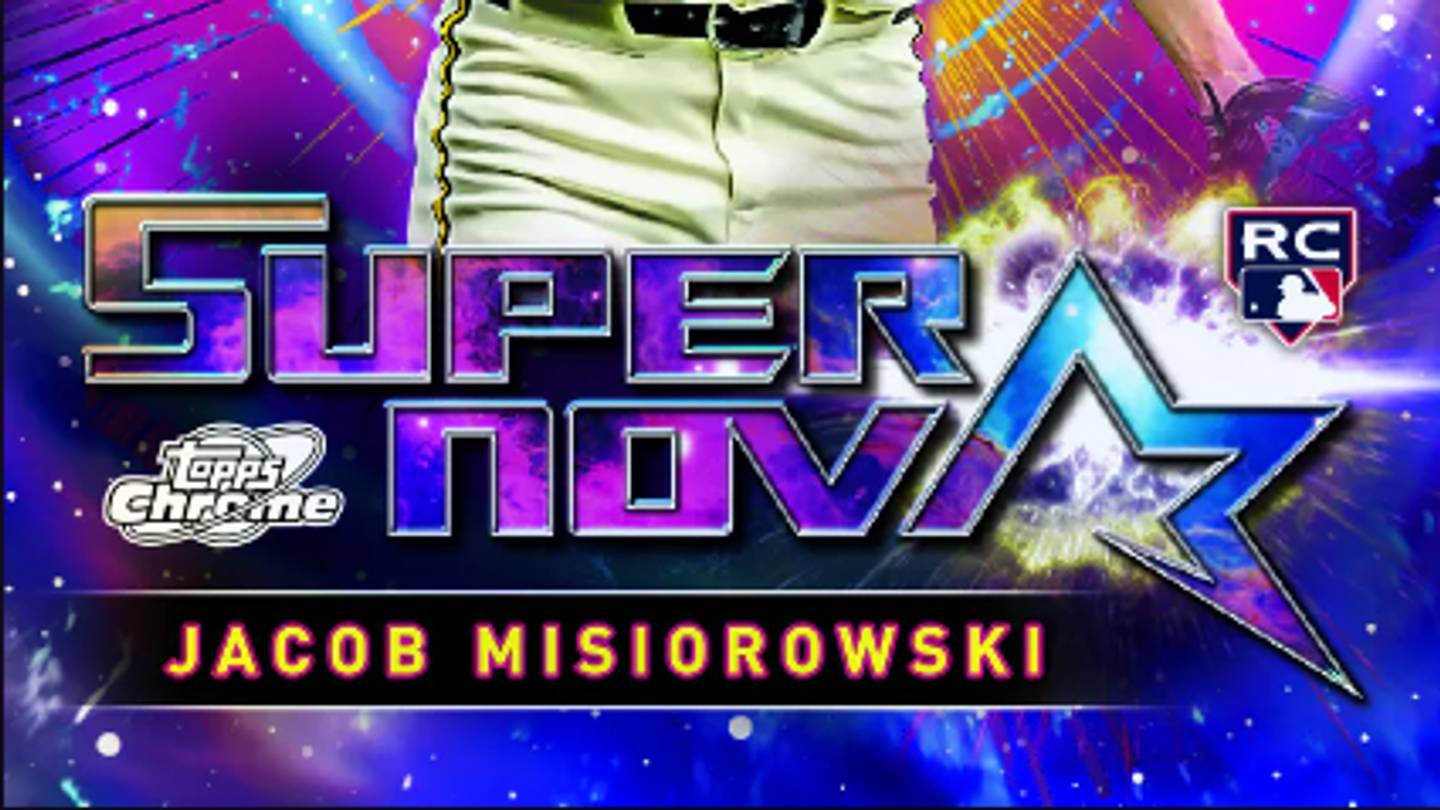
The card pictured at the top of this page, which SI ran with the story, is Jacob Misiorowski's Supernova. Misiorowski is one of the 23 players whose Supernovas never went into packs.
The Gold /50 Route
Topps' remedy is what it calls a Supernova Card Program, which it says "will allow collectors with the eligible Interstellar Gold /50 cards to obtain the corresponding player's Supernova cards."
The steps, as SI and CollectiblesNews describe them, are these. A collector holding an Interstellar Gold parallel numbered to 50 of one of the 23 affected players contacts Fanatics with the player's name, the card's exact serial number, and clear photos of the front and back. After verification, Topps supplies a prepaid shipping label. The collector sends in the Gold card, and it comes back along with one Supernova of the same player.
Two kinds of Gold card do not qualify. Autographed versions of the Gold /50 are excluded, and so are the Judge and Soto Golds, because those two players' Supernovas are already in the product.
One Use per Serial Number
The program also carries a limit. Each Interstellar Gold /50 can be used only once, CollectiblesNews reports, even if the card later changes hands.
Topps has said it will publish which cards are spent. "To provide transparency, the Black Hole program website will identify which numbered Gold /50 cards have already been used to obtain a Supernova card," the company said, as quoted by SI. "We encourage collectors to check this information before purchasing a card for the purpose of participating in the program."
The races themselves are already moving. SI reports that the Black Hole tracker showed one Aaron Judge code redeemed.
Analysis: A used Gold /50 looks exactly like an unused one. Once a serial has produced its Supernova, the card is still a numbered parallel, but it can no longer bring a buyer any closer to a Black Hole autograph. That makes the serial number, checked against Topps' list, part of what a buyer is paying for.
What the Arithmetic Allows
Analysis: One Supernova per serial number caps the program at 50 Supernovas per affected player, and only if every one of that player's Gold /50s turns up and is sent in. A collector chasing a Black Hole card for one of the 23 needs 10 of that player's Supernovas. With packs out of the picture, that means 10 different Gold serial numbers going through the program, whether the collector owns those Gold cards or buys the Supernovas from the people who sent them in.
Analysis: CASE #0430 argued that the code under a Supernova's black peel was the thing a secondary-market buyer had to check, because a used code cannot help anyone else's entry. For 23 of the 25 players there is now a second check before that one: whether the Gold /50 that would produce the Supernova has already been used. Judge and Soto are the only two races still being fed from sealed boxes. For everyone else, the race starts with a list of serial numbers.
Confidence note: The Topps statement, the program terms, the eligibility exclusions, the Topps quote about the Black Hole website and the redeemed Judge code are from Sports Illustrated Collectibles (Cole Benz, Nov. 9, 2026). The one-use-per-card rule, the prepaid label, the "published odds" detail and Topps' statement that the Black Hole rules and prizes are otherwise unchanged are from CollectiblesNews (Matt Johnson, Nov. 9, 2026). OTIA (Nov. 9, 2026) independently reports the omission, the two packed-out players and the program's return of the Gold card. Black Hole program background is from CASE #0430. Passages labeled Analysis are the blog's interpretation. Image: Topps, via SI.