Josh Allen Joins the Million-Dollar Card Club — First NFL Player to Hit Seven Figures Since 2023
An Arizona grandmother walked into a Target, bought a pack of 2018 Panini football cards on a whim, and pulled a card that just sold for $1.35 million — making Josh Allen the first NFL player to reach the million-dollar card milestone since Patrick Mahomes in 2023.
The story sounds like a hobby fairy tale, but the sale is very real, and it signals something profound about where the football card market is heading as the Fanatics era begins and the 2026 NFL season approaches.
The $1.35 Million Josh Allen 1/1
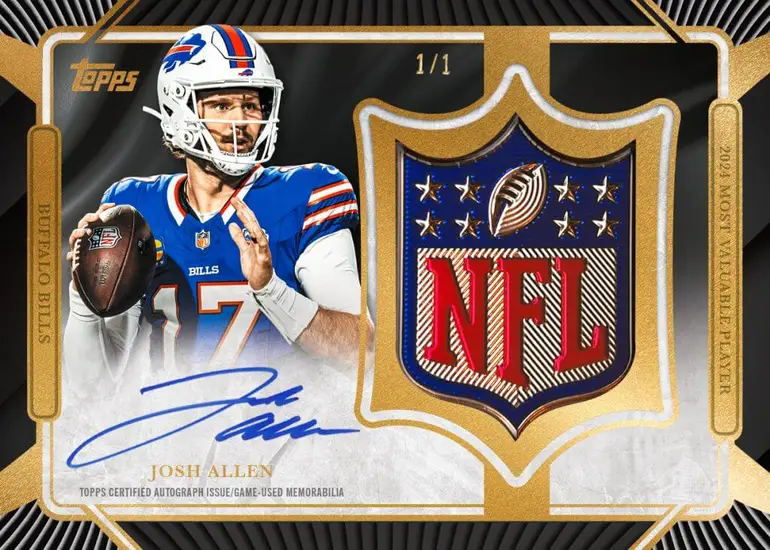
The card in question is a 2018 Panini National Treasures Josh Allen Rookie Patch Autograph, numbered 1/1 — the only copy in existence. Pulled from a retail pack by a casual buyer with no prior collecting experience, the card was graded by PSA and sold through Goldin Auctions for the seven-figure sum.
The sale places Allen in extraordinarily rare company. Only three NFL players have cards that have crossed the million-dollar threshold: Patrick Mahomes (whose 2017 National Treasures 1/1 sold for $1.15M in 2023), Tom Brady (multiple high-end 1/1s in the million-dollar range), and now Josh Allen. For active quarterbacks, it's an even shorter list — just Mahomes and Allen.
Josh Allen's Market Trajectory
When Allen entered the league as the seventh overall pick in 2018, his rookie cards were a fraction of their current value. Despite early accuracy concerns and a rocky first two seasons, Allen's meteoric rise to MVP-caliber play transformed his collectible market.
Key milestones in the Allen card market:
- 2018-2019: Rookie base cards in the $50-100 range, 1/1 patches at $5,000-10,000
- 2020: Breakout season pushes 1/1 values to $50,000+
- 2021: Playoff run and MVP caliber play — 1/1s approach $100,000
- 2023-2024: Consistent elite performance, Buffalo Bills Super Bowl contention
- 2026: $1.35M sale of the National Treasures 1/1 — a tenfold increase in three years
Allen's trajectory mirrors Mahomes' but with a later acceleration. Where Mahomes was an immediate superstar (MVP in his second season as a starter), Allen was a development project who took longer to reach elite status. The delayed curve means his early rookie cards were more widely distributed before demand exploded — potentially making high-grade copies rarer in the long run.
The NFL Million-Dollar Card Club
The NFL has lagged behind the NBA and MLB in generating million-dollar card sales, and the gap tells an important story. Here are the known seven-figure NFL card sales:
- Patrick Mahomes — 2017 National Treasures 1/1 RP: $1.15M (2023)
- Tom Brady — Multiple 1/1s have crossed $1M, including a 2000 Playoff Contenders Championship Ticket
- Josh Allen — 2018 National Treasures 1/1 RP: $1.35M (2026)
By comparison, the NBA has five players with million-dollar cards (Jordan, LeBron, Kobe, Luka, Wembanyama), and MLB has four (Mantle, Ruth, Wagner, Trout). The NFL's shorter list reflects both the smaller football card market and the positional risk premium — quarterbacks dominate value, while running backs and receivers rarely approach seven figures.
What Allen's Record Means for Other QB Cards
The Josh Allen sale creates upward pricing pressure across the entire NFL quarterback market. If Allen — a great but not GOAT-tier quarterback — can command $1.35M for his 1/1, what does that imply for:
- Joe Burrow: Already has multiple high-value 1/1s, but none have crossed $1M. A Super Bowl win changes this instantly.
- Justin Herbert: Same draft class as Burrow, elite stats, but no playoff success yet.
- Lamar Jackson: Two-time MVP, but his rookie cards have lagged behind Mahomes and Allen.
- Caleb Williams / 2024 QB class: Rookie cards are still in their infancy — this sets a ceiling benchmark they can aspire to.
The broader implication is that the NFL quarterback market now has established pricing tiers: Mahomes at the top (Super Bowl wins + MVP), Allen in the second tier (MVP-caliber, deep playoff runs), and the rest of the league below. As the Fanatics/Topps era ramps up production and marketing for NFL products, these tiers could expand rather than contract.
The Fanatics Factor
This sale comes at a pivotal moment for the football card industry. Fanatics has begun rolling out its first Topps-branded NFL products, ending Panini's long dominance of the football card market. The transition period — where Panini licenses wind down and Fanatics ramps up — creates a unique dynamic:
- Panini cards (2014-2025): Will the National Treasures and Flawless lines maintain value after Fanatics takes over? Or does the new regime create a "vintage premium" for Panini-era rookies?
- Topps/Fanatics cards (2025+): First-year NFL products from Topps will carry historical significance as the start of a new era — but production quality and print runs remain unknown.
- Rookie card bifurcation: Allen, Mahomes, and Burrow have Panini-only rookie cards. The 2024-2026 QB classes will have both Panini and Topps rookie cards, splitting the market.
The $1.35M Allen sale suggests that top-tier Panini rookies from the pre-Fanatics era are already being treated as scarce legacy assets. This is rational — you can't pull a new 2018 National Treasures Josh Allen 1/1 ever again. The card is a closed population.
The Grandmother Factor: Why the Story Matters
Beyond the numbers, the human story of this sale is worth examining. An Arizona grandmother bought a pack of cards for fun, pulled a generational card, and became an accidental millionaire. This narrative plays directly into the hobby's most powerful marketing story: that anyone, anywhere, can pull a life-changing card from a retail pack.
These stories matter because they drive new entrants into the hobby. Every viral "grandma pulls 1/1" story puts more eyes on retail shelves, more clicks on breaker streams, and more pressure on already-depleted retail supplies. The timing — just as the NFL season approaches and Fanatics launches its first products — makes this a powerful catalyst for the football card market entering the second half of 2026.
Verdict: The Josh Allen $1.35M sale is a landmark moment for the NFL card market — not because it changes the economics of the hobby, but because it establishes a pricing ceiling that every elite quarterback rookie card now measures against. For a market that has spent years playing catch-up to basketball and baseball, this is the signal that football cards have arrived at the million-dollar table.