Football's $1 Million Card Club Is Almost One Card — Tom Brady's, 22 Times
Thirty-three players across five sports have now had a card sell for at least $1 million publicly. Football's share of that list is, in practical terms, one man holding one card. The Athletic's Larry Holder, working from Card Ladder's sales database, reports that Tom Brady's 2000 Playoff Contenders Championship Rookie Ticket autograph — serial numbered to 100 — accounts for all 22 of Brady's million-dollar sales. Not most of them. All of them.
How Ordinary a Million Has Become
The threshold has stopped meaning what it once did. Holder notes there has been at least one publicly known $1 million card sale in each of the last nine months, and in 12 of the past 13 — with 10 such sales in July and August alone.
It took a long time to get here. The first $1 million card sale came in April 2015, when a 1909 Honus Wagner T206 Sweet Caporal graded PSA 3 sold for $1.32 million. The next one did not arrive until October 2016, when a PSA 5 Wagner brought $3.12 million. A decade later the club adds members in batches: five joined between May and June this year alone — Nikola Jokić, Cristiano Ronaldo, Josh Allen, Victor Wembanyama and Shai Gilgeous-Alexander.
Several of those crossings are already in these files. Wembanyama's $5.11 million rookie was CASE #0012; Shohei Ohtani's $11 million dual Gold Logoman, which Holder places as the third most expensive publicly known sale ever, closed out the bounty chase this blog tracked through CASE #0199 and CASE #0205; and Macklin Celebrini's $1.28 million Young Guns Gold Outburst — the sale that opens Holder's piece — was CASE #0262.
The Football Problem
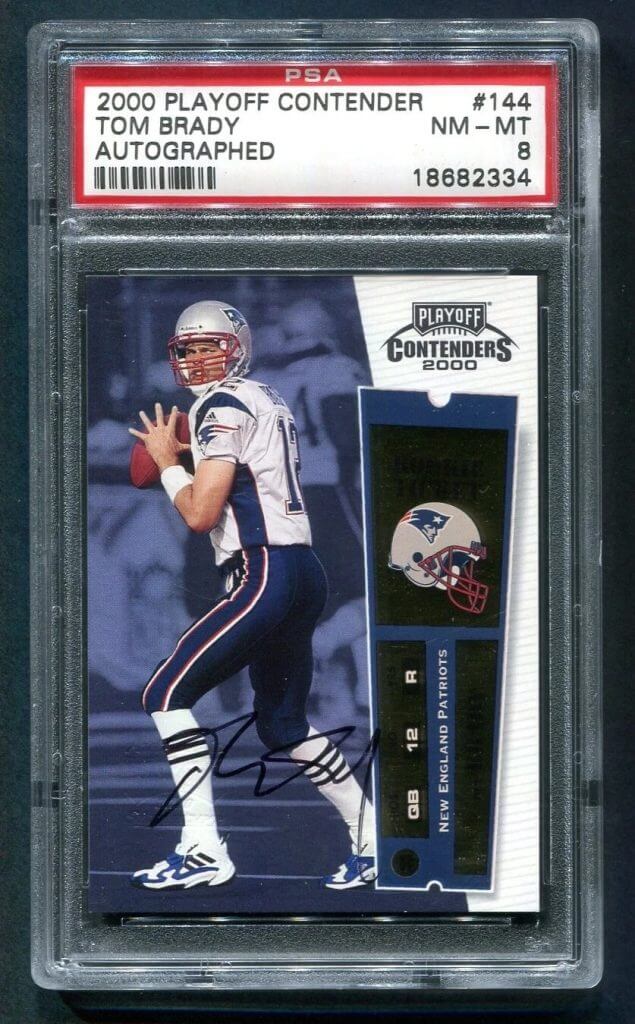
Against that, football looks strange. Brady's 22 entries all come from the same 2000 Playoff Contenders Championship Rookie Ticket. The card is not appreciating in a straight line either: Holder reports the last public sale came in June 2023 at $1.2 million, half what a copy brought in October 2022.
A note on the photograph above, because the distinction is the whole point: it shows a 2000 Playoff Contenders #144 Tom Brady Rookie Ticket autograph in a PSA 8 holder, certification number 18682334. That is the widely available version of the card. The one behind every sale discussed here is the Championship Rookie Ticket parallel, serial numbered to 100 — the same design, a hundredth of the supply.
The only other football names in the neighbourhood arrived oddly. Justin Herbert has two entries, both from September 2022 and within two days of each other — $1.1 million for a 2020 Panini Prizm Black Finite one-of-one graded BGS 9, and $1.8 million for a 2020 Panini National Treasures NFL Shield patch autograph one-of-one at BGS 8.5 with a 10 autograph. Holder's own assessment of those buyers is blunt; he calls them misguided, which is his characterization rather than a market finding. Joe Burrow's single entry has since fallen from $1.7 million to $950,402.52 — out of the club it briefly joined.
Analysis: There is a structural reason a sport with football's audience is thin at this altitude, and it is about supply rather than demand. The seven-figure market rewards one-of-ones, on-card autographs of universally agreed-upon greats, and pre-war scarcity. Football's modern era is dominated by quarterbacks whose signature rookie products are serial-numbered in the dozens or hundreds rather than to one, and its vintage does not carry the cultural weight of a T206 Wagner or a 1952 Mantle. That reading is ours, not Holder's — but the pattern in his own data is hard to miss: the football entry that clears $1 million over and over is the one card that combines a rookie-year autograph, a print run of 100, and the most-decorated career in the sport's history.
Baseball Just Reordered Itself
The list moved again while it was being published. Holder notes that Mickey Mantle only caught Brady in June, when a PSA 8 example of his 1952 Topps card sold for $1.83 million — top-grade copies of it rarely change hands at all. Then, on August 21, another PSA 8 sold for $3.05 million, and Mantle passed him. This blog's own case file on that card is CASE #0023.
Michael Jordan, meanwhile, is not in the top five — which Holder flags as the biggest surprise on the list. He does hold the ceiling: the 2007-08 Upper Deck Exquisite Collection dual NBA Logoman patch autograph one-of-one shared with Kobe Bryant sold for $12.9 million in August 2025, the most expensive publicly known sports card sale ever. The reason Jordan's count is low is supply — per Gem Rate there are 340 PSA 10 copies of his 1986 Fleer rookie, which is not the kind of scarcity that produces repeat seven-figure results.
Bryant has the most varied portfolio, with 12 different million-dollar cards. His best solo result belongs to a card this blog examined only yesterday in CASE #0274: a 1997-98 Metal Universe Precious Metal Gems Green, numbered to 10, graded PSA 5, which sold for $3.15 million in April 2026.
The Club Has No Women in It
Holder closes on an absence worth stating plainly: no women's sports athlete has had a card sell for $1 million. Caitlin Clark is nearest, with two sales above $500,000 last year, topping out at $660,000 for her 2024 Panini Flawless WNBA Logowoman autographed and inscribed one-of-one. Behind her is Serena Williams, whose 2003 NetPro International Series Authentic Apparel rookie patch autograph at PSA 8 with a 10 autograph sold for $266,400 back in May 2022.
Verdict: the million-dollar club is now routine enough to add members monthly, and football's entire standing in it still rests on one quarterback and one 26-year-old card.
Confidence note: the 33-player count, the monthly sale cadence, the 2015 and 2016 Wagner sales, Brady's 22 sales and their single-card source, the Herbert and Burrow figures, the August 21 Mantle sale, the Jordan and Bryant totals, the Gem Rate population of 340, and the Clark and Williams figures are reported by The Athletic (Larry Holder, August 20, 2026), drawing on Card Ladder. Passages marked Analysis are this blog's interpretation, not findings in the source.