1986 Fleer #32 Patrick Ewing RC — The Rookie Card That Arrived a Year Late — Card of the Day
Patrick Ewing's rookie card came out during his second season. That is not a typo, and it is not a quirk of his career — it is a quirk of the industry. By the time Fleer put a Ewing card into a wax pack, he had already been the No. 1 overall pick, already averaged 20.0 points a game, and already won Rookie of the Year. The hobby simply had not been paying attention.
The Card That Arrived a Year Late
Ewing went first overall to the New York Knicks in the 1985 draft after four seasons at Georgetown, where he averaged 15.3 points, 9.2 rebounds and 3.4 blocks per game and carried the Hoyas to the 1984 national title. He won Rookie of the Year in 1985-86 on 20.0 points, 9.0 rebounds and 2.1 blocks a night. The Knicks won 23 games that year and 24 the next, and Ewing kept producing anyway — 21.5 points and 8.8 rebounds in year two, playing alongside fellow future Hall of Famer Bernard King.
None of that generated a mainstream rookie card at the time. Per Beckett, Ewing's first officially licensed NBA card was part of the 1985-86 Star set, which the hobby treats as an extended rookie card, or XRC. His only Rookie Card is this one: 1986 Fleer #32, from the set that reintroduced basketball cards to a market that had largely abandoned them.
It sits in distinguished company. Beckett notes that the only cards in the 1986 Fleer set carrying a higher book value are the rookies of Michael Jordan, Hakeem Olajuwon, Charles Barkley and Karl Malone. Ewing is the fifth name on that list — in a 132-card set.
PSA Population Report
| PSA Grade | Population | Value |
|---|---|---|
| GEM-MT 10 | 163 | $5,750 |
| MINT 9 | 1,853 | $475 |
| NM-MT 8 | 4,115 | $200 |
| Total Graded (All Grades) | 9,902 | — |
* Population data as of August 16, 2026. PSA population counts are dynamic and increase as more cards are submitted for grading.
163 gem copies out of 9,902 submissions is a 1.65% gem rate. Nearly ten thousand people have sent this card to PSA and roughly one in sixty got the grade back.
The Set Is the Story
This is the third card from 1986 Fleer to run in this column, and the three of them together say more than any one of them does alone. The blog covered Magic Johnson #53 in CASE #0213 — 189 PSA 10s from 8,064 graded, a 2.34% gem rate. It covered Dominique Wilkins #121 in CASE #0225 — 94 from 7,793, a 1.21% rate. Ewing lands between them at 1.65%.
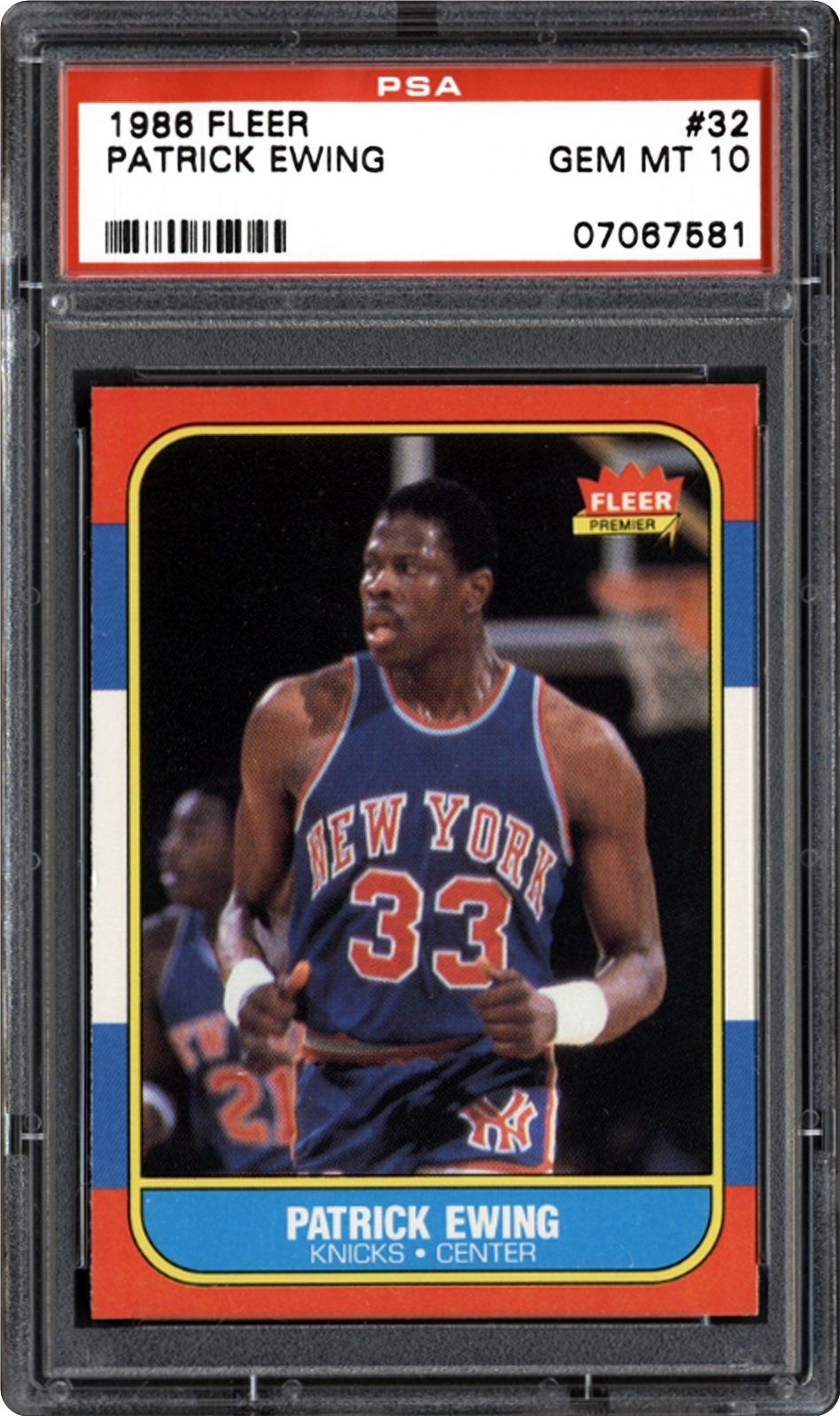
Three different cards, three different print positions, three different levels of collector demand, and the gem rates cluster inside a single point and change. That is what a set-wide condition problem looks like rather than a card-specific one. It is not hard to see why: the 1986 Fleer design frames every card in red, white and blue stripes, and a multi-colored striped border is the least forgiving surface in card design. Every chip has a contrasting color behind it, and every millimeter of drift off-center is visible against the stripe. The card you pull is not the variable here — the set is.
For contrast, look two years forward. CASE #0243 covered the 1988 Fleer Scottie Pippen rookie: 273 PSA 10s from 16,129 graded, a 1.69% rate that looks nearly identical until you notice it took 63% more submissions to produce it. The junk wax era was ramping up. Print runs were climbing. The odds were not improving.
The Verdict
The pictured example is a PSA GEM MT 10 — one of the 163 that exist. PSA's Price Guide puts that grade at $5,750 against $475 for a PSA 9, which is the entire story of this card compressed into two numbers: a twelve-fold jump for one grade point, on a card that clears it 1.65% of the time.
Ewing's rookie card is a year late, fifth in its own set's pecking order, and harder to find in a 10 than its reputation suggests. Charged with being underrated in a set full of legends — and with hiding a brutal condition rate behind a familiar name.