PSA's App Now Tracks Cards It Has Never Graded — the Third Move in Ten Days Aimed at the Decision to Submit
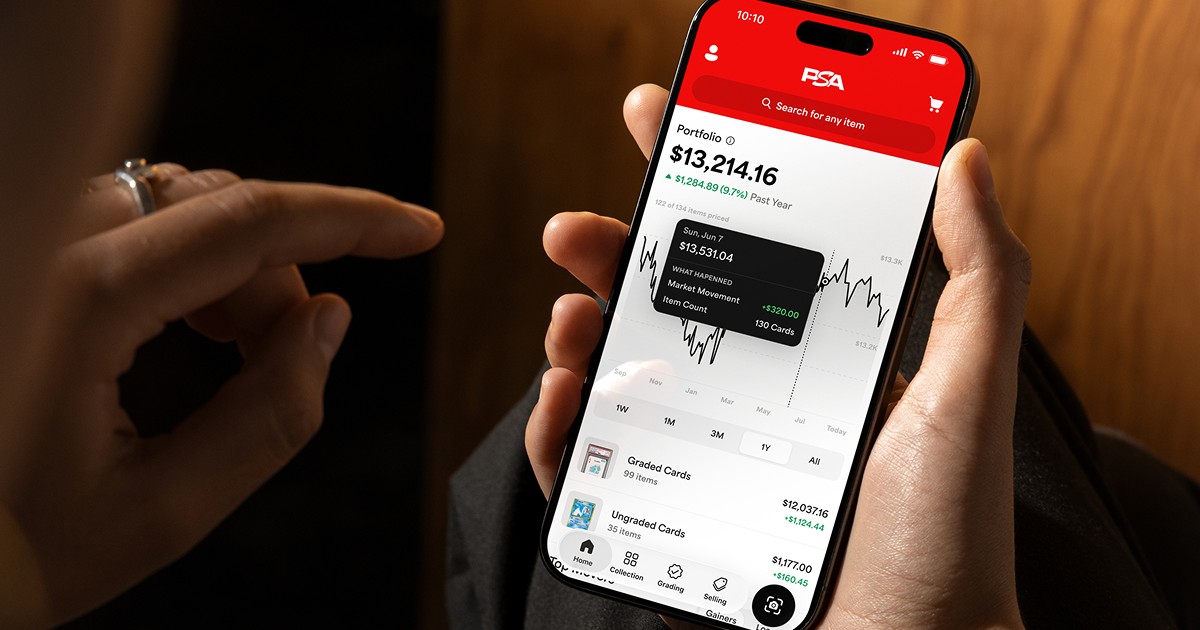
PSA's app will now keep track of a card PSA has never touched. On September 23 the company rolled out a reworked Collection experience that accepts ungraded cards alongside slabs, puts a running estimated value on the whole pile, and lets a collector follow what a raw card might be worth in different grades before deciding whether to send it in.
That last part is the one to read closely, because PSA wrote it plainly. In its own announcement, the company says a collector can "follow the value of an ungraded card over time, research different grades, and make a more informed decision about what you want to do with it next."
What Actually Changed
PSA's announcement, titled "Meet the New PSA Collection Experience," lists the new tools:
- A portfolio view showing the total estimated value of a collection, with a chart of its historical performance and the cards that have gained or lost the most.
- Support for ungraded cards, tracked "side by side" with graded ones.
- Folders that can be sorted and filtered, including by graded or ungraded status and by changes in value.
- Public links for any folder, which PSA says can be shared "on social media, by text, email, or anywhere else," including a folder of cards a collector has for sale.
Heavy, which covered the rollout the same day, adds two details worth knowing. PSA's FAQ, it reports, says Collection supports ungraded cards along with cards graded by PSA, SGC, BGS, BVC, CSG and CGC, so a rival's slab can sit in the same portfolio as PSA's own. And the app's App Store listing covers sports cards plus Pokémon, ONE PIECE, Magic: The Gathering and Yu-Gi-Oh!
PSA attaches its own caution: "Past sales do not guarantee future performance. Nothing in the PSA Collection experience constitutes investment advice." An estimate on a raw card is also not a grade, and the grade a card eventually receives is what sets its market.
Three Moves in Ten Days
Taken alone, this is an app update. Set beside the rest of PSA's September, it looks like part of a sequence.
On September 14, PSA opened its $59.99 Standard tier, the first service level it had launched since pausing its four cheapest tiers in June (CASE #0317). On September 21, ICv2 reported PSA GO, a program that lets customers hand cards to staff at 50 Lids stores, who then package and ship them to PSA (CASE #0335). And on September 23 came Collection's raw-card support.
Analysis: Each of the three reaches the collector at a different point in the decision to grade, and each one reaches earlier than the last. Standard sets what a submission costs once a collector has decided to send a card. PSA GO changes where that card gets handed over. Collection sits in front of both, at the moment a collector is still asking whether a card is worth grading at all, and it puts PSA's own research tools in the room when the answer gets made. That reading is this blog's, not PSA's; the company has not described the three as a single strategy.
The Backlog Is Still the Backdrop
None of this reopens the tiers most collectors are waiting on. PSA's public Backlog Tracker, in its September 22 entry, puts the active global backlog at "approximately 9 million units (from 9.9 million on September 8)." The update before that put it at 9.9 million, down from 10.9 million reported August 25. The company's stated target for reopening its Value tiers is a backlog of 5 million, the figure CASE #0193 first put on this blog in July.
The same tracker entry adds one detail about the Standard tier that matters for anyone weighing it: incoming Standard orders are "processed behind items already in our care," with active Value and Bulk orders submitted before the pause keeping priority. It also credits the newly opened Frankfurt facility, the European hub CASE #0079 covered in June as the first phase of PSA's $200 million build-out.
Analysis: The last two tracker updates each took roughly a million cards off the queue. About four million remain between today's figure and the 5 million line. If the next few fortnights matched the last two exactly, that would be about four more updates, but the tracker's own history argues against reading it as a straight line: between its July 14 and July 28 entries, the backlog rose from 11 million to 12.4 million before it began falling again.
Why a Raw Card Counts Now
While Value stays shut, cards collectors would once have sent in cheaply are sitting in boxes instead. Now a collector can log one in PSA's app, watch its value, study what graded copies have done, and keep it there until the price of grading makes sense.
Verdict: PSA cannot grade its way out of the backlog any faster than its hubs allow, so it has moved into the waiting room. The raw-card tracker is a useful free tool, but it is also PSA making sure that when a collector finally decides a card is worth grading, PSA's app is where that decision gets made.
Confidence note: Feature details and the investment-advice disclaimer are from PSA's own announcement, "Meet the New PSA Collection Experience." The September 23 rollout date, the list of supported grading companies from PSA's FAQ, and the App Store category list are as reported by Heavy (September 23, 2026). Backlog figures, the Standard-tier queueing policy and the Frankfurt reference are from PSA's public Backlog Tracker. The PSA GO details are from CASE #0335, which cites ICv2 and PSA. Passages marked Analysis are this blog's interpretation, not findings in any source.