A FedEx Truck Carrying PSA Orders Was Burglarized. PSA's Email Caps Payouts at the Insured Value, and Its Press Statement Leaves the Cap Out
A FedEx vehicle carrying graded cards back from PSA was burglarized, and PSA has started telling customers how they will be paid. The email it sent them and the statement it gave the press describe the same compensation in different terms, and PSA's own coverage page explains the difference.
The first public account came from the collector SKY-B, who posted on X on Saturday, Oct. 17, 2026, that PSA had emailed him about his 104-card submission. "Over $100,000 in cards just gone," he wrote. The dollar figure is his own. Later that day he posted three screenshots of the email, with his name and order number blacked out.
What the Email Says
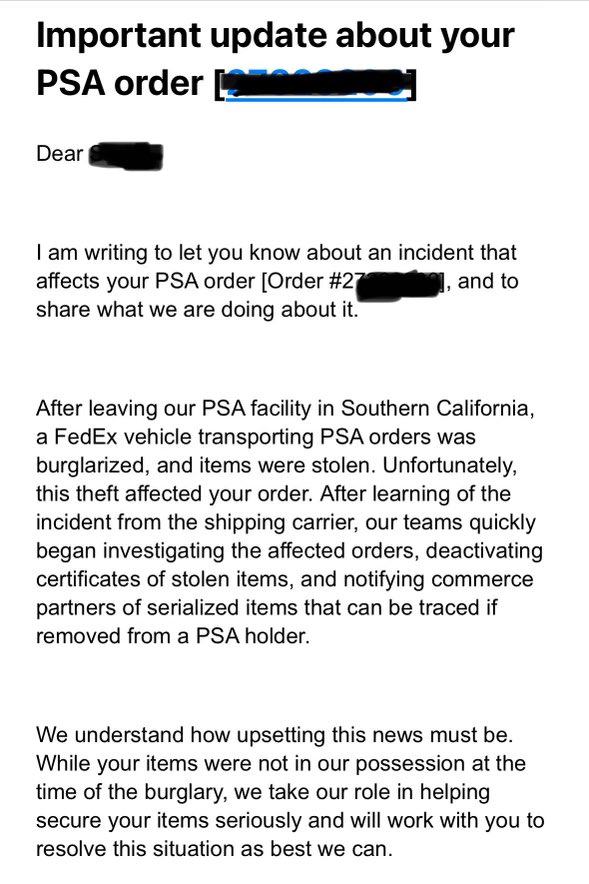
"After leaving our PSA facility in Southern California, a FedEx vehicle transporting PSA orders was burglarized, and items were stolen," the email reads. It gives no date or location for the burglary and no count of affected orders.
Under "What we are doing," PSA says it has deactivated the certificates for the stolen items, "making them harder to sell," and notified "commerce partners across digital, auction, and other selling platforms." It says it is working with FedEx and with law enforcement, and will review its procedures for "shipping partners."
Then the compensation: "We will compensate you for the items from your order that were involved, in accordance with our terms and conditions, which is based on fair market value up to the Maximum Insured Value ('MIV') you selected for each item." PSA says it will contact customers "next week" to "explain how fair market value, capped by MIV, is determined."
One sentence covers responsibility: "While your items were not in our possession at the time of the burglary, we take our role in helping secure your items seriously and will work with you to resolve this situation as best we can."
What PSA Told the Press
On Monday, Oct. 19, a PSA spokesperson gave Heavy a statement. "We are aware of a theft involving a third-party shipping vehicle carrying PSA-graded items," it begins. PSA said its customer service team "has contacted affected customers directly and is arranging compensation based on fair market value."
Analysis: The public statement and the customer email agree on the facts and differ on the cap. The email says fair market value "up to" and "capped by" the MIV each customer selected. The statement, as Heavy published it, says "based on fair market value" and stops there. For a customer whose card is worth more than the MIV they chose, the cap decides the payout.
What PSA's Coverage Page Says
PSA's coverage page defines MIV as "the maximum amount you can receive as compensation, up to the item's fair market value, if your collectible is damaged or lost while in PSA's care." A payout "is limited to the lower of the item's fair market value or the Max Insured Value for your selected service level."
The MIV comes with the service level a customer pays for. When PSA opened its $59.99 Standard tier on Sept. 14, its ceiling was $1,000 per card, and Priority's was $1,500 at $79.99 (CASE #0317). If PSA decides after grading that a card is worth more than its MIV, the page says, PSA "will upgrade the service level for that item," charges the difference, and covers the card at the higher MIV once the fee is paid.
On timing, coverage begins "when PSA confirms its arrival at our facility and continues until it reaches its next destination," with "back to you" as an example. PSA does not insure packages on the way in.
Analysis: By PSA's own terms, a card on its way back to the customer is still covered. That is why PSA is paying at all, even though the email says the items "were not in our possession." Possession is about who held the box. Coverage is about who pays, and PSA's page puts the return trip inside its coverage, capped at the MIV. Whether the cap pays in full turns on whether each card went in at a level matching its value, and on how PSA sets fair market value, which it has promised to explain this week.
The Certificates and the Serial Numbers
The email says PSA notified partners "of serialized items that can be traced if removed from a PSA holder." On Oct. 18, Boston Card Hunter posted on X what he called "the current list of 383 serialized cards that were stolen from the Fedex truck carrying PSA packages." The count is his.
Analysis: A deactivated cert flags the slab. Once a card is cracked out, the slab's number no longer goes with it, and a card printed with its own serial number is the kind that can still be traced. That is why the email singles out serialized items. An unnumbered card out of its holder carries nothing to match against a stolen list.
Heavy reported that, as of Oct. 18, the date and location of the burglary, the number of affected shipments and the total value of the theft "remain unclear." SKY-B has written that he has "an awful feeling PSA is going to be extremely unfair on what the values of these cards are." PSA has not yet given anyone a valuation.
Verdict: PSA is treating the burglary as a covered loss, and its coverage page explains why: the trip back to the customer is inside its coverage. The customer email states the MIV cap plainly. The press statement does not mention it. Next week's valuation letters will show what the cap means for each order.
Confidence note: The email text is quoted from the three screenshots SKY-B posted on X on Oct. 17, 2026. PSA's public statement is quoted from Heavy's report, updated Oct. 19, 2026. The MIV definition, payout limit, service-level upgrade rule and coverage period are from PSA's coverage page (psacard.com/info/coverage). The 383-card count is Boston Card Hunter's (X, Oct. 18). Passages labeled Analysis are this blog's interpretation, not findings in those sources.