Topps Puts a 1-of-1 Black Hole Autograph at the End of a 10-Supernova Race in Cosmic Chrome, and the Code Under the Peel Is What a Buyer Should Check
The biggest chase in 2026 Topps Cosmic Chrome Baseball is not in the packs. It is a one-of-one Black Hole Autograph for each of 25 players, and Topps will hand each one to the first collector who logs ten Supernova inserts of that player. That turns a Supernova into two things at once: a card, and a code under a black peel. Once the code has been used, it cannot help anyone else's entry.
Topps announced the program on its social channels on Nov. 3, the day before Cosmic Chrome reached hobby shelves. "The first person to collect TEN of a player's Super Nova inserts in 2026 Cosmic Chrome will receive a 1-of-1 Black Hole Autograph of that player," the post read, as embedded by Sports Illustrated. Heavy, working from the official rules on Topps' Black Hole promotion page, filled in the mechanics.
How the Race Works
Each Supernova carries a unique, single-use code beneath a black peel. Collectors scan the card's QR code or go straight to the promotion page, create a free account and enter their codes. Topps says an email address has to be verified before an entrant is eligible to win, according to Heavy.
Every player has his own leaderboard. An Ohtani Supernova counts only toward Ohtani's autograph and a Judge counts only toward Judge's, so a collector can chase several players at once but needs ten of the same player for any one prize. Per Heavy's reading of the rules, the winner is the first to redeem ten distinct Supernovas of a player and complete verification.
Reaching ten on the website is not the finish line. Topps requires a potential winner to hold all ten physical cards and prove ownership, Heavy reports, and the rules give winners seven days to answer the notification email. The prize is delivered to the winner's Fanatics Collect Vault account.
The entry period opens on or about Nov. 6, 2026. It runs through July 31, 2036, or until all 25 prizes are claimed. In practice each player's race ends when a winner clears verification.
The 25 Players
SI published the full checklist of subjects. There are 25 players and 25 autographs, one each:
- Aaron Judge, Juan Soto, Vladimir Guerrero Jr., Freddie Freeman, Bobby Witt Jr.
- Mike Trout, Shohei Ohtani, Ronald Acuña Jr., Francisco Lindor, Paul Skenes
- Bryce Harper, Elly De La Cruz, Julio Rodríguez, Gunnar Henderson, Junior Caminero
- Yoshinobu Yamamoto, Nick Kurtz, Trey Yesavage, Chase Burns, Nolan McLean
- Jacob Misiorowski, Samuel Basallo, Roman Anthony, Jac Caglianone, Munetaka Murakami
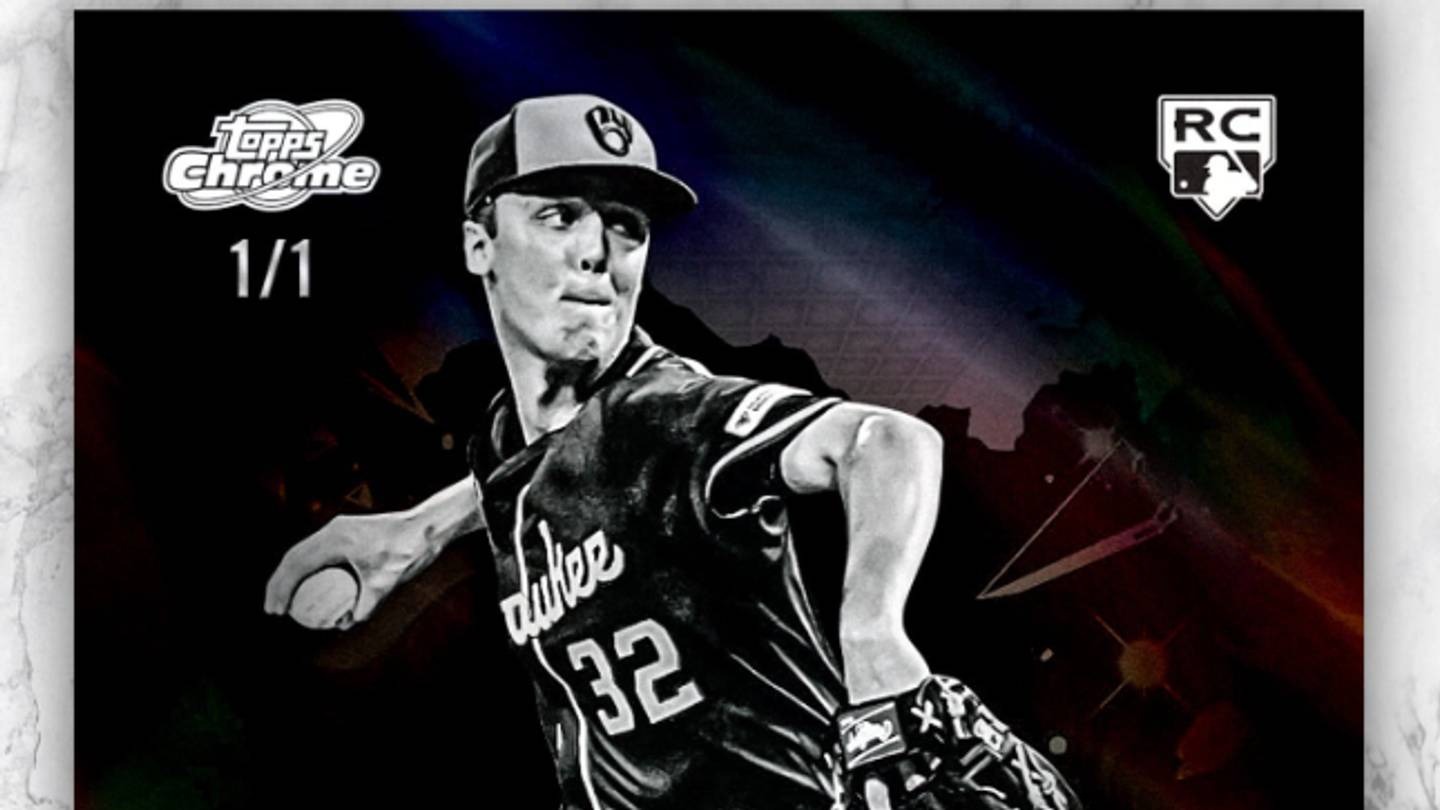
The image Topps Ripped released with the announcement is Misiorowski's Black Hole card, a black-and-white action shot of the Brewers right-hander on a dark nebula background, marked 1/1 and carrying the rookie logo.
How Many Supernovas Exist
The official rules list 1,250 eligible cards in total, Heavy reports. Spread evenly across 25 players, that is 50 apiece. Heavy is careful to say that the aggregate does not establish any individual player's print run. SI went further, writing that "it was reported that there are only 50 copies of the Super Nova inserts for each player," while noting that the cards are not serial-numbered. The blog treats 1,250 as the established figure and 50 per player as SI's report.
Analysis: If a player's run really is near 50, a winner has to hold about a fifth of that player's copies, and has to register them before anyone else does. That is the blog's arithmetic on SI's reported figure, not a number Topps has published.
The Back of the Card Now Matters
Topps lets collectors buy Supernovas on the secondary market and count them toward an entry. Heavy points out the problem that creates: a photo of the card front cannot tell a buyer whether the code has already been redeemed. A Supernova with a used code is still a collectible, but it cannot move anyone else up a leaderboard, and the official rules put the risk of buying a previously submitted code on the buyer.
Analysis: For a single bought mid-race, the peel is now part of the card's condition. A buyer paying a chase premium to get from nine cards to ten is paying for the code as much as the cardboard, so the questions worth asking a seller are whether the peel is intact and whether the code has been entered. The second question has a second half. Once a player's autograph is claimed, every remaining copy of that player's Supernova goes back to being an insert, and any premium tied to the race no longer has a prize behind it. Whether that shows up in sale prices is something the market has not had time to demonstrate.
Analysis: The 25 races also run independently. A prize can fall early for a player whose copies end up in a few hands and stay open for years for one whose cards sit with collectors who never peel them.
What to Watch
Once entries open, the first number to watch is how quickly any single leaderboard approaches ten, because that is what decides how long the chase premium on that player's Supernovas has to run.
Verdict: Topps has put a one-of-one at the end of a ten-card race and made the code under the peel the thing that counts. For anyone buying a Supernova single, an unverified code is the risk the rules leave with the buyer.
Confidence note: Program mechanics, the 1,250-card aggregate, the entry dates, the secondary-market and used-code terms, the possession check and the seven-day response window are from Heavy (Erik C. Anderson, updated Nov. 3, 2026), which reported them from Topps' official rules. The announcement text, the 25-player list, the per-player leaderboards and the "50 copies" report are from Sports Illustrated Collectibles (Cole Benz, Nov. 3, 2026), with player names given in their standard spellings. The Nov. 4 release date is from a published retailer release calendar. Passages marked Analysis are the blog's interpretation.