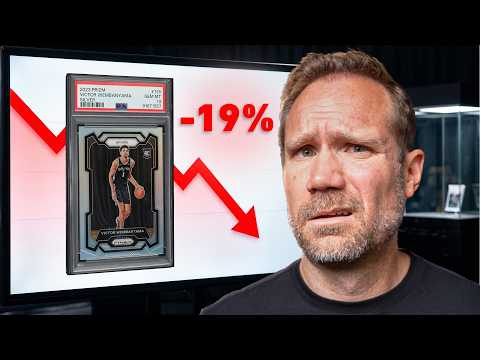
Video of the Day: Wemby Cards CRASH HARD After Spurs' Finals Loss — Market Correction or Buying Opportunity?
Victor Wembanyama's rookie card market entered 2026 on a record-setting high — a $5.11 million private sale of his 1-of-1 Logoman, Defensive Player of the Year honors, and the San Antonio Spurs' unexpected run to the NBA Finals. Then the Knicks happened. Now the Wemby card market is in free fall, and the question every collector is asking is whether this is a buying opportunity or the beginning of a prolonged correction.
The Sports Card Investor video tracking this crash — published just hours after the Spurs' Game 5 loss — lays out the data in stark terms. Wembanyama's Prizm base rookie, which traded at $450-$500 during the Finals run, has dropped to the $280-$320 range. His Topps Chrome base, which peaked near $350 during the playoff surge, is now hovering around $200. The high-end inserts have taken even bigger percentage hits: his Kaboom insert, which commanded $4,000-$5,000 during the postseason hype, is now finding buyers in the $2,500 range.
Postseason Performance and Market Reaction
The Spurs' run to the Finals was ahead of schedule — nobody expected a team led by a 22-year-old sophomore to reach the championship round, even one as transcendent as Wembanyama. But the 4-1 loss to the New York Knicks has reframed the narrative. The market had priced Wemby's cards as if he had already arrived as a champion; the Finals loss introduced uncertainty about whether the supporting cast is good enough to get back, and whether Wembanyama's game — dominant in the regular season but less consistent against elite playoff defenses — translates to championship-level basketball as cleanly as the hype suggested.
The numbers from this correction tell a story that goes beyond the Finals. Wembanyama's card values had already begun cooling from their post-All-Star-break peak before the playoffs started. The Finals run created a temporary price spike that masked an underlying trend: the initial wave of speculators who bought Wemby rookies at issuance prices were taking profits, and the new buyers stepping in at higher price points had thinner conviction. The Finals loss didn't cause the correction — it just removed the narrative that was holding prices up.
Comparing to Previous Corrections
This pattern is not unique to Wembanyama. Luka Doncic's card market experienced a similar correction after the Mavericks' 2024 Finals loss, with his Prizm base dropping nearly 40% before stabilizing. Zion Williamson's card values followed an even steeper trajectory — a meteoric rookie-year rise, a multi-year injury-driven decline, and only a partial recovery when he returned to form. Ja Morant's market collapsed almost entirely after his suspension and has only recently begun to recover.
The common thread is that modern rookie card values are pathologically dependent on on-court success in a way that vintage cards simply aren't. A 1952 Topps Mickey Mantle doesn't care whether the Yankees win the pennant — its value is driven by scarcity, condition, and cultural legacy, not by Mantle's current season stats. But a 2023 Panini Prizm Wembanyama rookie, printed in quantities that dwarf anything from the vintage era, derives its value almost entirely from narrative momentum. When the narrative shifts, the floor can drop out.
The Long View
None of this means Wembanyama's card market is permanently broken. He is 22 years old with a 3x Defensive Player of the Year trajectory, unprecedented physical tools, and a Spurs organization that has shown it can build contenders. The "buy the dip" case is straightforward: if you believe Wembanyama will eventually win championships, today's prices will look like a discount in five years.
But the correction is a warning for collectors who treat modern rookie cards as investments rather than collectibles. The same qualities that make Wemby rookies exciting — high print runs, multiple parallel versions, heavy speculation — also make them volatile. The Finals loss didn't create the risk; it simply revealed it.
The Wembanyama market has entered a new phase where every playoff performance, every injury scare, and every off-season roster move will move prices. For long-term collectors, that volatility is noise. For short-term speculators, it's everything.
Channel: Sports Card Investor