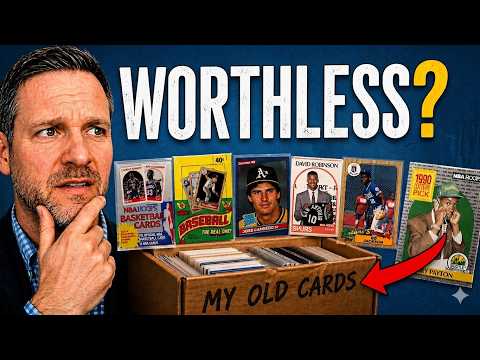
Video of the Day: Why Almost All of Your Sports Cards Are Worthless (5 Reasons)
Rookie Card Vault's latest video opens with a brutal premise: almost all of your sports cards are worthless. It's the kind of headline that makes collectors wince, but here's the uncomfortable truth — for the vast majority of cards printed after 1987, the video isn't wrong. The question is whether the 5 reasons cited stand up to scrutiny, and what they mean for collectors trying to navigate the current market.
Let's break down each reason, add the blog's perspective, and separate the genuine warnings from the clickbait.
Reason 1: Overproduction Kills Value
The video's first argument is the oldest in the hobby: cards printed in huge quantities will never be worth much. This is objectively true for the junk wax era (1987-1994), where print runs in the millions flooded the market. A 1989 Ken Griffey Jr. Upper Deck rookie was printed in such staggering numbers that even a PSA 10 trades for a fraction of what its iconic status would suggest.
The blog's take: Correct, but incomplete. The junk wax lesson is well-established — every collector knows it. The more relevant question is whether today's cards are being overproduced. Panini and Fanatics/Topps have learned from the junk wax era and keep print runs more disciplined, but the sheer number of products, parallels, and inserts creates a different kind of oversaturation — not of individual cards, but of choice. A card may be scarce, but if it's one of 500 parallel versions of the same rookie, its scarcity is diluted by confusion.
Reason 2: Grading Bubble Will Pop
The argument here is that the grading boom — 10+ million cards in the PSA pipeline alone — will eventually flood the market with high-grade copies, collapsing prices on graded cards. The logic is simple: more supply means lower prices.
The blog's take: Partially right, but the impact is uneven. The grading flood will primarily affect modern PSA 10s where gem rates are high (20-50% for many current releases). A 2023 PSA 10 that exists in 10,000+ copies will absolutely see price compression as another 5,000 enter the market. But vintage and key modern cards with low gem rates (under 5%) are largely immune — their populations are constrained by the physical reality of the cards themselves. A 1952 Topps Mantle can't be "regraded" into existence. The grading bubble is real, but it's selective.
Reason 3: The Economy Is a Time Bomb
The video argues that the broader economic environment — inflation, interest rates, recession fears — will eventually crash discretionary spending on collectibles. When people can't afford groceries, the logic goes, they stop buying $500 basketball cards.
The blog's take: The macro risk is real, but the sports card market has already corrected significantly from its 2021-2022 peak. Many segments (modern sealed wax, mid-tier graded cards) are down 30-50%. In a sense, the market has already priced in a recession. Blue-chip vintage has held steady because it functions as an alternative asset class, not a speculative vehicle. The question isn't whether the economy will hurt the hobby — it's whether the hobby has already absorbed that damage.
Reason 4: Liquidity Is an Illusion
Your card is only worth what someone will pay for it right now. The video points out that many cards with high "book values" sit unsold on eBay for months, only moving when prices drop 30-40% below listed comps.
The blog's take: This is the most underappreciated point in the video and deserves more attention than it gets. Liquidity varies enormously by player, grade, and price tier. A LeBron or Jordan card in PSA 9 will sell within hours at market price. A mid-tier Hall of Famer in PSA 8 might take six months. A modern insert numbered to 25 might never sell at any reasonable price because nobody knows it exists. The card's "value" is not what PSA says — it's what the last actual sale was, adjusted for time and patience. Seasoned collectors understand this; newer entrants often don't.
Reason 5: The Hobby Is a Casino Now
The video's final reason points to the rise of breaks, mystery packs, and chase culture — arguing that the hobby has transformed from collecting into gambling, and that the gambling premium inflates card values unsustainably.
The blog's take: The most compelling argument in the video. Breakers have fundamentally changed the economics of the hobby. When a breaker buys $5,000 worth of product and sells individual teams for $200 each, they've already made their money back before opening a single pack. The cards themselves become secondary — they're the "prize" in a system that's structurally designed to extract money from participants, not to distribute cards to collectors. If break regulation increases (which several states are considering), the demand for high-end product could soften significantly, dragging down singles prices with it.
The Verdict
Rookie Card Vault's video is a valuable reality check for collectors who entered the hobby during the pandemic boom and haven't experienced a down cycle. The 5 reasons are real risks, and dismissing them as "negativity" is how collectors lose money.
But the video's framing — "almost all of your cards are worthless" — conflates two different ideas. A 2020 Panini Prizm base rookie of a backup quarterback is effectively worthless, and it always was. A 1952 Topps Mickey Mantle in any grade isn't worthless, and it never will be. The skill in this hobby isn't buying cards — it's knowing which ones to buy, when to sell, and understanding the difference between a collectible and a lottery ticket.
The blog's adjusted take: most cards in your collection may be worth less than you think, but the cards that matter — the ones with historical significance, genuine scarcity, and broad demand — have survived every market cycle the hobby has ever seen. The trick is knowing which pile each of your cards belongs to.
Channel: Rookie Card Vault