1935 National Chicle #34 Bronko Nagurski — 187 Graded, One Mint 9, and Not a Single 10
PSA has graded the 1935 National Chicle Bronko Nagurski 187 times and has never once written a ten on the label. Not a single Gem Mint copy exists. There is exactly one Mint 9. There are six NM-MT 8s. The other 180 grade below that.
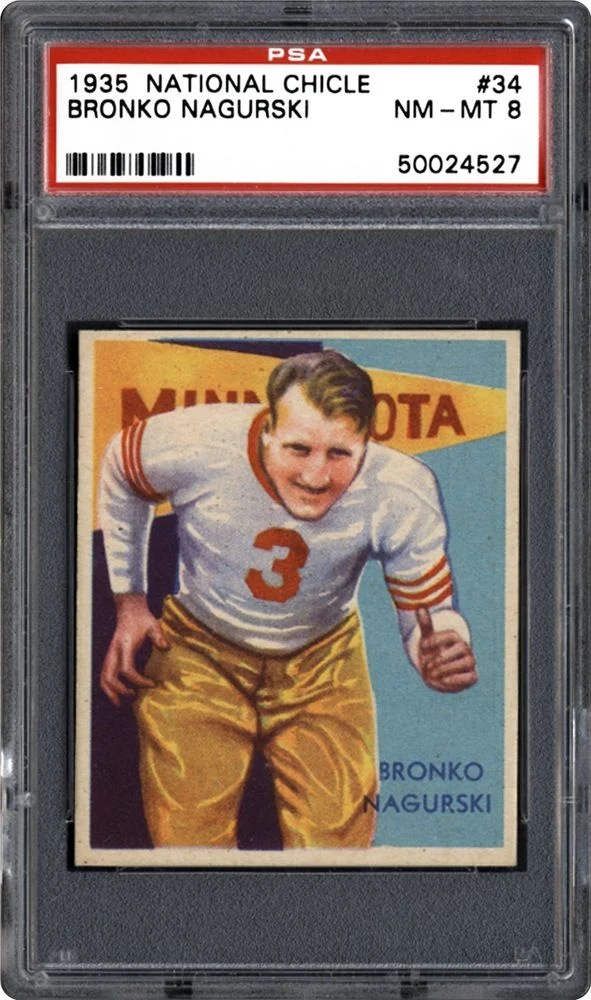
The card pictured above is one of the six. It sits in a PSA NM-MT 8 holder, certification number 50024527.
The Man Who Ran Straight Ahead
The Pro Football Hall of Fame does not bother with subtlety on Bronko Nagurski, and neither did he:
Never fancy, he just ran straight ahead, over and through the opposition. Although he is best remembered for his bull-like running, he had no peer as a blocker and his tackling was as effective as any the game has seen. He was the complete player.
At Minnesota he played four positions and was named All-America at two of them — fullback and tackle — which is a distinction the sport has more or less stopped issuing. He joined the Chicago Bears in 1930 and stayed nine seasons, listed by the Hall at fullback, running back and quarterback because he genuinely played all three.
The career line is 97 games, 633 carries, 2,778 rushing yards at 4.4 a pop, and 25 rushing touchdowns, plus 32 completions in 77 attempts for 474 yards. He was named first- or second-team All-NFL in seven of his first eight seasons.
He also threw the jump pass — fake the plunge, step back a yard, leap, and lob it — and one of those to Red Grange produced the deciding touchdown in the Bears' 1932 win over Portsmouth for the league title. The following year, in the NFL's first official championship game, he passed for two touchdowns including the winner.
Then, in 1938, the Bears would not raise him to $6,500, so he quit football and went to wrestle for a living. He came back in 1943, when the war had stripped the roster, and played tackle. Late in a must-win game they moved him to fullback and his line plunges keyed the tying drive. A week later, in the 1943 title game against Washington, the 35-year-old ended his career by scoring the touchdown that put Chicago ahead for good.
Card #34
The 1935 National Chicle set runs 36 cards, and Nagurski is #34 — third from the end of a checklist that closes on two more Bears, Luke Johnsos at #35 and Bernie Masterson at #36.
Both major databases treat this as his first card. PSA files him as Bronko Nagurski (R) (HOF), carrying the rookie flag in the certification itself; the Trading Card Database lists the checklist row verbatim as 34 Bronko Nagurski RC Chicago Bears. That is a rookie card printed in a player's sixth professional season, five years after he arrived — which tells you most of what there is to know about how football cards worked before the war. The cardboard did not follow the player. It followed whichever gum company was willing to try.
PSA Population Report
| PSA Grade | Population |
|---|---|
| PSA 10 | 0 |
| PSA 9 | 1 |
| PSA 8 | 6 |
| Total Graded (All Grades) | 187 |
* Population data as of August 26, 2026. PSA population counts are dynamic and increase as more cards are submitted for grading.
What the Numbers Say
Zero. Across 187 full straight grades and ninety-one years, PSA has never issued a Gem Mint 10 on this card. One copy has reached Mint 9. Six have reached NM-MT 8. Add the single 8.5 that sits between them and the entire top of this population is eight cards.
The straight-grade count is not the whole holding. PSA records a further 27 half grades and 9 qualified grades as separate buckets, which puts 223 Nagurski #34 slabs in the world altogether. It has also certified 10 copies as Authentic without a numerical grade.
Look at where the mass actually sits and the shape is the opposite of a modern card's. PSA 1: 33 copies. PSA 2: 30. PSA 3: 32. PSA 4: 23. PSA 5: 23. The population peaks at the very bottom of the scale and thins upward — 13 at a 6, 16 at a 7, then the cliff. Poor 1 is the single most common grade this card receives, and 141 of the 187 straight grades — better than three in four — come back at PSA 5 or lower.
Analysis: that curve is not a story about a badly printed card. It is a story about what survives. A 1935 gum card was a disposable object aimed at children, printed on thin stock, and the copies that reached a grading room ninety years later mostly reached it out of shoeboxes, albums and attics rather than out of storage. The population is bottom-heavy because the sample is bottom-heavy. Nobody set these aside.
It also explains the vacancy at the top better than any theory about the printing does. A card does not need a flaw to miss a 10 when the entire surviving supply has been handled for three generations.
The Verdict
Nagurski is a Hall of Famer from the Class of 1963 whose rookie card, ninety-one years after it was printed, has produced one Mint 9 and no tens at all. The card that is supposed to be the trophy of pre-war football is a card almost nobody can own in the condition the hobby has spent forty years teaching itself to want.
CASE #0284: Zero Gem Mint 10s from 187 graded, one Mint 9, and a rookie card issued in a Hall of Famer's sixth season. The 1935 National Chicle #34 is not scarce because it was printed badly — it is scarce at the top because it was printed for children and treated accordingly. Filed as a misdemeanor: destruction of property, ninety-one years running.