1952 Parkhurst #1 Maurice Richard -- The Rocket's Iconic Vintage Rookie -- Card of the Day
In hockey card collecting, there's vintage, and then there's Parkhurst vintage. The 1952 Parkhurst set is the cornerstone of post-war hockey card collecting — the first major hockey set issued after World War II — and its #1 card belongs to the most iconic player in NHL history through the 1940s and 1950s: Maurice "Rocket" Richard. This is the card that every serious hockey collector needs to understand, whether they're chasing registry sets or building a foundational collection of the sport's legends.
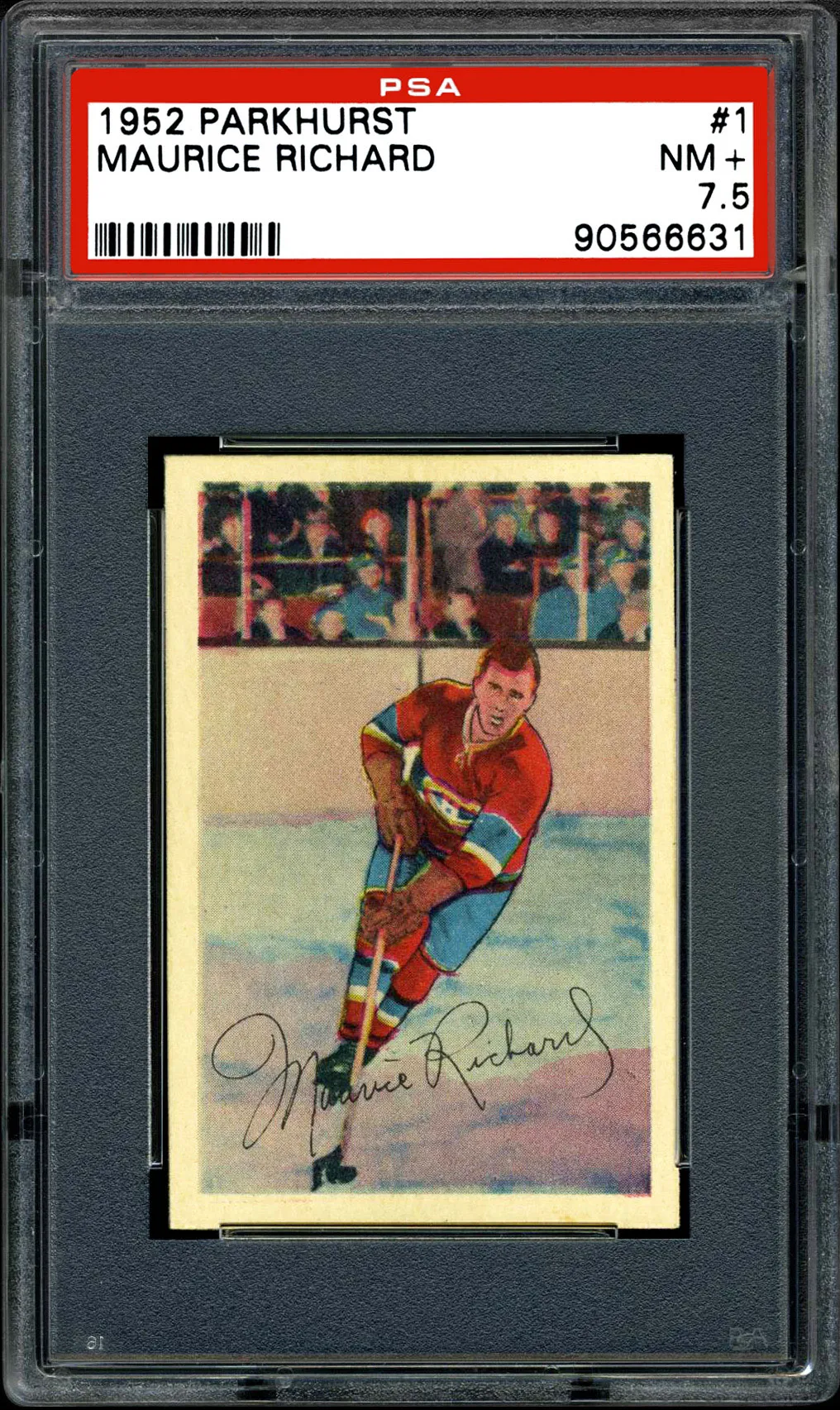
The Card: 1952 Parkhurst #1 Maurice Richard
The 1952 Parkhurst set consists of 105 cards printed on heavy paper stock measuring just 1¾" × 2½" — barely larger than a modern business card. These small, sepia-toned portraits capture hockey's first generation of superstars at the dawn of the modern NHL era, and the set is widely credited with launching the hockey card collecting hobby as we know it. Virtually every card in the checklist is a rookie card, including Gordie Howe, Terry Sawchuk, and the Rocket himself.
Richard's #1 card is the lead-off card in the set, and it carries the weight of that position. It depicts the Rocket in his Montreal Canadiens uniform, captured at age 30 — just after he had established himself as the NHL's premier goal-scorer and cultural icon. The card's small size and crude Parkhurst printing process (which produced notoriously off-center examples) mean that high-grade copies are disproportionately scarce relative to the total population, creating a condition premium curve that rivals any vintage hockey card in existence.
The 1952 Parkhurst set is also notable for its historical context. It was produced by Parkhurst Products, a Toronto-based confectionery company that entered the trading card business in the early 1950s. The brand would go on to become synonymous with Canadian hockey card collecting, and its legacy is so enduring that Upper Deck acquired the Parkhurst brand in 2005 and continues to release hockey cards under the name today.
The Rocket: A Career for the Ages
Maurice Richard's career reads like the blueprint for hockey greatness. He played 18 seasons with the Montreal Canadiens (1942-1960), winning eight Stanley Cup championships including an unmatched five consecutive titles from 1956 to 1960. He was the first player in NHL history to score 50 goals in a season, accomplishing the feat in just 50 games in 1944-45 — a record that stood as the gold standard for goal-scoring excellence for decades.
Richard retired in 1960 as the NHL's all-time leader in goals with 544, a mark that stood until Gordie Howe surpassed it in 1963. He won the Hart Trophy as league MVP in 1947, was named to 14 post-season NHL All-Star teams (eight on the first team), and was inducted into the Hockey Hall of Fame in 1961 — the Hall waived its five-year waiting period to enshrine him immediately after retirement.
Off the ice, Richard's cultural impact transcended sports. The Richard Riot of 1955 — triggered when NHL President Clarence Campbell suspended Richard for the remainder of the season and playoffs after a violent on-ice incident — is widely viewed as a precursor to Quebec's Quiet Revolution. Richard was a cultural icon among Quebec's francophone population, and his legend is a primary motif in Roch Carrier's classic Canadian short story The Hockey Sweater. In 1999, the Canadiens donated the Maurice "Rocket" Richard Trophy to the NHL, awarded annually to the league's regular-season goal-scoring leader.
PSA Population Report
| PSA Grade | Population | Value |
|---|---|---|
| GEM-MT 10 | 0 | — |
| MINT 9 | 0 | — |
| NM-MT 8 | 3 | $3,500 |
| Total Graded (All Grades) | 289 | — |
* Population data as of July 16, 2026. PSA population counts are dynamic and increase as more cards are submitted for grading.
Rarity in Context
The population numbers tell a stark story. With zero examples graded PSA 9 or 10 and only three examples at PSA 8, the 1952 Parkhurst #1 Maurice Richard is a card where high-grade condition is almost mythical. The Parkhurst printing process of the early 1950s — crude centering, soft focus, and heavy paper stock that wore easily — means that even an NM-MT 8 is an extraordinary find.
The total population of 289 graded examples is deceptively low for a card of this stature (by comparison, 2,604 examples of the 1952 Topps Willie Mays #261 have been graded). This reflects both the smaller production runs of the Parkhurst sets compared to their American Topps counterparts and the lower submission rates from hockey collectors compared to the baseball market. But those 289 cards span the full range from Poor 1 to NM-MT 8, and the drop-off in quality above mid-grade is steep.
The PSA Price Guide values — $3,500 for an 8, $1,400 for a 7, and $750 for a 6 — show a market that rewards condition aggressively. A PSA 5 (EX) at $500 is the value sweet spot for collectors who want a presentable card without chasing the near-impossible top of the market.
Why This Card Tonight
The blog has covered hockey COTDs before — Wayne Gretzky, Bobby Orr, Mario Lemieux, Glenn Hall, Mark Messier, and Patrick Roy — but never the pre-1955 vintage era of hockey. The 1952 Parkhurst #1 Maurice Richard is the card that fills that gap. It is the hockey equivalent of the 1952 Topps Mickey Mantle in terms of set importance, combined with a population scarcity that makes even mid-grade examples genuinely rare. For collectors who want to understand where hockey card collecting begins, this is the card.
The 1952 Parkhurst #1 Maurice Richard is the foundational card of post-war hockey collecting — the lead-off card in the most important vintage hockey set, featuring the NHL's first true superstar, with a population profile that makes every surviving example a piece of hockey history. Whether you're a die-hard hockey collector or a vintage card enthusiast expanding your horizons, this is a card every serious hobbyist should know.