1952 Topps #261 Willie Mays — The Say Hey Kid's Iconic Vintage Rookie — Card of the Day
When collectors talk about the Mount Rushmore of baseball cards, four names come up: the T206 Honus Wagner, the 1952 Topps Mickey Mantle, the 1914 Baltimore News Babe Ruth — and the 1952 Topps #261 Willie Mays. The Say Hey Kid's first Topps card is the second-most important card in the most iconic post-war set ever produced, and tonight — as baseball's biggest stars gather in Philadelphia for the 2026 All-Star Game and Jordan Walker's dramatic Home Run Derby win still echoes through Citizens Bank Park — there's no better moment to spotlight the man who defined the term "five-tool player."
The 1952 Topps set is the cornerstone of post-war baseball card collecting. Its full-color player portraits on pastel backgrounds defined the aesthetic of the modern card era, and its short-print high-number series (cards #311-407, including the legendary Mickey Mantle #311) created a scarcity dynamic that still drives the vintage market today. But while the Mantle commands the headlines and eight-figure auction results, the Mays #261 is the card that serious vintage collectors actually build their collections around — it's the attainable grail that sits just below the stratosphere.
The Card: 1952 Topps #261 Willie Mays
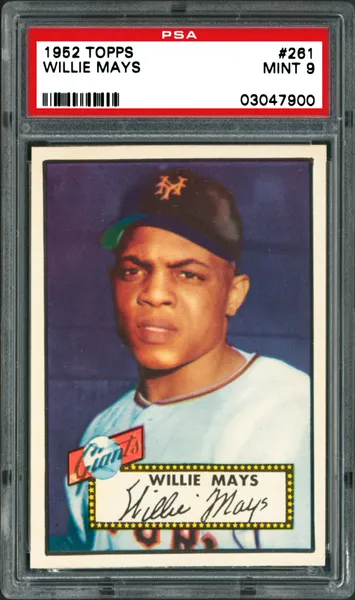
Willie Mays' first Topps card captures him at age 21, fresh off his rookie season with the New York Giants — a smiling young man in a cream-colored Giants jersey, set against a powder blue background that pops off the cardboard. It's the image of a player who hasn't yet become a legend, which is precisely what makes it so compelling to collectors. This isn't the iconic Willie Mays of the 1954 Catch or the 660 home runs — it's the kid who was about to become all of that.
The 1952 Topps #261 sits in a unique position in the vintage card hierarchy. It's the second most important card in the most important post-war set, behind only the Mantle. But unlike the Mantle (which is functionally out of reach for all but the wealthiest collectors in any grade above Poor), the Mays #261 offers a genuine entry point into high-end 1952 Topps collecting. A mid-grade example can still be had for five figures, making it one of the most accessible Hall of Fame rookie cards from the golden age of baseball cards.
Mays' career resume speaks for itself: 660 home runs, 3,283 hits, a .302 career average, 12 Gold Gloves, two National League MVP awards, and a Hall of Fame induction in 1979 on the first ballot with 94.7% of the vote. He is quite literally the standard by which all-around baseball greatness is measured — the only player in MLB history with 300 home runs, 300 stolen bases, and 12 Gold Gloves. His 1954 season alone (the Catch, the MVP, the World Series title) would be enough to cement his legacy; that he played at that level for two decades is what makes him an inner-circle immortal.
PSA Population Report
| PSA Grade | Population | Value |
|---|---|---|
| GEM-MT 10 | 1 | — |
| MINT 9 | 9 | $1,100,000 |
| NM-MT 8 | 60 | $165,000 |
| Total Graded (All Grades) | 2,604 | — |
* Population data as of July 14, 2026. PSA population counts are dynamic and increase as more cards are submitted for grading.
Rarity and the 1952 Topps Print Quality
The 1952 Topps set is notorious for its print quality challenges. Centering issues, print defects, and color registration problems are the rule rather than the exception — finding a 1952 Topps card that's well-centered and defect-free is genuinely difficult for any player in the set. This dynamic is what makes high-grade examples of the Mays #261 disproportionately rare relative to the total population.
Of the 2,604 total graded examples, only 10 cards exist in PSA 9 or 10 condition. That's a gem rate of roughly 0.4% — a figure that puts the Mays #261 in the same stratospheric rarity tier as the Mantle #311 when it comes to high-grade condition. The single PSA 10 (Gem-MT 10) is one of the rarest baseball cards in existence, with no publicly recorded sale to establish a market value.
The 8, 7, and 6 grades are where most serious collectors operate. A PSA 8 (NM-MT 8) with a population of just 60 is already a blue-chip asset at $165,000, and the gap between an 8 and a 9 ($1.1 million) is among the steepest condition premiums in the entire vintage card market. This spread reflects both the genuine scarcity of well-centered 1952s and the market's recognition that high-grade Mays cards are generational holdings.
Market Context: The Mays vs. The Mantle
The comparison between the 1952 Topps Mays #261 and the Mantle #311 is inevitable and instructive. The Mantle is the more famous card, the more valuable card, and the card that makes headlines when it sells. But the Mays is arguably the better value proposition for the collector who wants to own a piece of 1952 Topps history without chasing the absolute top of the market.
A PSA 3 Mantle will set you back roughly $50,000-80,000. A PSA 3 Mays — perfectly presentable with honest wear — trades in the $6,000-10,000 range. The Mays offers approximately 80% of the collecting experience (a Hall of Fame legend from the same iconic set) at roughly 10-15% of the cost. For the collector building a 1952 Topps set, the Mays #261 is the card you buy after you've secured the Mantle — or the card that substitutes for it if the Mantle is out of reach.
Why This Card Tonight
The Home Run Derby is baseball's annual celebration of raw power, and Jordan Walker's walk-off victory in Philadelphia tonight — complete with six straight do-or-die home runs in the final round — puts power hitting front and center in the baseball world's collective imagination. Willie Mays hit 660 career home runs, won four home run titles, and remains one of only 10 players in MLB history to hit 50+ home runs in a season (51 in 1955). His 1952 Topps #261 is the card that connects the golden age of baseball to the modern collecting era, and it's as relevant today as it was when it was first pulled from a wax pack 74 years ago.
The 1952 Topps #261 Willie Mays is a genuine hobby icon — the second-most important card in the most important post-war set, from the greatest all-around player in baseball history, with a population profile that makes every high-grade example a museum-quality piece. Whether you're chasing a PSA 10 unicorn or building a mid-grade vintage collection, this is a card every serious collector should understand.