Card of the Day: 1954 Topps #128 Hank Aaron RC — Hammerin' Hank's Defining Rookie
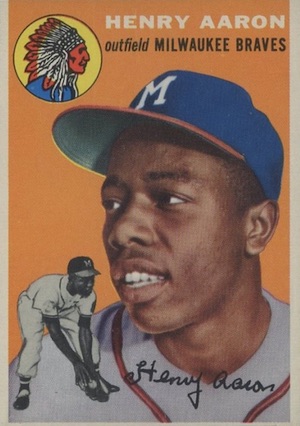
Hank Aaron's 1954 Topps rookie card is more than a piece of cardboard — it is a monument to one of baseball's most extraordinary careers. Aaron entered the major leagues in 1954 as a 20-year-old outfielder for the Milwaukee Braves and proceeded to put together a 23-year career that produced 755 home runs (a record that stood for 33 years), 3,771 hits, and a lifetime .305 batting average. The 1954 Topps set, with its distinctive colorized player photos against two-tone backgrounds, captured Aaron in the first card of what would become one of the most decorated careers in baseball history.
The card's design — featuring a young Aaron in a Braves cap with the classic 1954 Topps color palette — has become instantly recognizable across the hobby, a symbol of baseball's integration era and the quiet dignity of a player who let his bat do the talking. Unlike the high-number series short prints of the era, Aaron's #128 falls in the first series, making it more accessible than some contemporaries but no less significant in terms of collector demand.
Hank Aaron is one of the most important figures in baseball history — not just for his statistical achievements, but for the grace with which he pursued Babe Ruth's home run record while facing racist threats and public scrutiny. His 1954 Topps rookie card captures a moment just before the explosion of Aaron's career: he hit .280 with 13 home runs as a rookie in 1954, then launched into a Hall of Fame trajectory that would define the Milwaukee and Atlanta Braves franchise for two decades. The 1954 Topps set is also notable for including Ted Williams' final Topps appearance as a player and the first Topps card of Ernie Banks, but Aaron's #128 stands apart as the set's true key card.
In PSA 8 condition and above, this card competes with the 1952 Topps Mickey Mantle as a blue-chip pre-1960 baseball investment. The population data tells the story of a card that is genuinely scarce in high grade — the vast majority of the 6,000+ graded examples have settled in lower condition tiers, making the gap between a well-presented PSA 8 and the pristine PSA 10 an enormous gulf in both rarity and value.
PSA Population Report
| PSA Grade | Population | Value |
|---|---|---|
| PSA 10 | 2 | — |
| PSA 9 | 25 | $480,000 |
| PSA 8 | 194 | $33,000 |
| Total Graded (All Grades) | 6,031 | — |
* Population data as of June 14, 2026.
The population numbers underscore a critical reality: only 2 cards have ever earned a PSA 10 grade, and just 25 have reached PSA 9. With 6,031 total graded examples, the gem rate sits at a microscopic 0.03% — a figure that places the 1954 Aaron among the most condition-sensitive key cards in the entire post-war market. Even PSA 8 examples, representing the top 3.2% of all graded copies, command a $33,000 price guide value that reflects the extreme scarcity of high-grade examples relative to collector demand.
As the hobby grapples with the PSA grading pause (CASE #0084) and the rise of modern wax (CASE #0087), the 1954 Aaron RC represents the counter-programming: a card whose value is built on 70-plus years of sustained collector demand, not market hype. In a moment when collectors are questioning where to put their money — vintage or modern, graded or raw — the Hank Aaron RC stands as a reminder that certain cards transcend market cycles.
The 1954 Topps Hank Aaron #128 is not merely a Hall of Fame rookie card. It is a foundational piece of the post-war baseball card market — a card whose scarcity in high grade, historical significance, and enduring collector demand place it in the conversation for the most important baseball card of the 1950s. With only 2 PSA 10s in existence and a price trajectory that has appreciated consistently across multiple market cycles, the Aaron RC remains one of the hobby's most compelling long-term holdings.