Card of the Day: 1955 Topps All-American Niles Kinnick #6 — The Heisman Hero Who Never Came Home
Some cards carry value because of scarcity. Others carry value because of condition. A rare few carry the weight of history itself. The 1955 Topps All-American Nile Kinnick rookie card belongs to the third category — a card that memorializes a Heisman Trophy winner, a war hero, and a what-might-have-been story that still resonates nearly a century later.
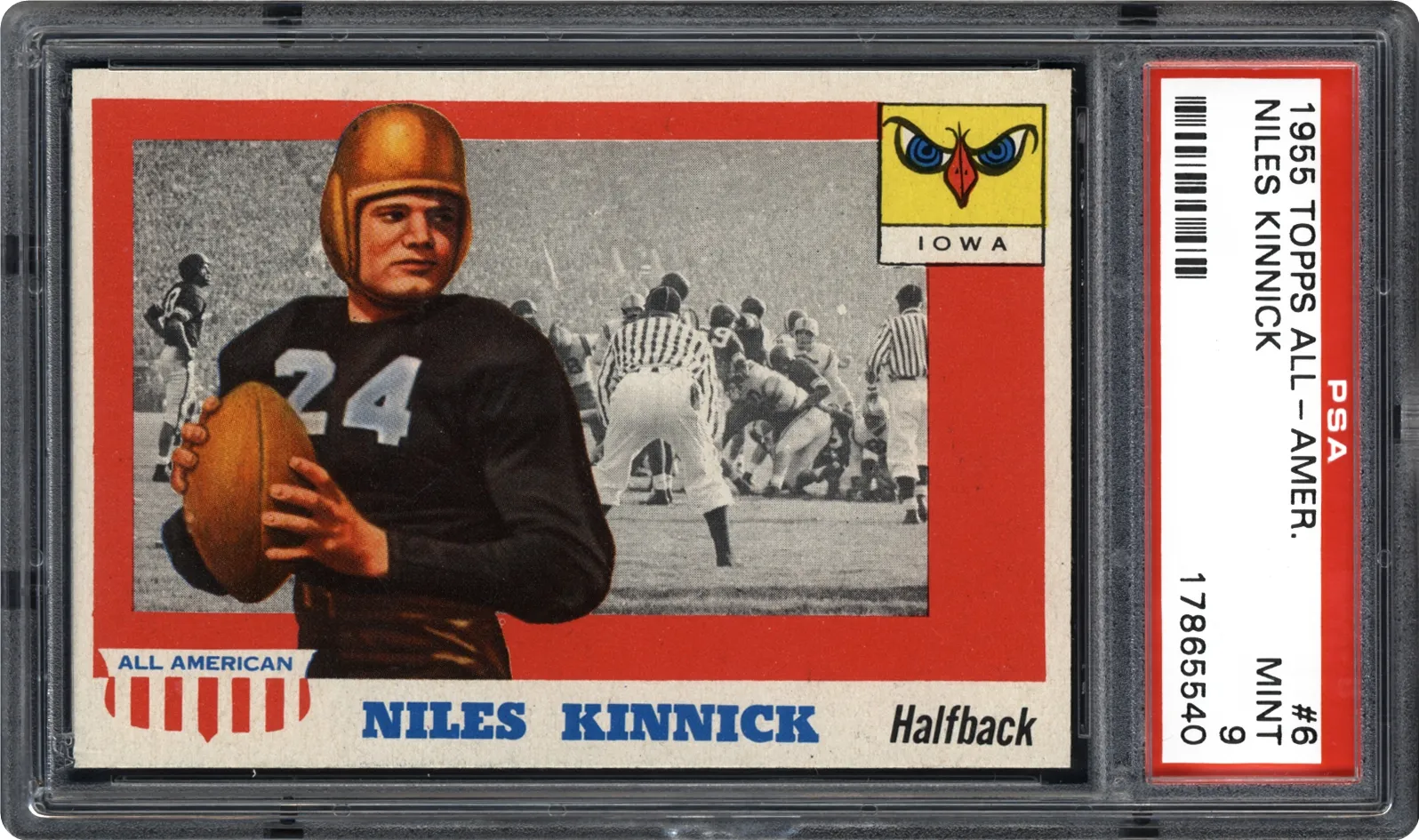
The card itself contains an error that makes it even more distinctive: Topps misspelled his name. The card reads "Niles Kinnick" instead of "Nile Kinnick" — an uncorrected error that has become a defining characteristic of the card rather than a flaw collectors try to avoid. In the world of vintage football cards, a recognizable error can add narrative value, and the Kinnick misspelling is the most famous in the entire 1955 Topps All-American set.
The Man Behind the Card
Nile Kinnick was the University of Iowa's first Heisman Trophy winner, capturing college football's highest honor in 1939 after a season that saw him lead the nation in scoring with 107 points — a remarkable total for a single-wing tailback who also played defensive back, punted, and returned kicks. In an era when the Heisman was dominated by players from Notre Dame, Army, and the major eastern programs, Kinnick's win put Iowa football on the map in a way that had never happened before.
After graduation, Kinnick enrolled at the University of Iowa College of Law but put his legal career on hold when the United States entered World War II. He joined the U.S. Navy and trained as a naval aviator, earning his wings in 1942. On June 2, 1943 — just days before the anniversary of D-Day — Kinnick was on a routine training flight over the Gulf of Paria off the coast of Venezuela when his F4F Wildcat developed an oil leak. Rather than eject over water, he attempted to return to the USS Lexington. His engine failed. He was 24 years old.
His body was never recovered. The Navy memorialized him as missing in action, and the University of Iowa retired his number — the first athlete in the school's history to receive that honor.
The 1955 Topps All-American Set
The 1955 Topps All-American football set is unlike any other. Rather than depicting active NFL players, the set features 100 college football legends, ranging from the early 1900s through the 1940s. Issued more than a decade after Kinnick's death, this card serves as his de facto rookie card — a posthumous tribute to a player whose life and career were cut short before the modern trading card era began.
The set includes other icons like Jim Thorpe, Red Grange, and Bronko Nagurski, but the Kinnick card carries a unique emotional weight. It captures a player who never had the chance to play professional football in the modern sense — Kinnick was drafted by the Brooklyn Dodgers of the AAFC in 1941 but never played a down. The only photographic evidence of his playing career comes from his college days at Iowa, and the Topps All-American card uses a portrait that shows Kinnick in his Iowa uniform, helmetless, looking every bit the all-American boy who went to war and never came home.
The misspelling of his first name as "Niles" is believed to be a simple research error by Topps — a mistake that was never corrected during the print run. Unlike modern error cards that are corrected mid-production, creating scarce "corrected" versions, the 1955 Topps Kinnick card exists only in its uncorrected "Niles" state. There is no corrected version to collect, which means the error is universal rather than rare — but it is the error that makes the card instantly recognizable and gives it a story that every new generation of collectors rediscovers.
PSA Population Report
| PSA Grade | Population | Value |
|---|---|---|
| GEM-MT 10 | 0 | — |
| MINT 9 | 6 | $2,750 |
| NM-MT 8 | 90 | $350 |
| Total Graded (All Grades) | 778 | — |
* Population data as of June 16, 2026. PSA population counts are dynamic and increase as more cards are submitted for grading.
Market Analysis
The Kinnick card's market tells a story of extreme condition sensitivity. A PSA 9 commands roughly $2,750 — a substantial premium that reflects both the card's scarcity in high grade and its emotional collector appeal. With just 6 PSA 9s in existence and zero PSA 10s, there is no such thing as a truly "gem mint" Kinnick rookie. The highest grade available is MINT 9, and the supply is so tight that even a single sale can move the market.
PSA 8 examples trade around $350 — still a significant figure for a card from a niche set that doesn't feature an active NFL player. At the lower end, raw copies in VG-EX condition can be found for under $100, making the card accessible to collectors who want to own a piece of football history without the six-figure price tags attached to other pre-war and early post-war football rarities.
The Kinnick card also benefits from the broader cultural awareness of his story. Iowa's Kinnick Stadium — named in his honor — keeps his memory alive for every generation of college football fans. Each time Iowa plays a night game, the "Kinnick Wave" sees fans and players alike turn to the University of Iowa Stead Family Children's Hospital and wave to the children watching from the windows, a tradition that has made the stadium name synonymous with sportsmanship. Every new article, documentary, or feature about the Wave introduces another cohort of collectors to Nile Kinnick's story — and to his card.
Verdict: The 1955 Topps All-American "Niles" Kinnick #6 is more than a football card — it is a memorial, a historical document, and an error card that doubles as a conversation piece. With zero PSA 10s and only six PSA 9s in existence, it is one of the most condition-sensitive pre-modern football cards on the market. For collectors who value story over flash, there may be no more meaningful card in the entire 1955 Topps All-American set.