1959 Topps #514 Bob Gibson — the Fifth-Most-Graded Card in a 572-Card Set, Behind Only Mantle, Clemente, Aaron and Mays
Bob Gibson's rookie card sits at #514 in the 1959 Topps set, the same season Gibson was still two years from his first All-Star selection and more than a decade from the Cardinals retiring his number. Nobody printing this card in 1959 was betting on a Hall of Famer. Collectors have graded it anyway — 6,045 times, more than all but four other cards in a 572-card set.
PSA Population Report
| PSA Grade | Population |
|---|---|
| PSA 10 | 3 |
| PSA 9 | 32 |
| PSA 8 | 391 |
| Total Graded (All Grades) | 6,045 |
* Population data as of September 23, 2026. PSA population counts are dynamic and increase as more cards are submitted for grading.
Fifth in a Field of 572, Behind Only the Set's Four Biggest Names
A full sweep of every card in 1959 Topps — all 572, walked sequentially by CardFacts id — puts Gibson's submission total in real context. Only four cards in the entire set have been graded more: Mickey Mantle's base card at 10,442, Roberto Clemente at 8,038, Hank Aaron at 6,902, and Willie Mays at 6,717. Gibson's 6,045 outpaces every other card in the set, including Mantle's own "Mantle Hits 42nd" feat card, Sandy Koufax, Ernie Banks, and Frank Robinson. A rookie pitcher who hadn't yet thrown a big-league pitch that anyone remembers is graded more often than every position player in the set not named Mantle, Clemente, Aaron, or Mays.
The Gem Rate Runs the Other Way
Volume and rarity point in opposite directions here. Gibson's three PSA 10s against 6,045 total slabs is a 0.05% gem rate — well under the set-wide average of 0.13% across all 572 cards. Sorted against the 248 cards in the set that have earned at least one PSA 10, Gibson's rate ranks the 11th-lowest, tougher to gem than all but ten other cards. The ten ahead of it on toughness are mostly the same handful of superstars: Mantle's base card manages just one PSA 10 in 10,442 attempts (0.01%), Aaron's is one in 6,902, and Frank Robinson, Willie Mays' catch card, Yogi Berra, and Mantle's own "Mantle Hits 42nd" all cluster in the same range. The cards that got submitted the most are, disproportionately, the cards that grade the worst at the top end — a set-wide pattern, not something specific to Gibson.
Analysis: that pattern reads as submission volume outrunning surviving condition. The star and rookie cards in this set were handled, traded, and kept in wallets and shoeboxes far more than the common players around them, which is exactly what drives both numbers up together — more copies survive to be graded, and fewer of them survive in gem condition.
Most of the Set Never Gems at All
324 of the set's 572 cards — 56.6% — have never produced a single PSA 10, at any point since PSA began grading. Against that baseline, Gibson's three tens put him in a minority: the smaller half of the set that has managed a Gem Mint copy at all, even before asking how rare that copy is relative to submissions.
A Birth Year Fixed Mid-Run, Three Cards Over
The sweep turned up one other thing worth noting from the same set: card #40, Warren Spahn, exists in PSA's database as three separate cataloged printings — one reading "Born in 1921" (correct), one reading "Born in 1931" (the error), and a third, "Born in 1931-3 Obscured," where the erroneous digit was blacked out mid-print-run rather than reset. Topps caught its own mistake on the presses. It's a reminder that a full-set walk turns up more than population numbers — cataloging quirks like this one are why collectors specialize in a single vintage set for years at a time.
What PSA Doesn't Price
PSA's Price Guide covers this card from EX 5 through MT 9. It publishes no value at the Gem Mint 10 — three exist, and PSA has apparently never recorded a guide price for that grade.
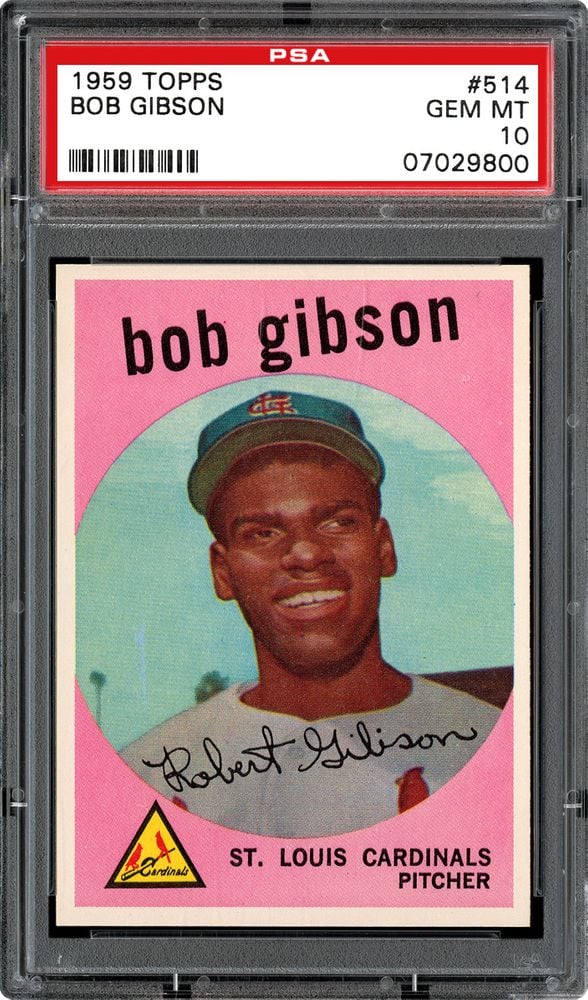
PSA's own cert lookup for one of the three tens, 07029800, independently confirms the population from a separate endpoint: item grade GEM MT 10, PSA Population 3, Pop Higher 0. The label reads "1959 TOPPS / BOB GIBSON / #514 / GEM MT 10" over a pink-bordered portrait of a young Gibson in a Cardinals cap, signed facsimile across the chest.
The verdict: this isn't the most-graded card in 1959 Topps, but it's closer to the top than to the middle — fifth of 572 — and it gems at less than half the rate the set manages on average. That combination, heavy volume and a stingy grading curve, is what six-figure rookie cards from Hall of Famers tend to look like a lifetime later.