Card of the Day: 1966 Topps #35 Bobby Orr RC
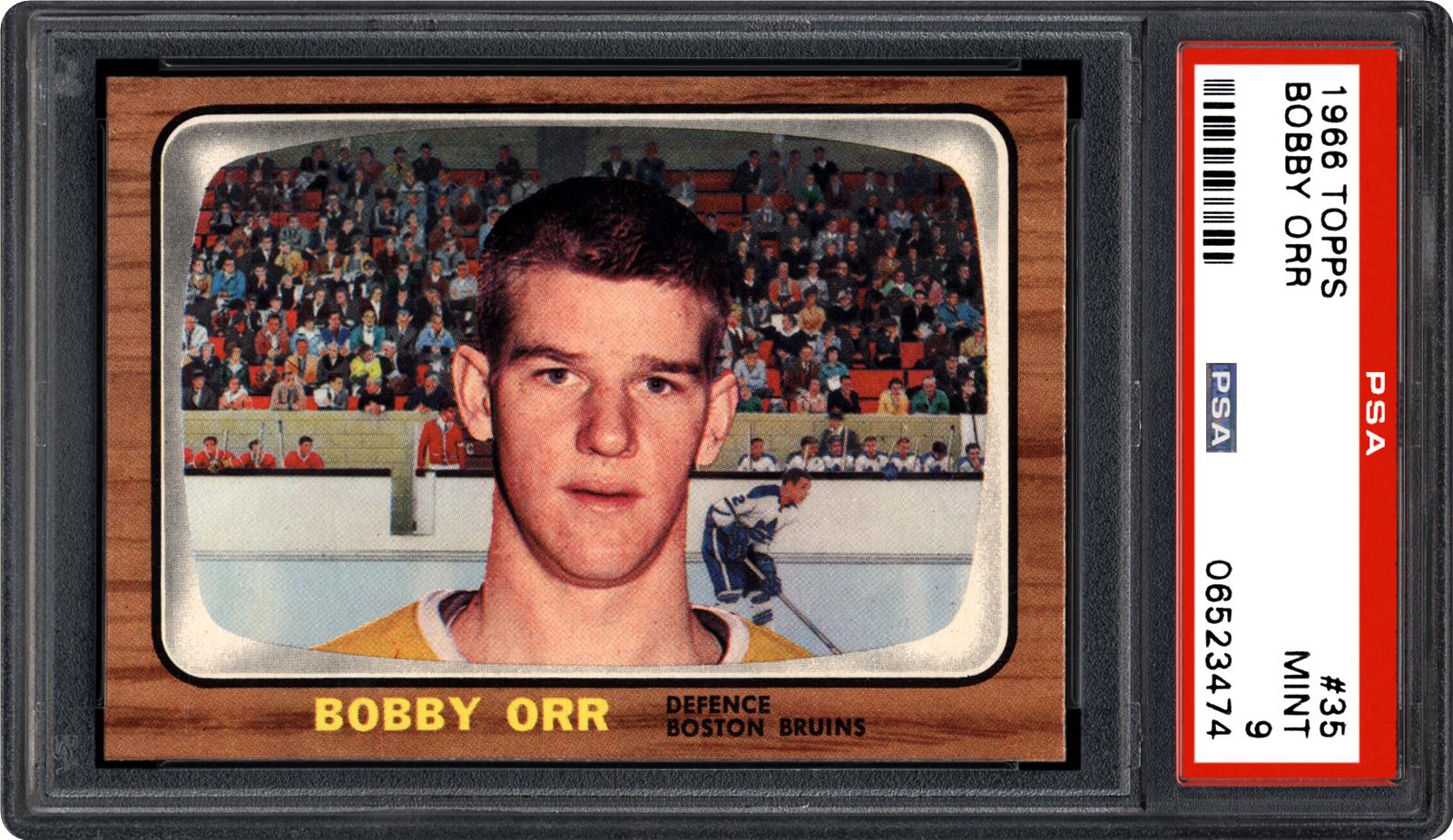
PSA has graded 1,243 copies of Bobby Orr's rookie card. Exactly one has come back MINT 9, and not a single one in the set's entire grading history has ever earned a GEM-MT 10. The card pictured here is that lone 9 — cert 06523474.
The Card
1966-67 Topps #35 is Bobby Orr's rookie card, issued for his first NHL season with the Boston Bruins. It is a horizontal card, which is unusual for vintage hockey, and its design is the reason collectors either love it or curse it: a wood-grain border wrapping a rounded photo window shaped like a television screen. Orr's headshot fills the frame, an arena crowd behind him, a play developing over his shoulder. The bottom panel reads BOBBY ORR — DEFENCE — BOSTON BRUINS.
There is no alternate. No parallel, no variation, no second issue to chase in a different set. If you want Bobby Orr's rookie card, this is the card, and there are 1,243 graded copies in the world.
The Player
Orr did not refine the defenceman position — he broke it. He won the Norris Trophy as the league's best defenceman eight consecutive times, from 1968 through 1975. He won three straight Hart Trophies as league MVP. He remains the only defenceman ever to win the Art Ross Trophy as the NHL's scoring leader, and he did it twice. He carried Boston to Stanley Cups in 1970 and 1972, winning the Conn Smythe both times.
His knees ended it early. He was elected to the Hockey Hall of Fame in 1979 at 31 years old, the customary waiting period waived. The career is short enough to fit on one page and large enough that hockey still measures its defencemen against it.
The Condition Challenge
The wood-grain border is the villain. It is dark, it runs to all four edges, and it registers every corner touch and edge nick as a bright white break in the grain. On a light-bordered card a soft corner is a minor deduction; here it is visible from across a room.
The horizontal format compounds it. These cards were cut inconsistently, and left-to-right centering on a wide card has more room to drift than on a standard portrait issue. Sixty years of shoeboxes and rubber bands did the rest.
The population is the proof. Of 1,243 copies submitted, 47 have graded NM-MT 8 and one has graded MINT 9. Everything else — more than 96 percent of every copy PSA has ever seen — came back at a 7 or below. This is not a card people have failed to submit; it is a card that does not survive.
PSA Population Report
| PSA Grade | Population | Value |
|---|---|---|
| GEM-MT 10 | 0 | — |
| MINT 9 | 1 | $250,000 |
| NM-MT 8 | 47 | $45,000 |
| Total Graded (All Grades) | 1,243 | — |
* Population data as of August 7, 2026. PSA population counts are dynamic and increase as more cards are submitted for grading.
Where the Value Lives
The PSA Price Guide ladder on this card climbs faster than almost anything in vintage hockey. An EX 5 lists at $5,500 and an EX-MT 6 at $8,250 — the entry points, and already serious money. NM 7 lists at $16,500, NM+ 7.5 at $22,000, and NM-MT 8 at $45,000. The 8.5 lists at $90,000, double the 8.
Then the top. The MINT 9 lists at $250,000 — more than five times the 8 and roughly forty-five times the EX 5. With no GEM-MT 10 in existence and one 9 on the planet, that number describes a card with no comparable and no replacement.
Compare it with the 1972-73 O-Pee-Chee Orr #129 we filed on June 11 (CASE #0078), which had two PSA 10s in fifty-three years. That card is scarce at the top. This one has no top at all.
The greatest defenceman who ever played, on the only rookie card he has, in a set engineered to destroy itself — and after 1,243 attempts, nobody has ever produced a perfect one.