Card of the Day: 1969 Topps #260 Reggie Jackson RC
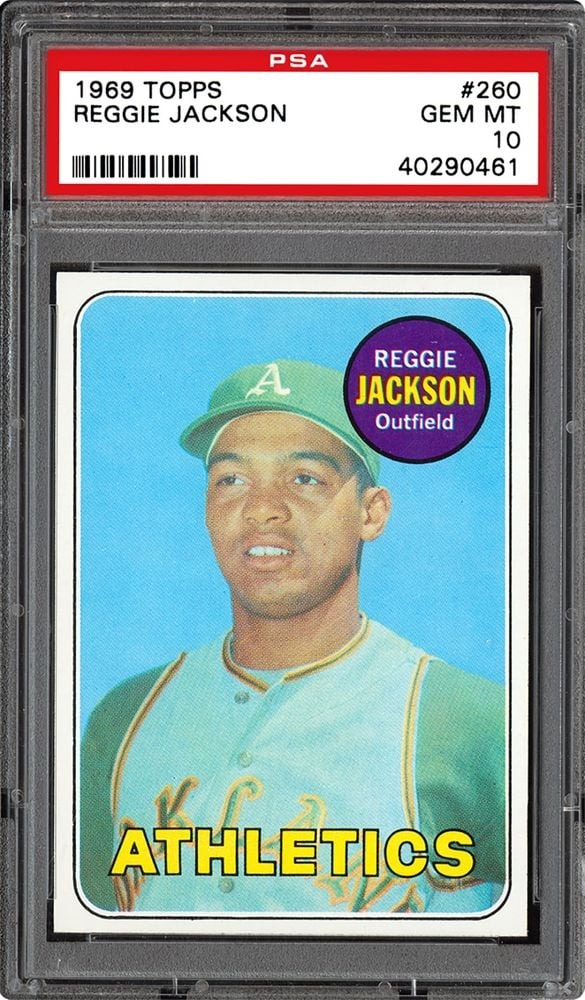
One. PSA has graded 11,749 copies of the 1969 Topps Reggie Jackson rookie and certified exactly one at GEM-MT 10. Not ten. Not three. One — a gem rate of eight thousandths of one percent. The card pictured above is that card: cert 40290461, the only PSA 10 of this issue in existence.
Jackson hit 563 home runs, won five World Series titles, earned the nickname Mr. October by hitting three home runs on three consecutive pitches in the 1977 Series, and entered the Hall of Fame in 1993. His rookie card is a 22-year-old in Kansas City-era Athletics green and gold, and almost nobody owns a clean one.
A White Border and a Circle
The 1969 Topps design is spare: a full-bleed color photo, a thin white border, the team name in block capitals across the bottom, and a circular button in the upper corner carrying the player's name and position. On Jackson's card the button is purple, the letters yellow and white, the background a washed-out light blue, and ATHLETICS runs along the base in heavy yellow type.
That white border is the whole condition story. It is unforgiving of handling in the way every white-bordered vintage issue is — a corner tap reads as a pale blunt point, a fingerprint reads as a gray smudge, and the border makes any off-center cut immediately visible because there is a straight white reference line on all four sides.
Then add the specific problem of 1969 Topps: print quality across the run was inconsistent, and the sheer size of the set meant enormous production. A card can survive fifty-seven years in fine shape and still fail a 10 on centering alone, decided by a cut that happened before it ever left the factory.
PSA Population Report
| PSA Grade | Population | Value |
|---|---|---|
| PSA 10 | 1 | — |
| PSA 9 | 41 | $70,500 |
| PSA 8 | 591 | $3,500 |
| Total Graded (All Grades) | 11,749 | — |
* Population data as of August 12, 2026. PSA's Price Guide lists no value at GEM-MT 10 — with a population of one, there is nothing to price against.
The Cliff Is at Nine
Look at where the money sits. The PSA 9 carries a $70,500 Price Guide value against $3,500 for the PSA 8 — a twenty-fold step for a single grade point. That is one of the steepest 8-to-9 gaps you will find on a mainstream vintage rookie.
The reason is arithmetic. There are 41 Mint copies known and one Gem Mint copy that will almost certainly never trade. For any collector who wants the best obtainable example of this card, the PSA 9 is the top of the market — the grade above it is a museum piece, not an option. Compare that to the 1974 Winfield in CASE #0237, where ten GEM-MT 10s exist and the 9 sits at $1,550, or the 1975 Yount in CASE #0234 with six 10s and 277 9s. Jackson's ladder is narrower at the top than either.
The PSA 8 at $3,500 is the interesting slot. It is the last grade with real supply — 591 copies — and it buys a card that displays honestly for a fraction of what the tier above costs.
Why This Card Was Always Going to Be Hard
Jackson's 1969 issue arrived one year after his breakout: the card back credits a 22-year-old with 29 home runs in 1968, his first full season as an everyday player. Nobody in 1969 was setting this card aside as an investment. It went into shoeboxes, bicycle spokes, and rubber-banded stacks alongside 663 other cards, and the survivors carry every year of that.
Fifty-seven years later the market is asking for a perfectly centered, sharp-cornered, clean-bordered copy of a card that was mass-produced for children. PSA has found one.
Verdict: misdemeanor. A first-ballot Hall of Famer's only rookie card, with a single perfect copy in nearly twelve thousand submissions — and a Mint example that costs twenty times the grade below it.