1970 Topps #25 Jan Stenerud RC — Nine PSA 10s in 762, and Canton's First Pure Kicker
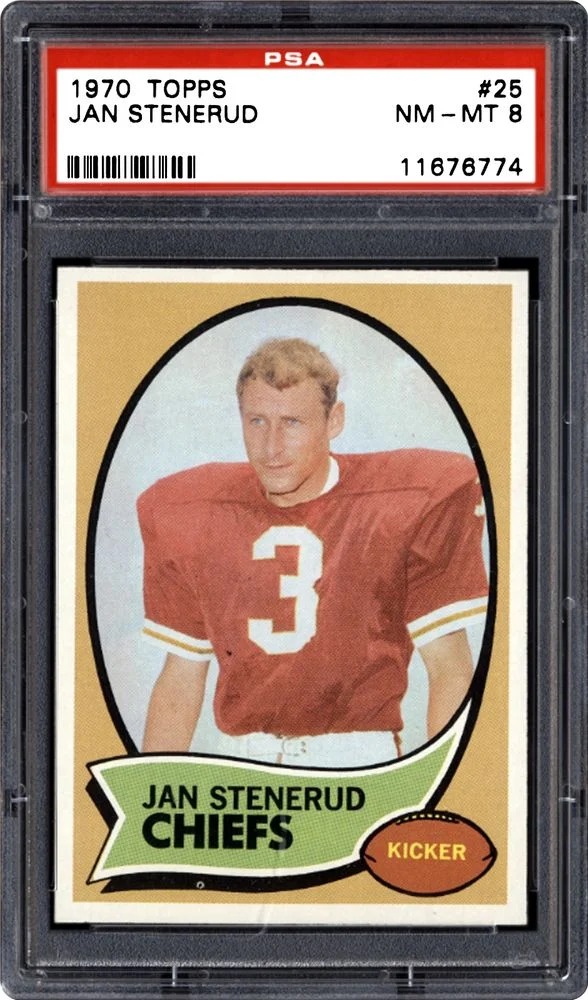
The 1970 Topps football design tucks each player's position into a little brown football in the bottom corner of the card. On card #25, that football reads KICKER. In every case file this blog has published, it has never once run the word. No kicker, no placekicker, not a single field goal. CASE #0290 closes that gap with the man who made the position worth a Hall of Fame bust.
A Ski Jumper Who Got Spotted by the Basketball Coach
Jan Stenerud was born in Fetsund, Norway, in November 1942, and he came to Montana State on a skiing scholarship. He was a ski jumper. Late in his sophomore year, according to the Pro Football Hall of Fame, the college's basketball coach happened to see him kicking a football and passed word along to the football coach.
He joined the team in his senior academic year and played two varsity seasons. In the first of them he connected on a then-NCAA record 59-yard field goal and scored 82 points. The Kansas City Chiefs took him in the third round of the AFL's 1966 Future Draft — a Norwegian ski jumper with two years of football behind him, drafted on the strength of a leg.
Why This Card, and Why 1970
This is Stenerud's rookie card. PSA files it as "Jan Stenerud (R) (HOF)," and the TCDB checklist for the set carries the same designation on row 25.
The timing is the part worth sitting with. The card came out months after Super Bowl IV, where Stenerud's three field goals — including a then-Super Bowl record 48-yarder — accounted for the first nine points of Kansas City's upset of the Minnesota Vikings. Nine points from the kicker before anyone else scored at all. Nineteen seventy is also the year he hit the longest field goal of his career, a 55-yarder against Denver.
So the rookie card of the first pure placekicker in Canton arrives in the window where a kicker had just decided a Super Bowl. The photograph is the ordinary Topps portrait treatment of the era: Stenerud in the red Chiefs jersey, number 3, framed in a black oval on a gold field, his name on a green banner. Nothing about the card announces itself. The football in the corner does the announcing.
PSA Population Report
| PSA Grade | Population |
|---|---|
| PSA 10 | 9 |
| PSA 9 | 100 |
| PSA 8 | 260 |
| Total Graded (All Grades) | 762 |
* Population data as of August 28, 2026. PSA population counts are dynamic and increase as more cards are submitted for grading.
Those 762 are full straight grades. PSA has also certified 18 half grades and 35 qualified examples of card #25, which brings the total number of Stenerud rookies in PSA holders to 815.
The ladder peaks where vintage football usually peaks — 260 at PSA 8, 171 at PSA 7, 110 at PSA 6 — and then falls off a cliff. One hundred nines. Nine tens.
The Set-Mate Comparison
This blog has been inside 1970 Topps once before, at CASE #0231, for the O.J. Simpson rookie at card #90. Those numbers were pulled fresh from PSA this morning rather than quoted from the old file: 5,872 straight grades, 671 at PSA 8, 119 at PSA 9, and one PSA 10.
One, in 5,872. Stenerud has nine, in 762.
Analysis: Two cards from the same set, printed on the same stock in the same year, produce top-end results that are not remotely comparable — the kicker's card reaches PSA 10 at roughly seventy times the rate of the set's marquee rookie, off an eighth of the submissions. Nothing in PSA's data attributes that gap to a cause. The population report records what got graded and how it scored; it does not record which copies people bothered to send, or why. The two facts sit next to each other and the reader can draw the line.
Nineteen Years, and He Never Missed a Game
Stenerud kicked for the Chiefs for 13 seasons, from 1967 through 1979, and was released in the summer of 1980. Three months later he signed with Green Bay, where he stayed four years; the Packers traded him to Minnesota in 1984 for a seventh-round pick, and he retired after the 1985 season.
Nineteen seasons. Two hundred sixty-three games. He never missed one because of injury or illness.
He finished with 1,699 points, behind only George Blanda on the all-time scoring list at the time he walked away. His 373 career field goals and his seven seasons of 100 or more points were both NFL records. Seventeen of his field goals travelled more than 50 yards. He was a six-time all-league selection, played in two AFL All-Star Games and four Pro Bowls, and was named Outstanding Offensive Player of the 1972 Pro Bowl.
The Hall of Fame took him in the Class of 1991 — the first pure placekicker it ever enshrined.
The Verdict
Analysis: A card like this one is what the position looks like in the hobby's records. Seven hundred sixty-two straight-graded copies is a small number for a Hall of Fame rookie from a mainstream Topps set, and the blog's own record is a fair reflection of the same thing — hundreds of case files without the word "kicker" in any of them.
CASE #0290 is filed as a misdemeanor: nine PSA 10s, a Super Bowl decided nine points at a time, and a ski jumper from Fetsund who got found by a basketball coach. The little brown football on card #25 was telling the truth.