Card of the Day: 1970 Topps #90 O.J. Simpson RC
PSA has graded 5,848 copies of the 1970 Topps #90 O.J. Simpson rookie card. Exactly one of them is a GEM-MT 10.
Not one percent. One card.
The Card
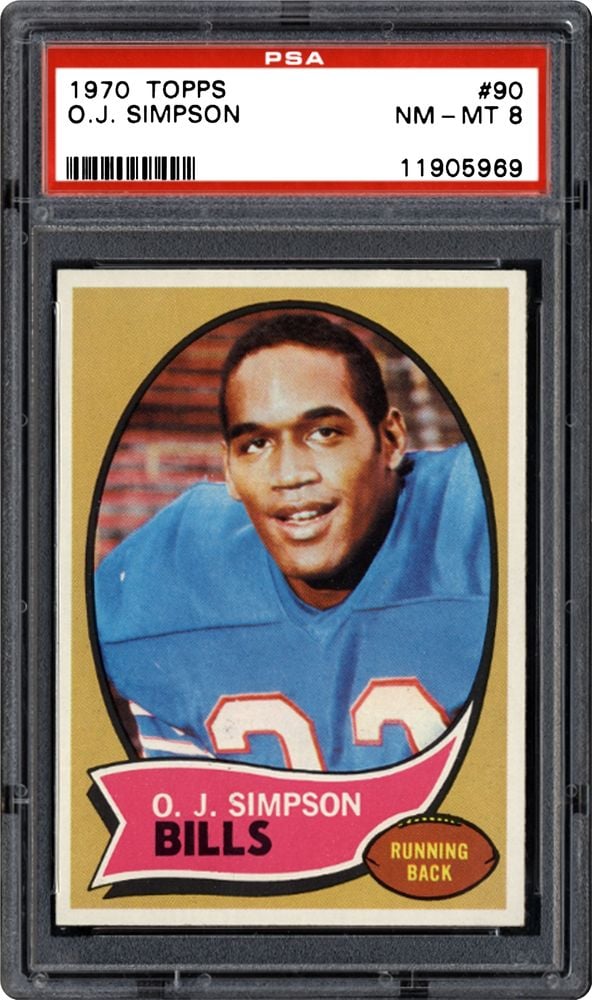
Card #90 in the 1970 Topps football set is Simpson's rookie card, showing him in Buffalo Bills blue with the position banner reading RUNNING BACK across the bottom. The design is pure 1970 Topps: an oval photo window floating on a flat gold field, the player name and team in a red ribbon underneath, and a football-shaped badge in the corner carrying the position.
The photo is a close crop — shoulders and helmet-less head, stadium seating blurred out behind him. It is one of the more recognizable rookie cards of the early-1970s football run, and it belongs to a Hall of Fame running back whose later life has been documented at length well outside the hobby. This entry is about the cardboard and the census.
PSA Population Report
| PSA Grade | Population | Value |
|---|---|---|
| GEM-MT 10 | 1 | — |
| MINT 9 | 119 | $4,950 |
| NM-MT 8 | 671 | $800 |
| Total Graded (All Grades) | 5,848 | — |
* Population data as of August 8, 2026. PSA population counts are dynamic and increase as more cards are submitted for grading.
Reading the Census
The interesting number in that table is not the single 10 — it is the 5,848.
Add the top three tiers together and you get 791 cards graded NM-MT 8 or better. Against a total census of 5,848, that is roughly 13.5% of everything PSA has ever graded of this card. The other 86.5% came back a PSA 7 or lower.
That is a very bottom-heavy population for a card this heavily submitted, and it tells you the failure mode is baked into the issue itself rather than into how any one copy was stored. A gold border on a flat, light-colored field punishes every chip and every off-center cut, and a card that has been submitted almost six thousand times has had its best surviving copies found already. The gem population is one because the population is mature, not because nobody has looked.
The Price Cliff
PSA's Price Guide puts the MT 9 at $4,950 and the NM-MT 8 at $800. That is roughly a six-fold jump for a single grade point, on a card where the 9 population (119) is not remotely rare in absolute terms — it is just rare relative to the 671 eights and the several thousand sevens-and-below sitting underneath them.
Further down the ladder, PSA's guide lists the NM 7 at $300 and the EX-MT 6 at $150. The entire spread from 6 to 9 is $150 to $4,950, and almost all of that value is created in the last step.
The slab pictured above is one of the 671 — cert 11905969, graded NM-MT 8. It is the grade where this card is genuinely available, and it sits one notch below where the money starts.
The Verdict
This is a condition-rarity card wearing a common card's population count. Nearly six thousand graded copies makes it sound accessible, and at the 6 and 7 level it genuinely is. But the census says the 1970 Topps gold border did its job for fifty-five years: the top of this population is thin, the single 10 is effectively unrepeatable, and the entire premium lives in the jump from 8 to 9.
If you want this rookie in a holder, the 8 is the honest buy. If you want the 9, understand you are paying six times as much for the last surviving quarter-millimeter of border.