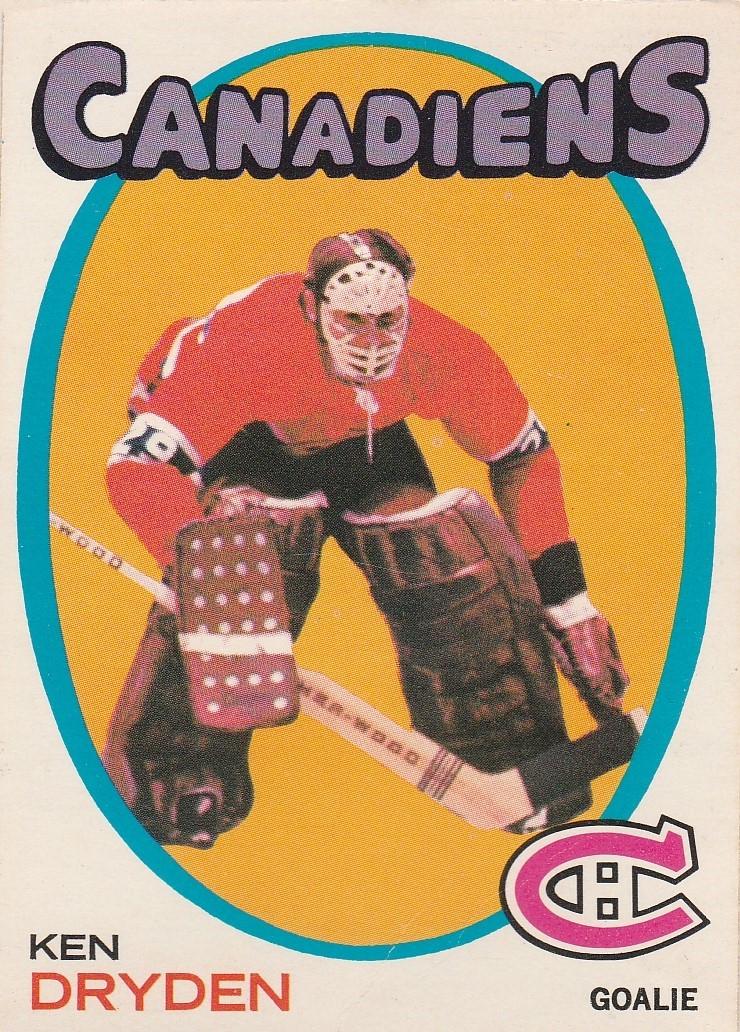
1971 O-Pee-Chee #45 Ken Dryden — the Most PSA 10s of Any Card in the Set, and He Still Gems Below the Set's Own Rate
No card in the 264-card 1971-72 O-Pee-Chee hockey set has more PSA 10s than card #45. Not Bobby Orr, who appears three times. Not Gordie Howe. Not Guy Lafleur's rookie, the most-submitted card in the set. The leader is a goaltender who had played six regular-season games in his life when the season this set documents began.
Ken Dryden was called up from a farm club in the spring of 1971. The Hockey Hall of Fame's account of what happened next repays reading in full: he appeared in six games, helped Montreal win six straight, and was then handed the net for a first-round playoff series against a Boston team that had set several NHL records that season — Phil Esposito, Bobby Orr, Wayne Cashman, Ken Hodge and Johnny Bucyk, with home ice. Esposito had scored 76 goals in 78 regular-season games. Against Dryden he scored three in seven games. Montreal took the series, then Minnesota, then Chicago, and Dryden won the Conn Smythe Trophy as the most outstanding performer of a playoff run he was not supposed to be in.
He won the Calder as rookie of the year the following season, making him the first goaltender in NHL history to take the Conn Smythe and then the Calder. Six Stanley Cups in eight seasons, 46 shutouts, inducted in 1983. He died on September 5, 2025.
This card is the one that came out of the machine while all of that was happening.
PSA Population Report
| PSA Grade | Population |
|---|---|
| PSA 10 | 13 |
| PSA 9 | 62 |
| PSA 8 | 205 |
| Total Graded (All Grades) | 1,714 |
* Population data as of September 16, 2026. PSA population counts are dynamic and increase as more cards are submitted for grading.
The four-row table is the least interesting version of this card. PSA's straight grades run to 1,714, with another 177 half grades and 53 qualified grades counted separately — 1,944 slabs in all — and the full curve peaks at the PSA 6, where 267 copies sit. The four is next at 264, then the five at 218. The three and the eight tie at 205 apiece.
Above the eight there are 75 copies in total: 62 nines and 13 tens, 4.4% of every straight grade PSA has assigned this card. Below it, at the far end, sit 120 copies graded PSA 1 — nine times as many as have ever gemmed.
The Whole Set, Card by Card
CardFacts ids run sequentially by card number inside a set, so all 264 cards can be walked. This blog pulled every one of them on September 16, 2026. The set has taken 46,804 straight grades, plus 1,861 half and 1,978 qualified, and it has produced exactly 591 PSA 10s — a set-wide gem rate of 1.26%. Sixty-one of the 264 cards have never graded a 10 at all.
Dryden's 13 is the highest count in the set, outright, with nothing tied. And here is the part that makes it strange: he gems at 0.76%, well under the set's own 1.26%. He does not lead because the card survives well. He leads because 1,714 people sent one in.
The set's four most-submitted cards make the same point in a row:
- #148 Guy Lafleur RC — 2,193 straight grades, 6 PSA 10s
- #45 Ken Dryden RC — 1,714 straight grades, 13 PSA 10s
- #133 Marcel Dionne — 1,405 straight grades, 6 PSA 10s
- #100 Bobby Orr — 848 straight grades, zero PSA 10s
Dryden has more PSA 10s than the other three combined. Orr's base card is the fourth-most-graded card in the set and has never produced a single gem in 848 attempts. The blog covered the Lafleur rookie from this same set in CASE #0246; the gap between his 2,193 submissions and his six tens is the sharpest illustration in the set of what 1971-72 O-Pee-Chee does to a card.
What it does is mostly at the edges. This is a dark-bordered, rough-cut set, and the grading record reads like one: of the 346 PSA 1s the entire 264-card checklist has produced, 243 of them — 70% — belong to just two cards, Lafleur's rookie and this one. The set's two most-submitted cards are also the two that got handled the hardest.
The cards that actually gem are the ones nobody chased. Forty-one cards in the set have five or more PSA 10s, and only three of those have been graded more than 500 times — Dryden, Dionne and Lafleur. The second-highest gem count in the entire set belongs to card #32, Ted Harris, with 10 PSA 10s from 157 straight grades: a 6.37% rate, five times the set's own.
The Verdict
The three Bruins the Hall of Fame names in its account of Dryden's spring are all in this set with him: Esposito at #20, Bucyk at #35, Orr at #100. Those three cards hold six PSA 10s between them. Dryden's one card holds 13.
He beat them in 1971 with six games of NHL experience, and fifty-five years later he is still ahead of them on the population report — not because his card survived better, but because more people cared enough to send it in and take their chances.