1971 Topps #245 Joe Greene RC — Zero PSA 10s in 3,296, and Fourteen Nines Behind a Black Border
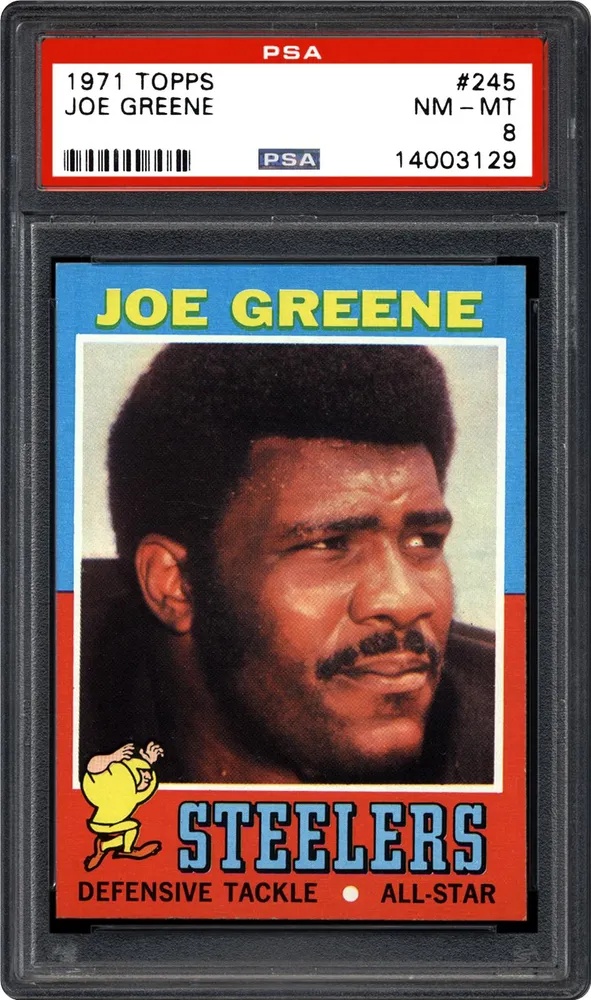
The card above is a PSA NM-MT 8, certification number 14003129. On most vintage football cards that is a very good copy sitting two rungs below the ceiling. On this one it is sitting two rungs below nothing at all.
PSA has certified 3,296 copies of the 1971 Topps Joe Greene rookie across every full grade it issues. The Gem Mint 10 column reads zero. Fourteen copies have come back Mint 9. That is the entire top of this card, fifty-five years after it came out of a pack.
The Card
Card #245 is built like the rest of the 1971 Topps football release: a hard black border wrapped around every edge, a blue panel across the top carrying JOE GREENE in yellow, and a red band underneath with STEELERS in block letters and a cartoon lineman planted beside it. Greene is photographed in close, helmet off. The strip along the bottom reads DEFENSIVE TACKLE ★ ALL-STAR.
Two sources agree on what the card is. PSA files the population under the player name "Joe Greene (R) (HOF)" — the (R) is PSA's rookie flag. TCDB's 1971 Topps checklist carries #245 as "Joe Greene AS, RC." It is his first Topps card and an All-Star subset card at the same time, the same double duty the 1982 Topps All-Pro rookies of Lawrence Taylor (CASE #0276) and Anthony Muñoz (CASE #0281) pull in a later set.
Analysis: the black border is doing most of the damage. A black edge displays every white speck of chipping the printing process, the pack and the shoebox can put on a card, where a white or light border hides the same wear completely. Nothing in PSA's data attributes the grades to the borders — but the set is black-bordered and the top of its population is empty, and those two facts sit next to each other on every card in it.
PSA Population Report
| PSA Grade | Population |
|---|---|
| PSA 10 | 0 |
| PSA 9 | 14 |
| PSA 8 | 273 |
| Total Graded (All Grades) | 3,296 |
* Population data as of August 27, 2026. PSA population counts are dynamic and increase as more cards are submitted for grading.
Where the Card Gives Out
Read the full ladder and the failure point is obvious. The population peaks at PSA 6, with 701 copies. Below it sit 666 at PSA 4, 651 at PSA 5, 306 at PSA 3. Above it, 559 at PSA 7, then the fall: 273 at PSA 8, 14 at PSA 9, none at PSA 10.
PSA separately records 155 half grades and 108 qualified copies of the card, counted outside the 3,296 above. Add all three buckets together and 3,559 Joe Greene rookies are sitting in PSA holders. Not one of them is a 10.
The Other Rookie in the Same Set
This blog opened the file on 1971 Topps #156 Terry Bradshaw on August 4 (CASE #0219). Bradshaw's population, re-pulled this morning: 6,297 copies across the full grades, with 458 at PSA 8, 21 at PSA 9, and 3 at PSA 10. Same set, same borders, same year, nearly twice the submissions.
Analysis: the interesting part is that Greene's card is not the worse survivor. Fourteen nines out of 3,296 is a rate of 0.42%; Bradshaw's 21 out of 6,297 is 0.33%. Counting everything graded 8 or better, Greene returns 8.7% against Bradshaw's 7.7%. On every rung the two cards share, the Greene population is the cleaner of the two. It has simply never cleared the last rung, and the Bradshaw has — three times out of nearly seven thousand tries.
Analysis: a zero is not proof that a card is harder than one with three. It is proof that nobody has found one yet, on a card that has been submitted half as often. The 1971 borders set the difficulty; the submission count sets how many lottery tickets have been bought against it.
The Man in the Slab
Greene was a 1968 consensus All-America at North Texas State and Pittsburgh's first pick in the 1969 NFL Draft, per the Pro Football Hall of Fame. He was named NFL Defensive Rookie of the Year that season and collected the first of ten Pro Bowl invitations. He was All-NFL five times and earned all-conference recognition eleven consecutive years, 1969 through 1979.
The Hall names him Defensive Player of the Year in both 1972 and 1974 — a career-high 11 sacks in 1972, including a five-sack, one-fumble-recovery afternoon against Houston in a must-win 9-3 game for an injury-riddled Steelers team. In 1974 he began lining up at a sharp angle between the guard and the center to wreck the blocking assignments in front of him, and Pittsburgh won its first AFC championship and Super Bowl IX. His interception and a fumble recovery at the Pittsburgh five-yard line were, in the Hall's telling, major factors in Minnesota's demise.
He opened his career with a 91-game streak and played 181 of a possible 190 regular-season games across thirteen years. Canton took him in 1987.
The nickname on the card is not there — Topps calls him Joe Greene, nothing more — and Greene spent a good deal of his enshrinement pushing back on it anyway. "I just want people to remember me as being a good player and not really mean," he said. "I want to be remembered for playing 13 years and contributing to four championship teams. I would like to be remembered for maybe setting a standard for others to achieve."
The Trenches, Two Days Apart
On August 25 this file ran its first offensive lineman (CASE #0281). Card #245 is the first defensive lineman. Every football COD before these two was a quarterback, running back, receiver, defensive back, linebacker or tight end — Deacon Jones, Bob Lilly, Alan Page, Merlin Olsen and Bruce Smith all return nothing across the full archive.
A Hall of Fame rookie card, a set that punishes every copy of it, 3,296 graded and not one perfect — and the man on the front asked to be remembered for the standard rather than the nickname. CASE #0287: CLOSED.