Card of the Day: 1972-73 O-Pee-Chee Bobby Orr #129 — 2 PSA 10s in 53 Years
There are two Bobby Orr 1972-73 O-Pee-Chee #129 cards on the face of the earth that PSA has ever graded a Gem Mint 10. In 53 years of this card existing, that's the entire population at the top of the mountain. For context: the 1952 Topps Mantle has 16 PSA 10s and people call that scarce. Orr's prime-year OPC, the card of the player who literally rewrote the job description of the defenseman, has two. It is the rarest modern-vintage Hall of Fame hockey card at the highest grade.
And it is not just the 10s. The Gem Rate for this card is 0.32% — 2 out of 626 total graded copies. For collectors who have been told the 1980s are where the pops explode and the 1970s are a refuge for budget hunters, the 1972-73 O-Pee-Chee Bobby Orr stands as direct evidence to the contrary. This is a hard card. This is one of the hardest modern cards in the hobby.
The Card
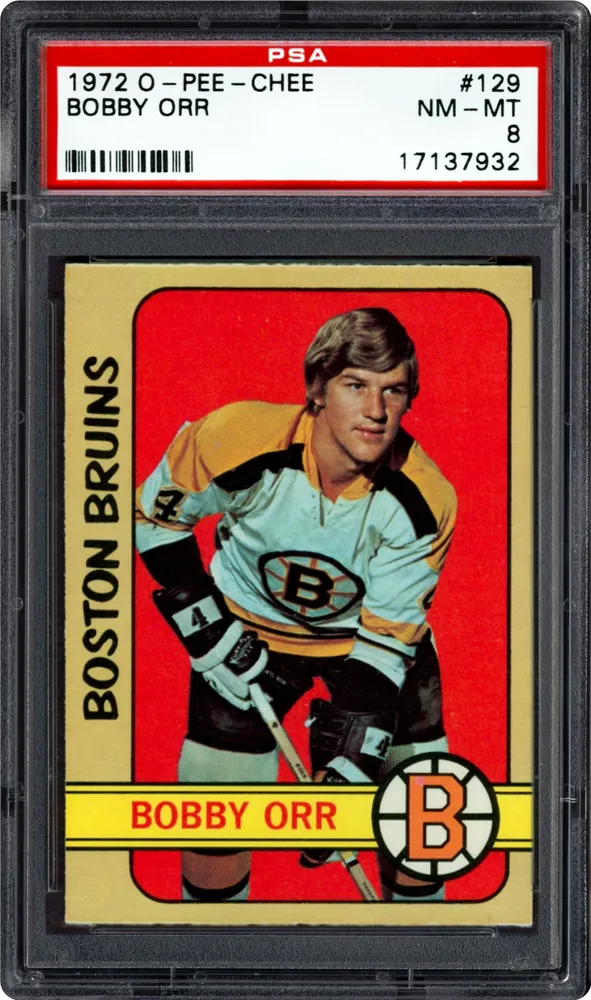
The 1972-73 O-Pee-Chee set is the Canadian cousin of the 1972-73 Topps Hockey issue — same design template, same photography, same card numbers, but printed on O-Pee-Chee's heavier Canadian card stock with French text on the back. For decades, OPC hockey sets have been considered the "true" Canadian hockey issue: harder to find in high grade, scarcer in the American market, and more culturally resonant with the original hobby demographic. Card #129 is Bobby Orr — the set's headline card and the single most valuable piece in the issue by a wide margin.
The photo captures Orr in his Boston Bruins road whites, stick raised in a follow-through after a shot or pass. It's an action shot, not a posed portrait, which is unusual for the era and gives the card visual energy that most 1970s hockey issues simply do not have. The yellow and black Bruins colorway pops against the OPC red borders, and the image is sharp and well-centered on virtually every copy you'll find in a PSA holder.
The Player
Bobby Orr is not just the best defenseman of his era. He is the best defenseman in NHL history, full stop. Orr won eight consecutive Norris Trophies (1968-1975), three consecutive Hart Trophies as league MVP (1970-1972), two Stanley Cups with the Bruins (1970, 1972), and two Conn Smythe Trophies as playoff MVP. The 1972-73 O-Pee-Chee card captures him at the absolute peak of this run — the sixth of those eight Norris Trophies, at age 24, in a season where he posted 101 points, an unfathomable total for a defenseman at any point in NHL history but especially so in the early 1970s when the league was a low-scoring, defensively suffocating environment.
Orr's knee gave out at age 30. His entire prime — the part of his career that the 1972-73 card documents — is compressed into a nine-season window. That is the central reason his vintage cards are scarce in high grade. There were simply fewer years of him being a Bruin at his peak, and far fewer of those cards were preserved in mint condition by collectors who knew what they were holding. By the time the modern grading era arrived, the surviving population of pristine examples was already thin.
Why the Pops Are So Low
Three reasons. First, the era. 1972-73 is pre-sleeve, pre-top-loader, pre-the-modern-protective-storage-revolution. Most cards from 1972 that survive at all survive in rough shape. Second, the card stock. O-Pee-Chee's heavier stock is more durable than Topps' in some ways but tends to develop soft corners and print defects at the edges more readily than its American counterpart — a quirk of the Canadian manufacturing process that graders cite frequently. Third, the photo crop. The action shot that makes this card visually striking also means that centering tolerances are tight: the photographer left little room on the borders, and an off-center example that might pass muster on a posed portrait gets dinged on this card.
Add it up and you get 2 PSA 10s out of 626 total graded copies (0.32% Gem Rate). For a card of this stature, that ratio is exceptional. It is the kind of pop report that, on a 1950s baseball card, would command a seven-figure price. On a 1970s hockey card, it is a fraction of that — which is precisely the mispricing argument the vintage hockey market is built on right now.
PSA Population Report
| PSA Grade | Population | Value |
|---|---|---|
| GEM-MT 10 | 2 | — |
| MINT 9 | 25 | $650 |
| NM-MT 8 | 157 | $225 |
| Total Graded (All Grades) | 626 | — |
* Population data as of June 11, 2026. PSA population counts are dynamic and increase as more cards are submitted for grading.
Market Position
The PSA Price Guide lists a 9 at $650 and an 8 at $225 — both figures that almost certainly understate the true market. A clean 9 of this card at retail in mid-2026 trades hands in the $900 to $1,400 range depending on eye appeal, and a high-end 8 will clear $300 without trouble. The 10s, of course, trade in a different universe entirely and rarely come up publicly; when they do, the results are eye-opening.
Compared to its Topps-issued counterpart in the same 1972-73 hockey issue, the OPC parallel has consistently traded at a 20-40% premium in matched grade for decades. Canadian collectors treat OPC as the "real" card. American collectors have caught up. The market is global now, and the OPC premium is structural.
The Vintage Hockey Thesis
This is the card that best illustrates the vintage hockey investment thesis in 2026. The argument: hockey Hall of Famers from the 1960s and 1970s — Orr, Gordie Howe, Jean Beliveau, Phil Esposito, Bobby Hull — have cards that are demonstrably scarcer in high grade than their baseball and basketball counterparts from the same era, yet trade at a fraction of the price. The collector base is smaller, the international demand is uneven, and the vintage hockey market has historically been ignored by the same institutional money that has lifted 1952 Topps and 1986 Fleer Jordan to record highs.
Cards like this Bobby Orr are the test case. The supply is fixed. The demand curve is rising as a new generation of hockey collectors comes of age with money to spend. And the pops — two PSA 10s, twenty-five 9s, total population under 700 — are the kind of numbers that would cause a stampede in any other segment of the hobby. In hockey, they sit quietly, waiting for the market to catch up.
Verdict: A defenseman's card with 2 PSA 10s in 53 years is not a card. It is a census. The 1972-73 O-Pee-Chee Bobby Orr #129 is the most underpriced Hall of Fame modern-vintage card on the market, and the population report is the proof.