1972 Topps #195 Julius Erving RC: He Signed With the Hawks, a Judge Sent Him Back to the Squires, and PSA Has Graded One 10
Julius Erving's rookie card shows him in a Virginia Squires uniform. In 1972 he signed with the Atlanta Hawks, the Milwaukee Bucks drafted him, and he played preseason games for Atlanta before a judge ordered him back to Virginia. PSA has graded 6,322 copies of the card, and exactly one is a Gem Mint 10.
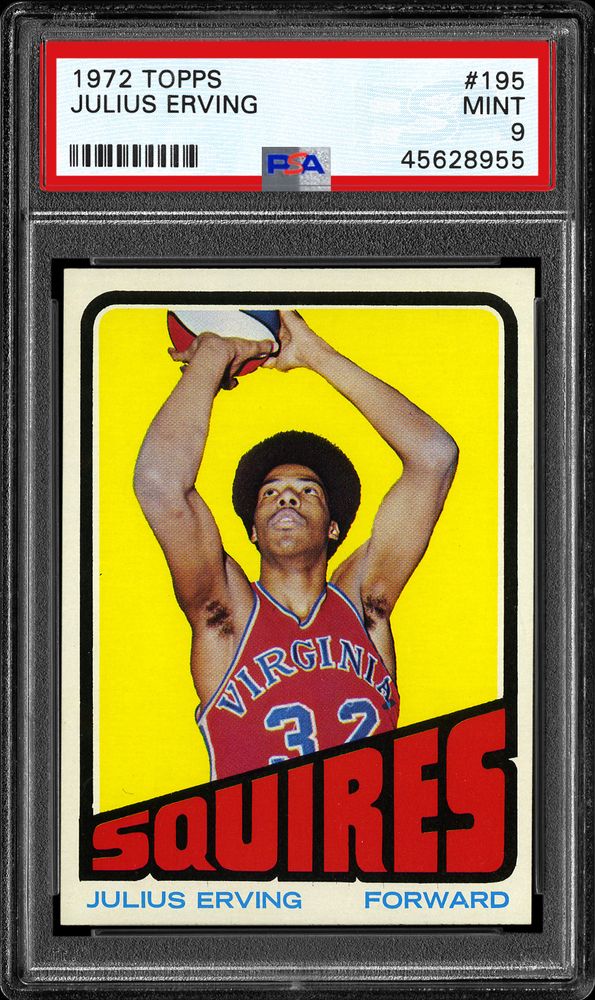
The card is #195 in the 1972-73 Topps basketball set, which PSA files as 1972 Topps, and PSA's record for it carries both the rookie and Hall of Fame designations. Erving holds the ball over his head with both hands, his eyes on the basket, in a red Virginia jersey with the number 32, against a plain yellow background. "SQUIRES" runs across the bottom in tall red block letters set at an angle, and the border below reads "JULIUS ERVING" and "FORWARD." The copy pictured is a PSA Mint 9, cert 45628955.
Three Teams, Two Leagues
Erving left the University of Massachusetts after his junior year under the ABA's "hardship" rule and signed with the Squires. As a rookie in 1971-72 he scored 27.3 points a game, made the ABA All-Rookie Team and finished second to Artis Gilmore for Rookie of the Year.
Then the contract fell apart. Erving had learned that his agent, Steve Arnold, was employed by the Squires and had talked him into a below-market deal, and he demanded a new one. Before the 1972 NBA draft he signed with the Hawks. The Bucks took him 12th overall in that draft anyway, and the Squires went to court to hold him to his contract.
He went to Atlanta's training camp, where Pete Maravich was his teammate, and played two exhibition games before NBA Commissioner J. Walter Kennedy ruled that Milwaukee held his rights. Kennedy fined the Hawks for each game, and Erving played one more while Atlanta appealed. On Oct. 2, Judge Edward Neaher issued an injunction barring him from playing for anyone but the Squires.
He went back to Virginia and scored 31.9 points a game in 1972-73, the best average of his career. The next year the Squires, short of money, sold his contract to the New York Nets.
Dr. J
With the Nets he won ABA championships in 1974 and 1976, and the Hall of Fame counts three ABA Most Valuable Player awards and three ABA scoring titles. He was the 1976 ABA Slam Dunk champion. When the leagues merged he joined the Philadelphia 76ers, won the 1981 NBA MVP and, in 1983, an NBA championship alongside Moses Malone. He is the only player voted MVP in both the ABA and the NBA. Across 16 seasons, none of his teams missed the playoffs, and he finished with 30,026 points in the two leagues combined. He was enshrined in the Naismith Hall of Fame in 1993.
PSA Population Report
| PSA Grade | Population |
|---|---|
| PSA 10 | 1 |
| PSA 9 | 160 |
| PSA 8 | 1,062 |
| Total Graded (All Grades) | 6,322 |
* Population data as of October 20, 2026. PSA population counts are dynamic and increase as more cards are submitted for grading.
One 10
Of 6,322 graded copies, PSA has called one a Gem Mint 10. Below it sit 160 Mint 9s, and 1,223 copies in all, about one in five, reach PSA 8 or better.
The rest of the population is built around the middle grades, with PSA 6 the most common result and PSA 7 close behind:
- PSA 9: 160
- PSA 8: 1,062
- PSA 7: 1,179
- PSA 6: 1,296
- PSA 5: 951
- PSA 4: 860
- PSA 3: 479
- PSA 2: 228
- PSA 1: 91
Fifteen more copies are encapsulated Authentic, which completes the 6,322.
PSA has also issued 399 half grades and 351 qualified grades on the card. The qualifiers cluster at PSA 8: there are 160 qualified 8s, the same number as the straight 9s.
Verdict: before his second pro season, the 22-year-old on this card had signed with one NBA team, been drafted by another, and been sent back to the ABA's Squires by court order. He became the only MVP of both leagues. Of 6,322 graded copies of his rookie card, one is a PSA 10.