1972 Topps #200 Roger Staubach RC — 4 PSA 10s From 5,626, and More Flawed Nines Than Clean Ones
Roger Staubach was a 30-year-old reigning Super Bowl MVP by the time Topps got around to printing his first card. He had won the Heisman at Navy in 1963, then spent four years of mandatory active duty — including service in Vietnam — before he could turn to professional football at all. He joined the Cowboys as a 27-year-old rookie in 1969 and did not win the starting job until 1971. That season ended with a victory in Super Bowl VI and Staubach as its MVP. The card came after all of it.
The Man Behind the Card
For the nine seasons he ran the Dallas offense, the Cowboys reached six NFC championship games, won four of them, and took Super Bowls VI and XII. He retired after 1979 with an 83.4 passer rating — the best mark any NFL passer had posted to that point — on 1,685 completions from 2,958 attempts for 22,700 yards and 153 touchdowns.
The passing numbers undersell him. Staubach ran 410 times for 2,264 yards, a 5.5-yard average, and 20 touchdowns; the scrambling is what made him genuinely difficult to plan against. He led the NFL in passing four times, was an All-NFC pick five times, and went to six Pro Bowls.
Then there is 1972, the year of this card, which he spent mostly hurt. A separated shoulder cost him most of the season. He came off the bench in a divisional playoff against San Francisco, relieved Craig Morton, and threw two touchdown passes in the final 90 seconds to win 30-28. He never gave the job back. Canton took him in 1985.
The Card
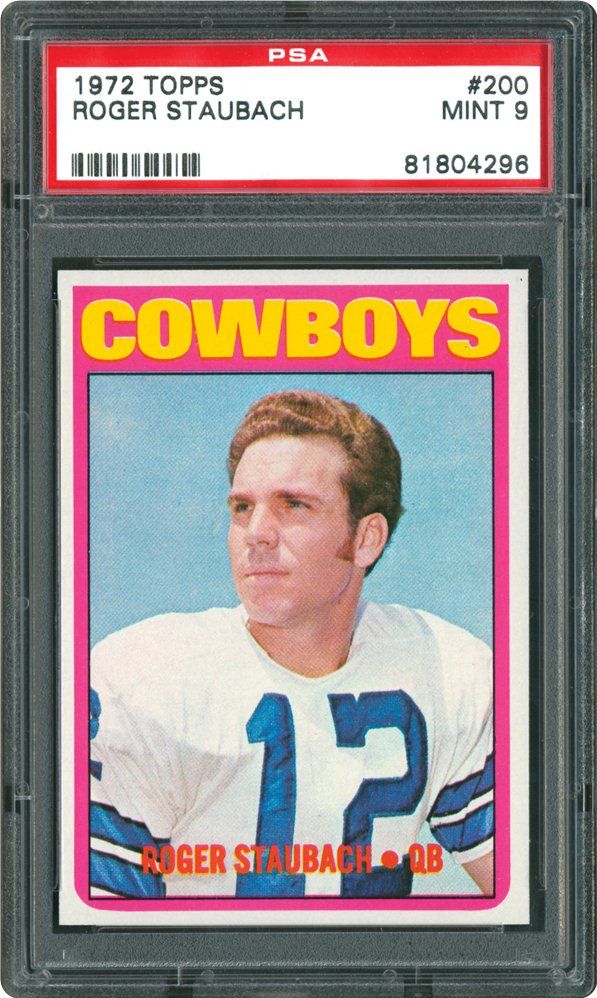
Card #200 is a plain, loud, wonderful piece of early-70s Topps design: a magenta border, COWBOYS in yellow block capitals across the top, and a posed portrait of Staubach in the white number 12 jersey against a flat blue sky, with ROGER STAUBACH • QB running along the bottom. TCDB's checklist for the set carries the entry verbatim as "200 Roger Staubach RC Dallas Cowboys."
The copy pictured above is in a PSA MINT 9 holder, certification number 81804296 — one of just 53 that grade.
PSA Population Report
| PSA Grade | Population |
|---|---|
| PSA 10 | 4 |
| PSA 9 | 53 |
| PSA 8 | 436 |
| Total Graded (All Grades) | 5,626 |
* Population data as of August 24, 2026. PSA population counts are dynamic and increase as more cards are submitted for grading.
What the Numbers Say
Four. Across 5,626 full straight grades and more than half a century, PSA has awarded this card four tens — a gem rate of 0.07%, or roughly one in every 1,400 copies submitted.
The straight-grade total also understates how many of these are in holders. PSA counts a further 289 half grades and 774 with a qualifier — separate buckets rather than slices — putting 6,689 Staubach rookies in PSA plastic altogether.
Those qualifiers are the story of the card. Look at where they land:
- PSA 9 — 53 clean, 105 qualified. Twice as many nines carry a qualifier as don't.
- PSA 8 — 436 clean, 332 qualified. Very nearly one for one.
The bulk of the straight population sits far lower, peaking at PSA 4 with 1,231 copies and staying heavy through 5 and 6. This is our reading, not a PSA finding: a card whose high grades are dominated by qualifiers is a card that was printed and handled in a way that produces one specific, nameable flaw rather than general wear — the copy is otherwise mint and one thing disqualifies it. On a 1972 Topps card, centering is the usual culprit, and the shape of this population is what a chronic centering problem looks like when it meets a set collectors genuinely care about.
Verdict: a Heisman winner who went to Vietnam before he went to Dallas, on a rookie card issued after he had already won a Super Bowl. Fifty-four years of submissions have produced four perfect copies — and more flawed nines than clean ones.