1973 Topps #615 Mike Schmidt RC (Rookie 3rd Basemen) — The Shared Rookie That Launched a Hall of Fame Legend — Card of the Day
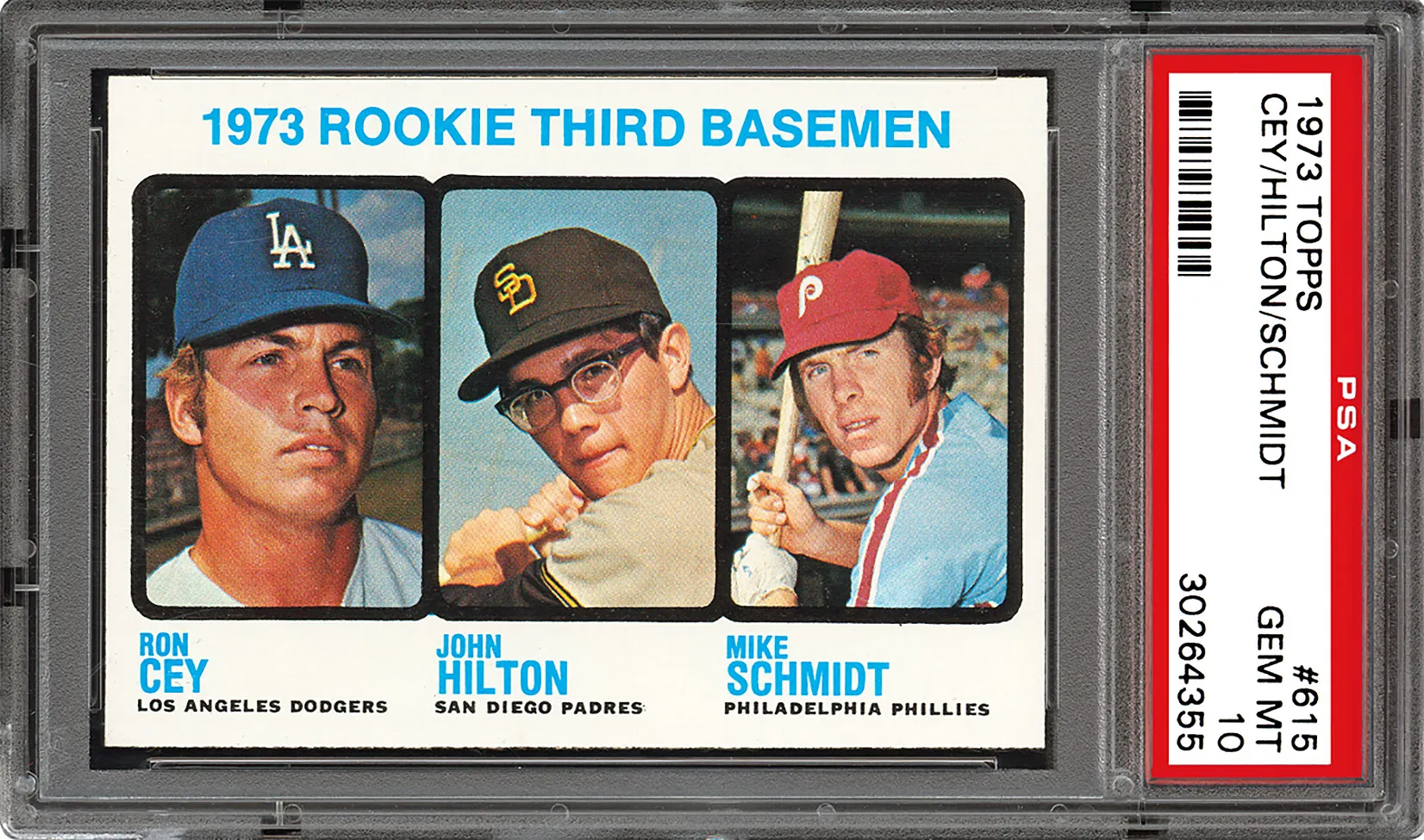
Before there was "Mike Schmidt, Hall of Fame third baseman," there was "Mike Schmidt, rookie third baseman on a shared card." The 1973 Topps #615 Rookie 3rd Basemen card is one of the most unusual rookie cards in baseball history — a three-player horizontal layout featuring Ron Cey, John Hilton, and a 23-year-old Schmidt who would go on to become arguably the greatest third baseman of all time. With only 5 PSA 10s in existence, this card is simultaneously accessible and impossibly rare at the top.
The Card That Almost Wasn't
The 1973 Topps set was released at a fascinating inflection point in baseball history. The set featured the final card of Roberto Clemente (who died in a plane crash on December 31, 1972) and the first cards of a generation of future Hall of Famers. But Topps took an unusual approach with its rookie cards that year — instead of giving each top prospect his own standalone card, several were grouped into multi-player "Rookie" cards.
The #615 Rookie 3rd Basemen card is the most famous of these. It shows three players in circular inset photos against a bright yellow background: Ron Cey (who would become the Dodgers' longtime third baseman), John Hilton (who played just 38 MLB games), and Mike Schmidt (who needs no introduction). The card's design — three headshots in a horizontal format with team logos — was standard early-70s Topps, but its significance has grown enormously as Schmidt's legend expanded.
Schmidt's Hall of Fame Career
Mike Schmidt debuted with the Philadelphia Phillies in September 1972 and played 18 seasons, all with the Phillies. His career numbers are staggering: 548 home runs, 1,595 RBIs, 10 Gold Gloves, 3 National League MVP awards (1980, 1981, 1986), and a World Series championship in 1980. He led the NL in home runs eight times — a record for any player in any league — and his 548 homers remain the most by any third baseman in baseball history.
What made Schmidt unique was the combination of elite power and elite defense at a position that historically favored one or the other. His .267 career batting average wasn't gaudy, but his .380 on-base percentage and .527 slugging percentage reflected the patient, power-hitting approach that defined the era. He was elected to the Hall of Fame in 1995 with 96.5% of the vote, one of the highest percentages ever.
The fact that his first Topps card shares space with two other players rather than standing alone is almost poetic — it captures Schmidt in the only role he ever had as an unknown, before he became the measuring stick for third-base excellence.
PSA Population Report
| PSA Grade | Population | Value |
|---|---|---|
| GEM-MT 10 | 5 | $234,000 |
| MINT 9 | 252 | $9,675 |
| NM-MT 8 | 1,646 | $1,450 |
| Total Graded (All Grades) | 11,344 | — |
* Population data as of July 10, 2026. PSA population counts are dynamic and increase as more cards are submitted for grading.
Why the Gem Rate Matters
The gem mint rate of 0.04% — only 5 PSA 10s out of 11,344 total graded — places this among the toughest high-grade vintage cards in the hobby. For context, the 1952 Topps Mickey Mantle has a higher gem rate. The reason lies in the card's physical production: 1973 Topps cards were printed on thin, easily damaged card stock with a surface finish that chipped and scuffed readily. The bright yellow background of #615 shows every surface imperfection, making clean copies extraordinarily difficult to find.
What makes this even more remarkable is that five of the 11,344 graded examples reached Gem-Mint. That's five cards that survived 53 years of basement boxes, rubber bands, bicycle spokes, and collectors' albums without a single significant flaw. Each of the five commands over $200,000 when it changes hands, placing the Schmidt rookie alongside the true blue-chip cards of the postwar era.
Value Beyond the Grade
The 1973 Topps #615 is unique in that it offers entry points at multiple collecting levels. A PSA 8 can be had for around $1,450 — significant but within reach for a serious collector. A PSA 9 at $9,675 is a major purchase but still far below the Mantle and Wagner stratosphere. And the PSA 10 at $234,000 is a trophy for the wealthy, but one that has shown consistent appreciation.
The card also benefits from the "shared rookie" dynamic. Ron Cey collectors and Schmidt collectors both want this card, creating dual demand streams. Cey, a six-time All-Star and 1981 World Series MVP, has his own dedicated following among Dodgers collectors, further supporting the card's floor.
Bottom line: The 1973 Topps #615 Rookie 3rd Basemen card is a masterpiece of vintage card design and a cornerstone of any serious baseball collection. Mike Schmidt's shared rookie card tells the story of three players at the start of their journeys — one who became a legend, one who became a solid major leaguer, and one who got a cup of coffee. That range of outcomes, captured on a single piece of cardboard, is what makes this hobby endlessly fascinating.