1974 Topps #219 Ray Guy RC — Three PSA 10s, and the Card Next Door Is Franco Harris
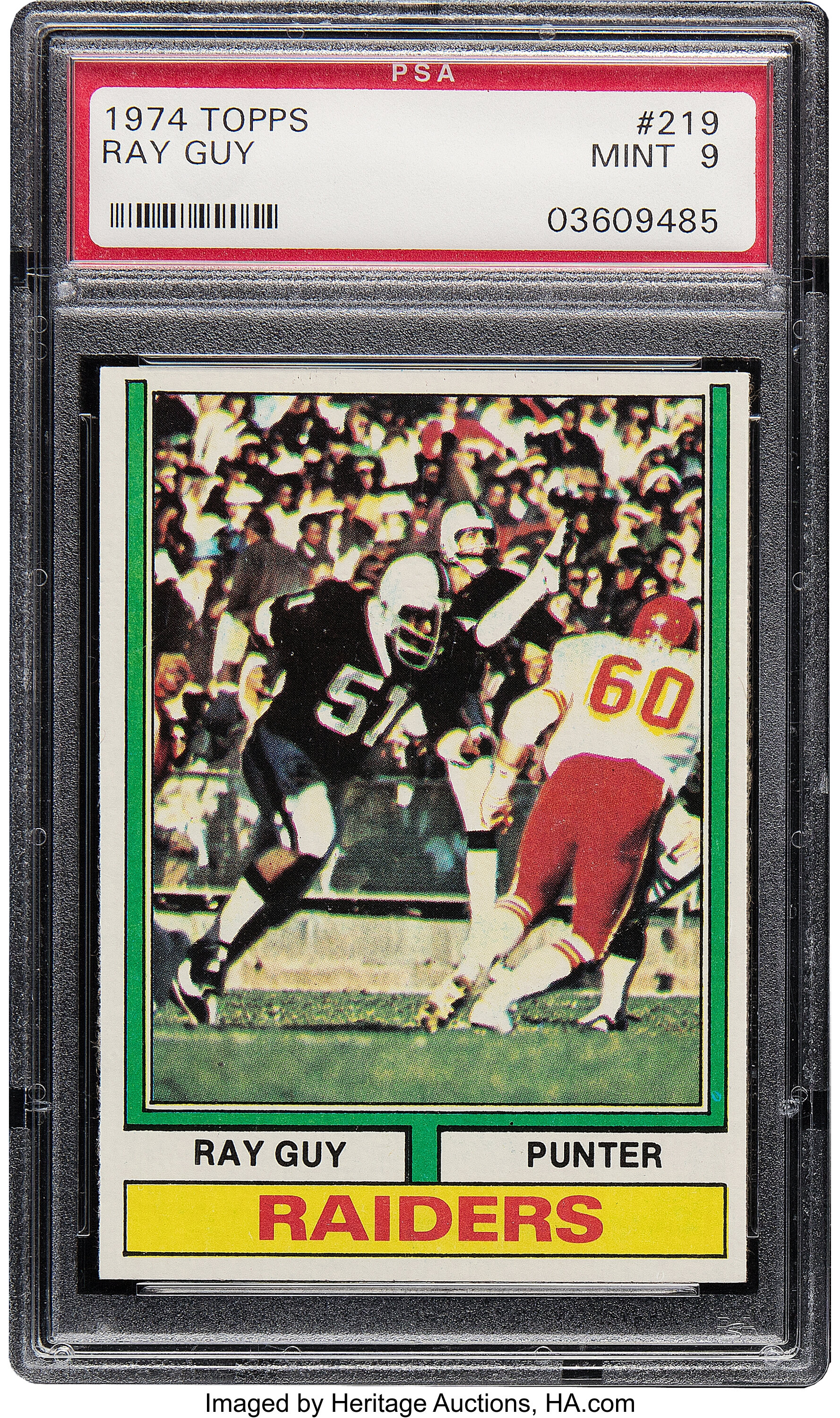
The Pro Football Hall of Fame did not enshrine a punter until 2014, and that punter's rookie card sits one number below Franco Harris in the same 1974 Topps set. PSA has assigned a straight grade to 741 copies of Ray Guy's #219. Three of them came back a 10.
Guy was the first punter ever taken in the first round of an NFL draft — the Oakland Raiders spent the 23rd pick of 1973 on him — and this is the card that followed the next year. The front is an in-game punt photo rather than the posed portrait the set usually runs: a Raiders blocker in the foreground, a rusher in red coming off the edge, the kick already gone. The nameplate reads RAY GUY / PUNTER / RAIDERS. The Trading Card Database flags it as his rookie card.
PSA Population Report
| PSA Grade | Population | Value |
|---|---|---|
| PSA 10 | 3 | $5,550 |
| PSA 9 | 53 | $750 |
| PSA 8 | 190 | $275 |
| Total Graded (All Grades) | 741 | — |
* Population data as of August 29, 2026. PSA population counts are dynamic and increase as more cards are submitted for grading.
The Qualifiers Are the Story Under the Table
That 741 counts full straight grades only. PSA has also slabbed 10 half-grade copies and 123 qualified ones — cards that earned a high number but carry a defect notation such as off-centering alongside it — which puts 874 Ray Guy rookies in PSA holders all told.
Look at where the qualified copies land. There are 53 straight PSA 9s and 47 qualified 9s. There are 190 straight PSA 8s and another 54 qualified 8s. At the top of the ladder, nearly as many copies have been stopped by a notation as have gone through clean.
Analysis: A qualifier count that heavy, concentrated in the two grades directly beneath the ceiling, is the shape of a card that grades well on most criteria and gets caught on one. PSA publishes the counts and the notations; it does not publish a cause, and nothing in the data assigns one. What the figures do establish is that the supply of clean high-grade copies is thinner than a raw count of 874 slabs suggests.
The Card Next Door
The comparison this set hands you for free is #220 — Franco Harris, 12,120 career rushing yards, four Super Bowls, Super Bowl IX MVP, Canton class of 1990. One card number away, same sheet, same print run, the same 52 years of handling.
Pulled from PSA the same morning as the figures above: Harris #220 has 891 straight grades, 7 PSA 10s and 152 PSA 9s. Guy has 741, three and 53. The Harris card has been submitted about 20 percent more often and has produced more than twice as many 10s and nearly three times as many 9s.
PSA's Price Guide runs the other direction. It carries the Harris PSA 10 at $2,200 and the Guy PSA 10 at $5,550. At PSA 9 it is $175 against $750; at PSA 8, $115 against $275. Those are guide values published by PSA rather than completed sales — the grader's own read of the market, not a transaction anyone can point to.
Analysis: Two things are true here at once and they are easy to blur. Franco Harris is by a distance the more celebrated football player, and his card is the more frequently graded one. Guy's card is the scarcer one at the top of the scale, and PSA guides it higher at every grade the guide lists. Renown and scarcity at the ceiling are separate inputs, and this pair is about as clean a demonstration as a single sheet can offer that the second does not depend on the first.
Fourteen Seasons, Three Blocked Punts
Guy spent his entire 14-year, 207-game career with the Raiders and averaged 42.4 yards, clearing 40 in 13 of those seasons. The exception was the strike-shortened 1982 campaign at 39.1. He led the NFL in punting in 1974, 1975 and 1977, went to seven Pro Bowls and was named All-Pro six times.
The durability number is the one that outlasts him. Three of his 1,049 career punts were blocked. From 1979 through his final game in 1986 he punted 619 consecutive times without one, a streak that ranked second all time when he retired. He added 111 more punts across 22 postseason games at the same 42.4 average.
He was not only a distance kicker. Across the 11 seasons of his career in which the league kept the statistic, he was credited with 209 punts downed inside the 20, and 77 of them came in his last three years. His longest was a 74-yarder against Denver in 1977, and he hit a 71-yarder in the 1980 AFC Championship Game against San Diego. His best seasonal average, 45.3 yards, came as a rookie — the year before this card was printed.
Canton took him in the class of 2014, the first true punter it ever elected. Hall president Jim Porter, writing after Guy died on November 3, 2022 at 72, noted that his election had been described at the time as completing a "full roster" of positions in the Hall.
The Specialists Are Their Own Category
These case files reached Canton's first pure placekicker yesterday — the 1970 Topps #25 Jan Stenerud rookie in CASE #0290, nine PSA 10s in 762 straight grades. Ray Guy's rookie sits at 741. Two Hall of Fame specialists, four years apart in different sets, graded almost exactly the same number of times, and the punter has a third as many 10s.
Before this week neither "kicker" nor "punter" had appeared in a case file here.
Verdict: Canton's first true punter has three PSA 10s, a guide price above the Hall of Fame running back printed next to him, and a near-mint population where almost half the copies carry a qualifier. The scarcest card on that stretch of the sheet belongs to the specialist.