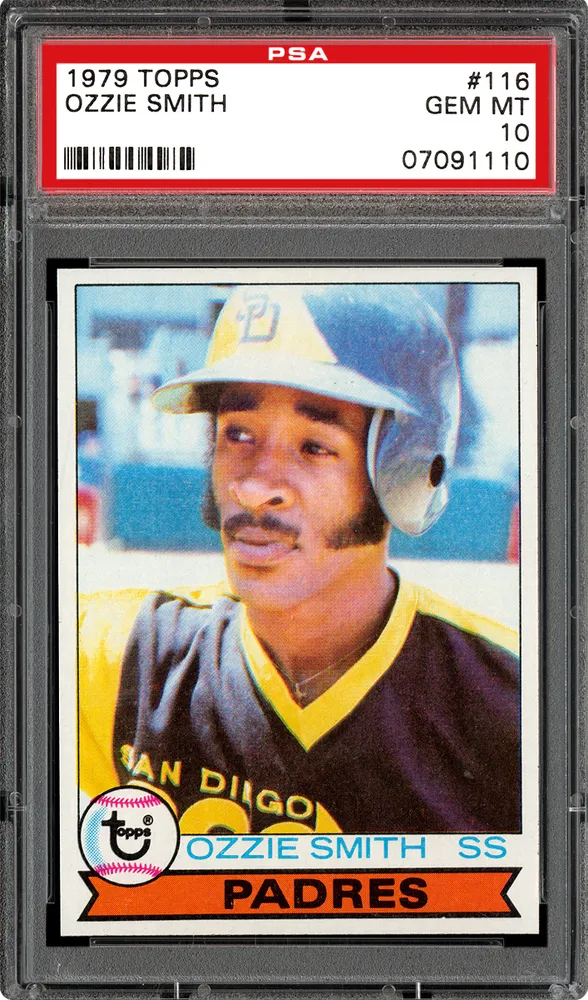
Card of the Day: 1979 Topps #116 Ozzie Smith RC — The Wizard of Oz's Defining Rookie Card
The 1979 Topps set is a time capsule of baseball's transition era — the last days of the polyester double-knit uniform, the dawn of free agency's full impact, and a rookie class that would reshape the sport for two decades. At the center of it all stands Card #116: Ozzie Smith, the San Diego Padres' acrobatic shortstop who would come to redefine defensive excellence.
The Wizard of Oz
Ozzie Smith wasn't just a shortstop — he was a revolution. Before Smith, defensive metrics didn't exist; after him, every shortstop was measured against his standard. His 13 Gold Glove Awards are the most ever by a shortstop, and his 15 All-Star selections speak to a career that blended longevity with sustained brilliance. But what made Smith truly special was the theater he brought to the position — the signature backflip before every game, the impossible diving stops, the laser arm from the hole. He didn't just play shortstop; he performed it.
The 1979 Topps #116 captures Smith in his Padres whites, portrait-style against the set's unmistakable yellow border. It's his true solo rookie card — a 1978 Topps Future Stars card (#705) featured him alongside George Hendrick and Dave Roberts in a shared format, but #116 is THE card. Smith was coming off a 1978 season where he hit .258 with 40 stolen bases and played 159 games at shortstop as a 23-year-old. The Padres knew they had something special. The rest of baseball was about to find out.
Why This Card Matters
The 1979 Topps Ozzie Smith rookie sits at an interesting crossroads in the hobby. It's a Hall of Fame RC from the late 1970s — an era that produced iconic rookies for Rickey Henderson (1980), Cal Ripken Jr. (1982), and Tony Gwynn (1983) — yet it predates the overproduction of the Junk Wax era by just a few years. The print run was substantial, but condition sensitivity is brutal. The 1979 Topps design features bright yellow borders that show every imperfection — chipping, corner wear, and surface scratches are visible from across the room. This is why the pop report tells such a stark story.
PSA Population Report
| PSA Grade | Population | Value |
|---|---|---|
| GEM-MT 10 | 5 | $144,000 |
| MINT 9 | 418 | $2,500 |
| NM-MT 8 | 2,775 | $450 |
| Total Graded (All Grades) | 14,483 | — |
* Population data as of June 28, 2026. PSA population counts are dynamic and increase as more cards are submitted for grading.
The numbers are staggering. Only 5 PSA 10s exist out of 14,483 graded examples — a gem mint rate of 0.03%. By comparison, many modern rookie cards with similar populations carry five-figure values; Smith's PSA 10 commands $144,000. The PSA 9 population of 418 is still very thin for a Hall of Famer of this stature, and those trade in the $2,500 range. The vast majority of submissions land in PSA 7 or below, victims of those unforgiving yellow borders.
Market Position
The 1979 Topps Ozzie Smith has been a steady performer in the hobby for decades. Unlike some Junk-Wax-adjacent cards that spike and crash, this card has built value organically through genuine demand from set builders, Hall of Fame collectors, and San Diego Cardinals fans alike. The PSA 8 at $450 represents the sweet spot for most collectors — presentable eye appeal without the exponential premium of a Gem Mint example. For those building a 1970s Hall of Fame rookie run, this card is non-negotiable.
It's worth noting that Smith's Cardinals years (1982-1996) produced his most iconic moments — the 1982 World Championship, the 1985 NLCS backflip before that legendary Game 5, the 1996 All-Star Game curtain call. But the Padres-era rookie card captures the before picture: a skinny 24-year-old who hadn't yet become a legend, hadn't yet done a backflip on national television, hadn't yet won a Gold Glove. He was simply the most exciting shortstop nobody outside San Diego had heard of.
Verdict
The 1979 Topps #116 Ozzie Smith is a Hall of Fame rookie card from the golden age of baseball card design, and its 5-copy PSA 10 population makes it one of the most condition-sensitive key cards of the 1970s. For the collector who wants a piece of defensive history at a reasonable entry point, the PSA 8 offers strong value. For the registry set builder chasing that PSA 10 — well, good luck. There are only five out there.