1982 Topps #434 Lawrence Taylor All-Pro RC — 193 Gems From 10,801, and 309 Qualified Eights
The sack did not become an official NFL statistic until 1982. Lawrence Taylor had already spent a full season destroying offenses without the league formally counting the thing he was best at — his 9.5 rookie sacks are still carried as unofficial. The 1982 Topps set arrived the same year the league started keeping the number, and card #434 puts him in the All-Pro subset before he had played a single officially-recorded down of it.
The Man Behind the Card
Taylor came out of North Carolina an All-America selection and went second overall in the 1981 NFL Draft to the New York Giants. The Pro Football Hall of Fame lists him at 6-3 and 237 pounds, which is not the build of a man who was about to redefine a position.
He did it immediately. His rookie year produced a career-high 133 tackles, 9.5 sacks, eight passes defensed, two forced fumbles, a fumble recovery and an interception. He was then named first-team All-Pro in each of his first nine seasons. The Hall's own summary credits him with changing the outside linebacker position from a read-and-react posture to an attacking one — he had the speed to run past linemen and the strength to go through them.
His peak was 1986: NFL MVP, the first defensive player to win the award since 1971, on a career-high 20.5 sacks and 105 total tackles. Two years later, playing with a torn pectoral muscle held together by a harness, he put up seven tackles, three sacks and two forced fumbles against the Saints in a game the Giants won 13-12.
Thirteen seasons: 132.5 official sacks, 1,088 tackles, 33 forced fumbles, 10 fumble recoveries, nine interceptions, 10 Pro Bowls, nine All-Pro selections, two Super Bowls, and a place on the NFL's 75th Anniversary All-Time Team in 1994. Canton took him in 1999.
The Card
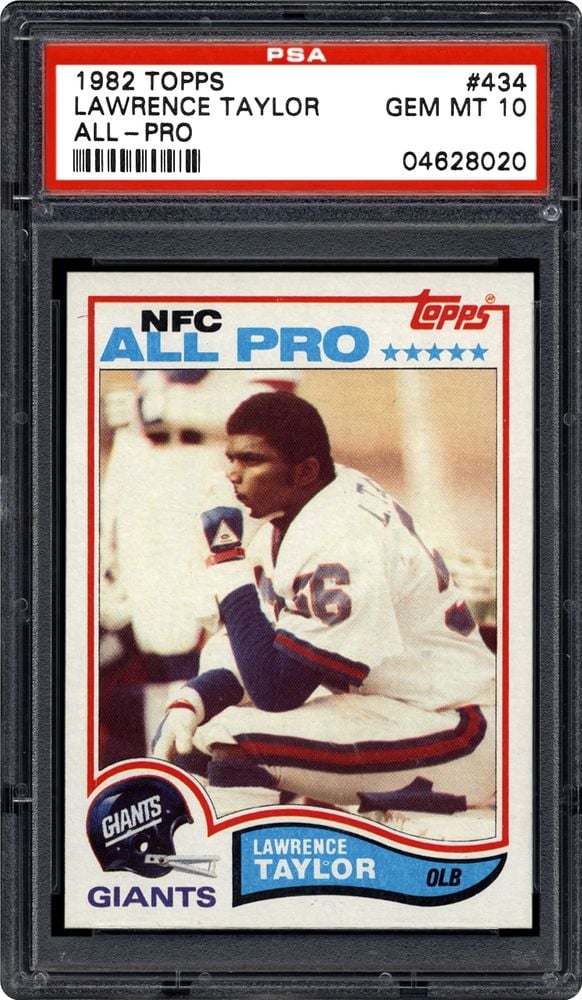
Card #434 is the All-Pro subset entry from Taylor's rookie-year Topps release, and checklists flag it as his rookie card. The design is pure early-80s Topps: a red-white-and-blue "NFC ALL PRO" banner with five stars across the top, the Giants helmet and a blue nameplate at the bottom reading LAWRENCE TAYLOR, OLB. The photograph is a sideline crouch in the white Giants road jersey — number 56 partly visible, helmet off.
PSA carries the card with Variety "ALL-PRO," which is a description of the subset rather than a second player on the card. The example pictured above is one of the 193 copies that have earned a PSA 10, certification number 04628020.
PSA Population Report
| PSA Grade | Population | Value |
|---|---|---|
| PSA 10 | 193 | $5,600 |
| PSA 9 | 1,210 | $550 |
| PSA 8 | 3,417 | $140 |
| Total Graded (All Grades) | 10,801 | — |
* Population data as of August 24, 2026. PSA population counts are dynamic and increase as more cards are submitted for grading.
What the Numbers Say
That 10,801 counts full straight grades only. PSA holds a further 103 half grades and 498 with a qualifier — separate buckets, not slices of the total, which puts 11,402 Taylor All-Pros in PSA holders altogether.
The qualifiers are where this card gets interesting. Of the 498, some 309 sit at PSA 8 and another 155 at PSA 9. Set that against the straight grades and the shape is unusual: for every eleven clean PSA 8s there is roughly one PSA 8 carrying a qualifier, a far heavier concentration at a single grade than the most recent comparable in these files — the 1979 Topps Earl Campbell rookie in CASE #0270 carries 622 qualified slabs, but spread across the grade range rather than piled at one number.
A qualifier means the card graded to a number on everything except one flaw serious enough to name — most often centering on cards from this era. The reading here is ours, not PSA's: a qualifier bulge sitting precisely at 8 suggests a card that routinely lands at NM-MT on surface, edges and corners while one axis of the centering fails, which is exactly the failure mode 1982 Topps is known for.
At the top the card behaves conventionally. A PSA 8 is $140 and a PSA 9 is $550; the PSA 10 is $5,600, better than ten times the nine. The gem rate is 1.79% — one in fifty-six — which for a heavily-printed early-80s issue is not punishing so much as ordinary.
Verdict: the rookie card of the most disruptive defensive player the sport has produced, issued the same year the NFL finally started counting sacks. The clean copies are common enough to own and the gems are scarce enough to matter — and 498 of these slabs never got a clean number at all.