1982 Topps #51 Anthony Muñoz All-Pro RC — 42 Gems From 2,359, and the Same Gem Rate as Lawrence Taylor
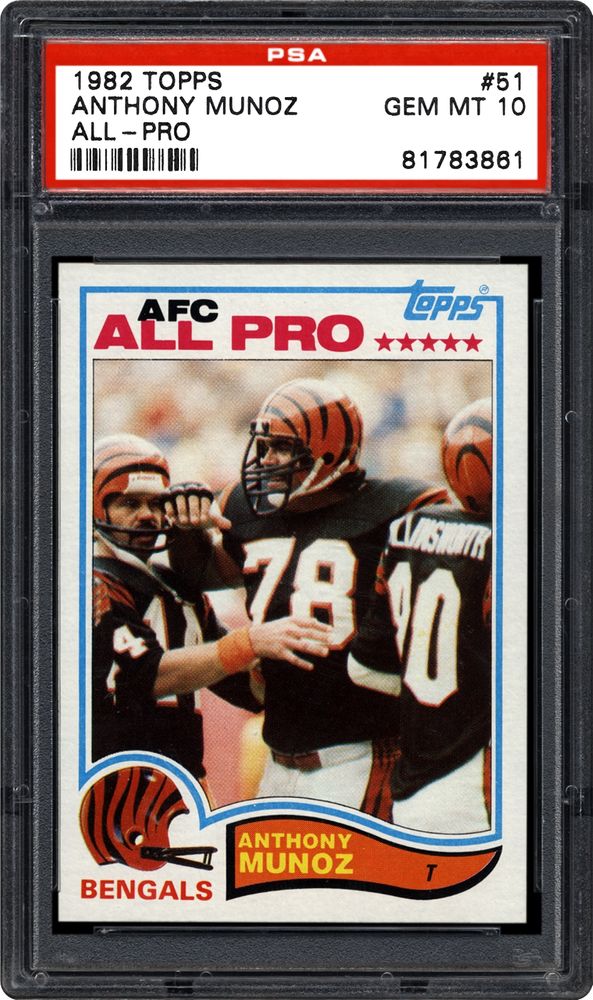
The card above is one of forty-two. PSA has certified 2,359 copies of Anthony Muñoz's 1982 Topps rookie card across every full grade it issues, and exactly 42 of them came back Gem Mint 10. The slab pictured is one of the forty-two — cert 81783861.
Forty-two gems out of 2,359 works out to a gem rate of 1.78%. Three days ago this blog opened the file on the other Hall of Fame rookie card in the same set, Lawrence Taylor's #434 All-Pro (CASE #0276). Taylor's gem rate, pulled fresh this morning: 1.79%.
Same set, same print run, same year. Two Hall of Fame rookie cards that survive the pack, the shoebox and the grading room at — within a hundredth of a percentage point — the same rate.
Then the two cards part company. PSA has graded 10,808 Taylors. It has graded 2,359 Muñozes.
Four and a Half Times the Submissions, the Same Odds
The population curves are the same shape. Muñoz: 915 copies at PSA 8, 416 at PSA 9, 42 at PSA 10. Taylor: 3,418 at PSA 8, 1,210 at PSA 9, 193 at PSA 10. Both are bottom-heavy, both lose roughly an order of magnitude between the 8 and the 10, and both land within a rounding error of each other at the top.
What differs is how many people bothered. Taylor's card has been submitted 4.58 times as often as Muñoz's, and PSA has issued 4.6 times as many Gem Mint 10s of it — the same multiple, which is what you get when the cardboard behaves identically and only the volume changes.
Analysis: the gem rates are a property of the cardboard; the population totals are a property of the collector. Nothing in PSA's data says the Muñoz is harder to find in perfect condition than the Taylor. It says that far fewer people have ever walked one to the counter. That is a statement about which positions the hobby pays attention to, not about which cards were printed well.
Scarcer, and Cheaper
Here is where it gets strange. There are 42 Muñoz rookies in a PSA 10 and 193 Taylors. PSA's own Price Guide values the Muñoz gem at $700 and the Taylor gem at $5,600 — eight times the price for the card that is four and a half times easier to find.
The inversion holds all the way down the ladder. A PSA 9 Muñoz guides at $150 against $550 for the Taylor; a PSA 8 at $25 against $140.
Analysis: scarcity is not doing the pricing here, and it rarely does on its own. Taylor changed how a defensive front is drawn up and did it in a market with New York's carrying power behind it. Muñoz played thirteen seasons at left tackle in Cincinnati. The hobby prices the highlight reel, and the position that has never had one is the position that blocks for it.
The Man in the Slab
Muñoz went third overall to the Bengals in the 1980 draft, a 6-foot-6, 278-pound tackle out of USC who had also pitched for the Trojans' 1978 NCAA champion baseball team and who missed all but one game of his senior season with a knee injury. The game he made it back for was the Rose Bowl, a 17-16 win over an unbeaten Ohio State.
He started all sixteen games as a rookie. From 1981 through 1991 he went to eleven straight Pro Bowls and was named All-Pro in every one of those eleven seasons, nine times on the first team. He was NFL Offensive Lineman of the Year in 1981, 1987 and 1988, and the NFL Players Association's Lineman of the Year four times. He blocked for two league MVPs — Ken Anderson in 1981, Boomer Esiason in 1988 — and caught seven passes for four touchdowns on tackle-eligible plays along the way.
Thirteen seasons, 185 games, all of them in Cincinnati. The Pro Football Hall of Fame took him in the Class of 1998, and he has since been named to the NFL's All-Decade Team of the 1980s, the 75th Anniversary All-Time Team and the NFL 100 All-Time Team.
An All-Pro Rookie Card
PSA files this card with the Variety ALL-PRO; the Trading Card Database lists the same row as 51 Anthony Munoz AP, RC. Both flags sit on one piece of cardboard, which makes this an unusual object — a rookie card that arrives already carrying a league honor. It did not have to project anything. Muñoz had been an All-Pro before it was printed, and he would be one every season for the next decade.
PSA Population Report
| PSA Grade | Population | Value |
|---|---|---|
| PSA 10 | 42 | $700 |
| PSA 9 | 416 | $150 |
| PSA 8 | 915 | $25 |
| Total Graded (All Grades) | 2,359 | — |
* Population data as of August 25, 2026. PSA population counts are dynamic and increase as more cards are submitted for grading.
Two numbers sit outside that table. PSA has also issued 10 half grades and 65 qualified grades on this card, which brings the total number of Muñoz #51 slabs in the world to 2,434. Thirty-six of the qualified grades are PSA 9s — cards that graded Mint but carry a noted defect. There are 42 clean 10s and 36 flagged 9s, which is about as narrow as that gap gets.
The Verdict
This blog has filed 97 Cards of the Day with population data attached. Not one of them, until today, has been an offensive lineman. That is the same pattern PSA's numbers describe from the other direction: a card that grades exactly as well as its famous setmate, gets submitted less than a quarter as often, and sells for an eighth as much.
CASE #0281: The 1982 Topps Anthony Muñoz is not a scarce card because it is hard to grade. It is a scarce card because the hobby never asked. Forty-two gems, $700, and a left tackle who was All-Pro before his rookie card came off the press. Filed as a misdemeanor — undervaluation with intent.