Card of the Day: 1982 Topps #21 Cal Ripken Jr. RC — The Iron Man's Defining Rookie Card
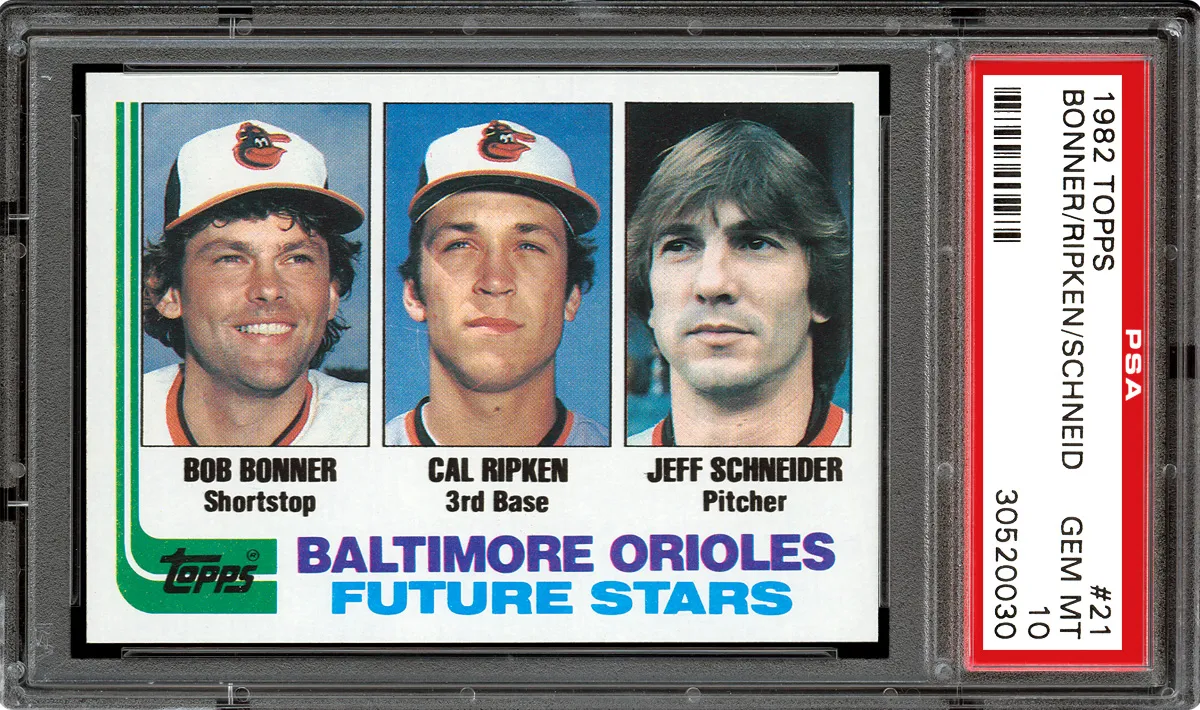
Some rookie cards belong to a single player. Others capture a moment — a snapshot of baseball history where multiple futures converged on one piece of cardboard. The 1982 Topps #21 Orioles Future Stars card is exactly that: a three-player rookie card featuring Bob Bonner, Cal Ripken Jr., and Jeff Schneider. One of these names became the face of a franchise, the all-time leader in consecutive games played, and a first-ballot Hall of Famer. The other two played a combined 195 MLB games. That's the lottery of baseball.
Cal Ripken Jr.'s official rookie card is this unassuming three-player design from the 1982 Topps set. It's not a solo action shot. It's not a glossy chrome parallel. It's a simple posed photo — three young Orioles prospects in their home whites, listed alphabetically: Bonner, Ripken, Schneider. But what that card represents, in retrospect, is the beginning of the most remarkable durability streak in professional sports history.
The Iron Man's Arrival
Ripken broke into the majors in 1981 as a 20-year-old shortstop, hitting just .128 in 23 games — an inauspicious start for a player who would go on to play 3,001 games over 21 seasons. By 1982, he was the Orioles' starting shortstop, batting .264 with 28 home runs and 93 RBIs, finishing second in AL Rookie of the Year voting. It was clear from day one that the 6'4" shortstop from Aberdeen, Maryland, was something different — a big-bodied infielder with surprising range, a cannon arm, and a swing built for power.
What nobody could have predicted was the streak. From May 30, 1982, to September 19, 1998, Ripken played in 2,632 consecutive games, shattering Lou Gehrig's record that had stood for 56 years. That streak — "The Streak" — became the defining narrative of Ripken's career, a testament to consistency, durability, and showing up every single day. On September 6, 1995, when Ripken played his 2,131st consecutive game and broke Gehrig's record, the nation stopped to watch. It remains one of the most celebrated moments in baseball history.
PSA Population Report
| PSA Grade | Population | Value |
|---|---|---|
| GEM-MT 10 | 556 | $1,800 |
| MINT 9 | 7,496 | $135 |
| NM-MT 8 | 19,655 | $50 |
| Total Graded (All Grades) | 41,284 | — |
* Population data as of June 25, 2026.
Market Analysis
The 1982 Topps #21 Cal Ripken RC is one of the most accessible Hall of Fame rookie cards in the hobby, but its condition sensitivity tells a deeper story. With 41,284 total graded copies, it's a heavily collected card — but only 556 exist in PSA 10, a gem rate of just 1.35%. That's remarkably scarce for a card from the early 1980s, when print runs were enormous and the Junk Wax Era was just beginning.
The 1982 Topps set was printed on thin card stock with a matte finish that scuffs easily. Centering was notoriously inconsistent — Topps' quality control in the early 80s meant that perfectly centered examples are genuinely rare. The "Orioles Future Stars" design, with its orange and black borders, shows wear readily. PSA 10 examples command $1,800, while PSA 9s trade around $135 — a 13x premium for perfection that reflects just how hard a true Gem Mint copy is to find.
What Drives the Market
Several factors keep Ripken's rookie card consistently strong:
- The Streak: Ripken's 2,632 consecutive games record is one of baseball's untouchable benchmarks — it's not a record that will ever be seriously challenged in the modern era of load management and rest days.
- Hall of Fame stature: First-ballot in 2007 with 98.53% of the vote. 19-time All-Star. Two-time AL MVP. 8-time Silver Slugger. 1991 All-Star Game MVP. 1983 World Series champion. The resume is unimpeachable.
- Accessible entry price: A raw example can still be found for under $50. A PSA 8 at $50 is one of the most affordable Hall of Fame rookie cards in the hobby — the kind of card a young collector can buy with allowance money.
- Multi-player card dynamics: As a "Future Stars" card featuring two minor leaguers alongside Ripken, the card has historically been undervalued compared to solo rookie cards. Collectors are increasingly recognizing this as his true mainstream RC.
Ripken's 2007 Hall of Fame induction created a predictable spike, but the card has built steady long-term growth rather than flash-in-the-pan speculation. It's the kind of card that appeals to both vintage purists (1982 is firmly in the "vintage" era by most definitions) and team collectors building Orioles and Baltimore baseball runs.
The Verdict
The 1982 Topps #21 Cal Ripken Jr. Orioles Future Stars card is a foundational piece of any Hall of Fame rookie card collection. It's historically significant, affordable at mid-grade levels, and genuinely scarce at the top — a combination that's increasingly hard to find in the modern market. The gem rate below 2% means that even in a 41,284-strong population, PSA 10s are true needle-in-a-haystack finds. For collectors who want to own the rookie card of baseball's Iron Man without breaking the bank, this is the card.
Verdict: A cornerstone Hall of Fame rookie card with legitimate scarcity at the top and broad, durable demand at every price point. The Streak alone ensures this card will never go out of style.