1984 Topps #280 Eric Dickerson RC — 143 Gems From 11,276, and the Same Gem Rate as Marino
The 1983 NFL Draft is remembered for its quarterbacks, and this blog has opened a file on the rookie card of each of the three who reached Canton. John Elway went first overall, Jim Kelly fourteenth, and Dan Marino twenty-seventh — five other quarterbacks were off the board before Miami took him. Today's card belongs to the man from that same first round who was not a quarterback, and who had rewritten the running back record book twice before his second season ended.
The Man Behind the Card
Eric Dickerson arrived from Southern Methodist as a two-time All-America selection and did not need a year to adjust. As a rookie in 1983 he set records for rushing attempts (390), rushing yards (1,808) and rushing touchdowns (18), and collected All-Pro, Pro Bowl, Player of the Year and Rookie of the Year honors in the same season.
Then he did something better. In 1984 he ran for 2,105 yards, shattering O. J. Simpson's 1973 record of 2,003, and posted twelve 100-yard games — also breaking a Simpson record. He gained more than 1,000 yards in each of his first four seasons with the Rams, three times going past 1,800.
The rest of the career kept its shape. A playoff-record 248 rushing yards against Dallas. A blockbuster trade to Indianapolis in 1987, where he still gained 1,011 yards in nine games. In 1988 he became the first Colt to lead the league in rushing since Alan Ameche in 1955. The following year he became the first player in NFL history to run for 1,000 yards in seven consecutive seasons, and the seventh back to reach 10,000 — faster than anyone before him, in 91 games. He retired with 13,259 rushing yards, second all-time at the time, six Pro Bowls and five All-Pro selections. Canton took him in 1999.
Ask him which record matters, though, and he goes back to the season this card is about:
"I think the one (record) I look at most and means the most to me is my rookie rushing record. You get one shot at that. You don't get several. You don't get 10. You get one."
The Card
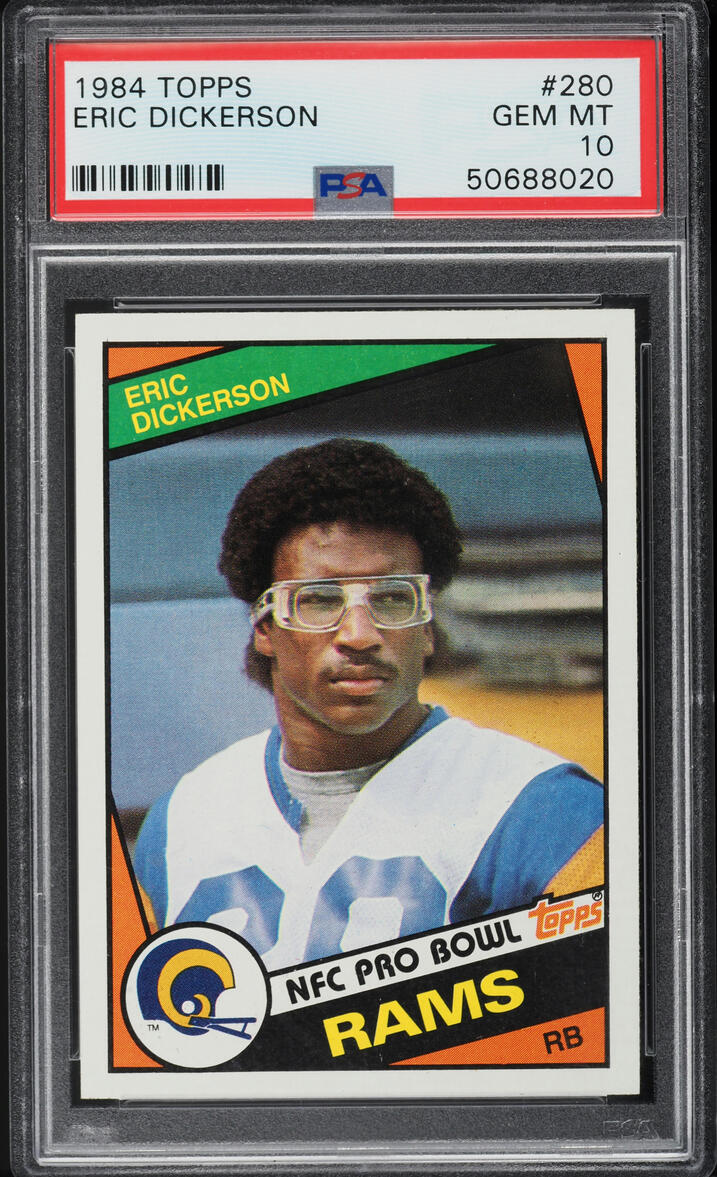
Card #280 is Dickerson's Topps rookie, issued in 1984 after that record-setting first season. The photograph is the one everybody pictures — the goggles, the Rams blue and white, a posed sideline portrait rather than an action shot. Topps ran a black "NFC PRO BOWL" banner across the bottom next to the Rams helmet, which is why checklists carry the card as a Pro Bowl designation and a rookie card at once.
It sits in the same set as two cards this blog has already opened files on: the Marino rookie at #123 (CASE #0019) and Elway's first Topps card at #63 (CASE #0113). Kelly's rookie came from that year's Topps USFL release (CASE #0152). For a set built on 1983's quarterbacks, the running back is the one whose numbers turn out to be the most interesting.
PSA Population Report
| PSA Grade | Population | Value |
|---|---|---|
| PSA 10 | 143 | $1,700 |
| PSA 9 | 2,879 | $100 |
| PSA 8 | 5,391 | $35 |
| Total Graded (All Grades) | 11,276 | — |
* Population data as of August 24, 2026. PSA population counts are dynamic and increase as more cards are submitted for grading.
That 11,276 is the count of full straight grades. PSA holds another 85 in half grades and 171 with a qualifier, which are separate buckets rather than a slice of the total — 11,532 slabs in all. Worth noting on its own: with 96 qualified nines and 65 qualified eights in that group, there are more qualified Dickerson rookies in the world than gem ones.
What the Numbers Say
Pulled the same day, the three 1984 Topps rookies line up like this:
- Dan Marino #123 — 420 tens from 32,685 graded, a 1.28% gem rate
- Eric Dickerson #280 — 143 tens from 11,276 graded, a 1.27% gem rate
- John Elway #63 — 188 tens from 29,094 graded, a 0.65% gem rate
Dickerson and Marino are, for practical purposes, the same card at the grading window: one in seventy-eight comes back a ten. Elway's comes back at half that rate from a nearly identical volume of submissions.
The scaling is what makes the Dickerson number readable. Marino's card has been graded 2.90 times as often as Dickerson's and has produced 2.94 times as many tens. The ratio holds almost exactly — which reads as scarcity produced by how many people sent the card in, not by the card being harder to grade than Marino's. That is our reading of the two populations, not a finding published by PSA.
The price ladder is where the thin top shows up. A PSA 8 is $35 and a PSA 9 is $100, both squarely in reach; the PSA 10 is $1,700, seventeen times the nine and roughly forty-nine times the eight. Nothing unusual for a mid-1980s Topps card, where centering does most of the deciding — but the step is steep enough that the 2,879 nines are the realistic ceiling for most collections, and the 143 tens are a different market.
Verdict: the best rookie season a running back has ever had, on a card that gems exactly as often as the Marino in the same set and has been graded a third as much. The scarcity at the top is real, and it was made by collector attention rather than by cardboard.